Decumulate & Downsize

Most of your investing life you and your adviser (if you have one) are focused on wealth accumulation. But, we tend to forget, eventually the whole idea of this long process of delayed gratification is to actually spend this money! That’s decumulation as opposed to wealth accumulation. This stage may also involve downsizing from larger homes to smaller ones or condos, moving to the country or otherwise simplifying your life and jettisoning possessions that may tie you down.

Time to stop following the Retirement herd

We are all social animals: we crave interaction and generally don’t like being alone. We crave that feeling of togetherness and being part of something bigger,  the added comfort and safety that comes with being part of a group or a  herd.

The herd protects individuals from being singled out, and in the animal kingdom provides safety from being killed by a predator.

Many people have developed a “herd” mentality in life deriving comfort by going with the flow and if everyone else is going in one direction they must know something that we don’t. It is easier not to complicate things by forging our own path based on what we learn or believe. What happens if we are wrong and the herd is right?

When it comes to retirement the “herd” has been doing this retirement thing for a long time. So they must be right, right?

I used to be a follower, part of the herd if you will. I was willing to put my fate in the hands of others and follow along blindly. Then I realized the retirement herd was heading in the wrong direction, and this wasn’t going to work for me. Let me explain.

Retirement worked when life expectancy was much lower

When the concept of retirement was created just over a hundred years ago, it worked.  The reason it worked was because life expectancy was much lower and if you were one of the lucky ones to reach the retirement finish line, you could expect to enjoy a couple of years in the proverbial “rocking chair,” watching the world go by.

Continue Reading…

Blend income splitting with retirement strategies

My investing premise is straightforward: Splitting family income is very beneficial. Take full advantage of all provisions that apply.

Think of income splitting in the same breath as your retirement planning. In my view, the two camps ought to fit like a glove to deliver the best value. Families are keenly interested in paying the least income tax. There are a few low-cost activities left on the platter.

It’s never too early to get familiar with the menu. Let’s blend income splitting with your retirement strategies.

Ideally, a family pays less income tax where two spouses achieve similar income levels. Equalizing incomes allows each spouse use of the graduated tax scales from low to high.

Another beneficial goal is to equalize asset levels as much as possible. Retirees who reduce the “clawback” retain more of the OAS pension and, perhaps, the age credit.

A dozen tips for splitting income near retirement

Utilize these income splitting tips before and after retirement: Continue Reading…

Can I afford to Retire?

The following is the second excerpt from Create the Retirement You Really Want: And Retire Smarter, Richer and Happier

By Clay Gillespie

Special the Financial Independence Hub

It was a beautiful May morning when I next saw Rachel and Mike. Rachel was carrying a large gift-wrapped box.

“This is for you,” she said, smiling and handing the box to me.

“Thank you,” I said, pleasantly surprised. “Most of my clients wait until they see how their portfolio performs before expressing their appreciation.”

“Shall we take it back then?”

“No, no! I’ll keep it,” I said, smiling, as I began to slide off the ribbon and remove the wrapping.

I opened the lid, looked inside and grinned with pleasure. “Much appreciated,” I said, looking proudly at a genuine leather soccer ball with my daughter’s name custom-printed on the top panel. “Sarah’s going to love it!”

“We wanted to give you a memento of our first meeting,” Rachel said.

“How very appropriate. Well, I don’t have a soccer ball for you,” I said, putting the ball down. “But hopefully I have an equally useful gift.”

“One that will last a lifetime?” Rachel asked.

“Yes. You might say it’s a gift that keeps on giving,” I said, grinning and handing them each a file folder.

“Our retirement numbers?” Mike asked.

“Yes. These are your illustrations.”

“Will we need to eat cat food?” Mike asked with a smile.

“No.” I laughed. “My goal is to help you maximize your retirement income, not minimize it.”

“And we won’t outlive our money?” Mike asked, more serious now.

“You should have plenty left for your children, unless you live to be Methuselah’s age.”

“Methuselah lived to be 969 years old,” Rachel said. “So I think the odds of that happening to us are slim,” she said pointedly.

“Right. My mistake,” I admitted. “I’ve taken the liberty of including a life expectancy table in your retirement illustration, so you’ll know the odds.”

“The odds of us dying at a certain age? I’m not sure I’m ready to see that!” Mike said uneasily.

“Don’t be such a worrywart, Mike,” Rachel said, chiding him gently. “It’s not as if you’re going to see the exact date and time of your death.” Suddenly, she frowned and looked at me. “Are we?”

“No,” I said smiling. “The actuaries aren’t that good, at least not yet. The life expectancies I’ve included are estimates based on a number of factors including your current age, your diet, exercise frequency, stress, body fat, genetics and the quality of health care.We’ll get to those in a moment. What you’re about to see is a financial illustration. It’s designed to give you an initial picture of your retirement situation for planning purposes. But first, we need to review your finances together so we’re all on the same page. Agreed?”

“Agreed,” they said together.

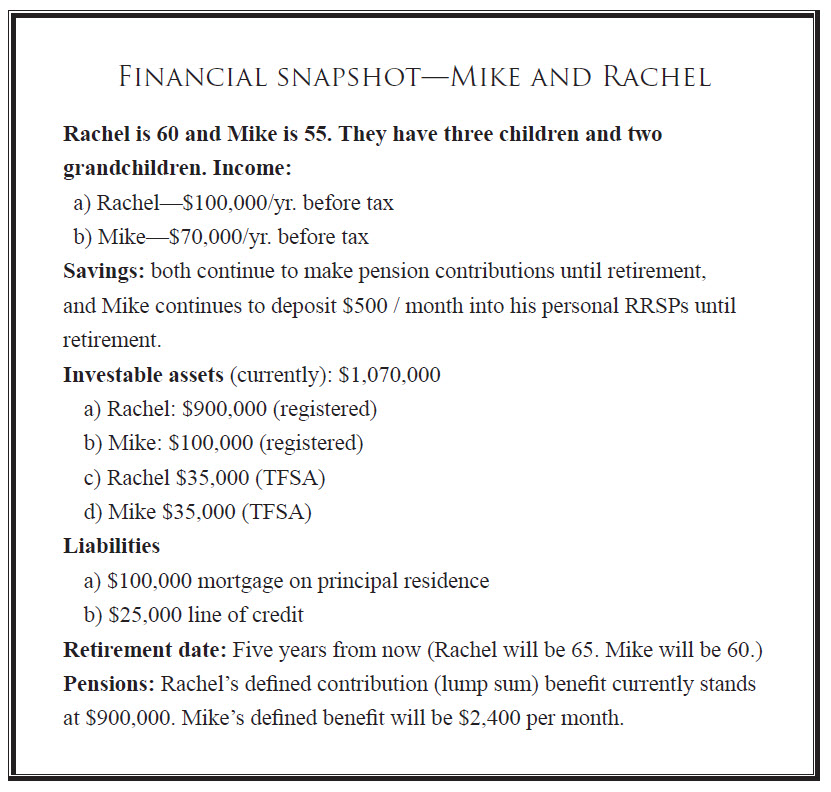
“Good. Here’s a quick snapshot of your current finances. As we go through it, I want you to let me know if anything is amiss.”

This is what they saw:

“As you can see, your gross income is $170,000 per year, while your combined income after tax is approximately $125,000.” “We work hard for our income,” Rachel said defensively.

Continue Reading…

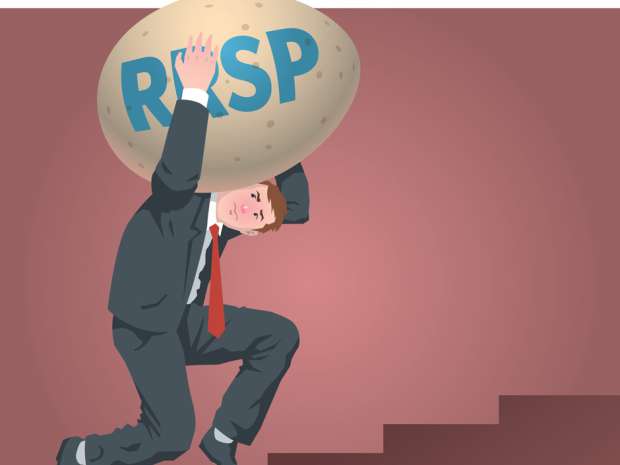
Large RRSPs nice problem to have, tax on them not so much

My latest Financial Post column can be found in Friday’s paper or online by clicking on this headline: Confronting the ‘wonderful’ problem of the too-large RRSP.

It describes what one source describes as a “nice problem to have.” That’s having accumulated so much money in a Registered Retirement Savings Plan (RRSP) that it presents a lucrative source of tax revenue for the federal Government once you reach age 71 and have to start making forced annual — and taxable — withdrawals from a Registered Retirement Income Fund or RRIF.

Doug Dahmer

This is a huge tipping point: moving from Wealth Accumulation to De-Accumulation, or what this site calls Decumulation.  Suddenly, you’re confronted with the flipside of what CIBC Wealth’s Jamie Golombek has famously dubbed “being blinded by the refund,” a reference to the juicy tax deductions we enjoy by making regular RRSP contributions during our high-earning high-taxed working years.

The article quotes regular Hub contributor Doug Dahmer – president of Burlington, Ont.-based Emeritus Retirement Income Specialists, and pictured here – who says baby boomers have a huge looming tax problem ahead with their 6-figure RRSPs once it comes time to start withdrawing money or securities from them. The FP piece references Dahmer’s Hub blog earlier this year: Better Retirement Choices: An elegantly simple solution.

The case for early RRSP withdrawals and delaying Government benefits

As Dahmer has related here and elsewhere, he does believe RRSPs can get too large (at least if you’re averse to generating large amounts of taxable income down the road), so he is an advocate of drawing down RRSPs during the low-taxed years that many semi-retirees may experience somewhere between corporate life (typically early 60s) until it’s RRIF time in your early 70s. Continue Reading…

How to find the best high-dividend-yield ETFs

High-dividend-yield ETFs can be great additions to a portfolio: here are tips that will help you find the best ones

Here’s a look at high dividend yield ETFs and our advice on finding the best ones for your diversified portfolio.

4 ways to invest in profitable high-dividend-yield ETFs

  • Look for ETFs that hold companies with long-term success and a long history of paying dividends. These companies are the most likely to keep paying and increasing their dividends.
  • The current financial health of each company in the ETF. If a company is doing well, has done so consistently, and shows signs of growth, these factors are indicative of stocks that will keep paying a dividend.
  • How does the company manage its relationships with investors? If there is a favourable relationship, and the company fits the other qualifications listed above, it may be a good dividend-paying stock to invest in.
  • Note the competition. Look for ETFs with companies with a strong hold on a growing market and a unique product or service that cuts its competition.

High-dividend-yield stocks are a key part of a successful portfolio but at the same time they can give investors a false sense of security. That’s because some investors tend to think that all high-dividend-yield stocks are safe.

When a high dividend yield means danger

A high dividend yield may be a danger sign. It may mean investors are selling and pushing the price down. A falling share price makes a stock’s yield goes up (because you still use the latest dividend payment as the numerator to calculate yield — but the denominator, the price, has dropped). But when a stock does cut or halt its dividend, its yield collapses.

The best ETF investments practice “passive” fund management

Continue Reading…

Powered by the Financial Independence Hub.
© 2013-2026 All Rights Reserved.
Financial Independence Hub Logo

Sign up for our Daily Digest E-Mail!

Get daily updates from the FindependenceHub.com straight to your inbox.