General

Review: The Disciplined Trader

81o4jz+QTgLI am not and never will be a “trader,” in the sense of a stock-picker/market-timer.
However, on the suggestion of my financial advisor, I recently ordered and read a copy of a classic trading book called The Disciplined Trader, by Mark Douglas (New York Institute of Finance, 1990).

Personally, my only interest in the topic involves hedging downside risk:  taking actions that limit some downside, at the expense of some potential upside. What surprised me about this book — which bears the subtitle Developing Winning Attitudes — is how much space was allocated to psychology and mental attitudes. In fact, fully all of the third of the four major sections is devoted to what I would call “softer” topics like understanding the nature of the mental environment, how memories, associations and beliefs manage environmental information, managing mental energy and similar topics. Continue Reading…

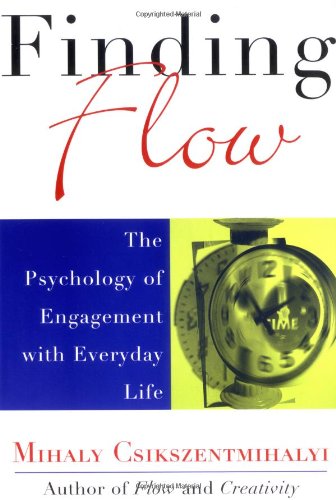
Hub Book Review: Finding Flow


findingflowYou have to give credit to Mihaly Czikszentmihalyi, a university professor who has managed to build a mini empire around the nebulous concept of Flow. We have already reviewed here at the Hub the original Flow as well as Creativity and Flow.

I’m pretty sure today’s review of Finding Flow will be my last but who knows? This particular book does have the virtue of brevity when compared to the other two: it runs just 180 pages, or 147 if you don’t count end matter.

As noted in the earlier reviews, I’m intrigued by the concept of Flow as it applies to Encore Careers and life after corporate employment. As many blogs in the Hub’s Encore Acts section have pointed out, aging baby boomers still have a potentially long and creative period ahead of them that lies between the traditional career and what used to be called Retirement.

So it seems to me that if late-bloomer Boomerpreneurs are going to make a success of this new stage of life, they’d better tap into the concept of Flow. It’s all tied in with passion and mastery, which is why I went to the well one last time with Czikszentmihalyi (pronounced, as the book helpfully notes on the back cover, “chick-SENT-me-high.”

He begins with a quotation from W.H. Auden: Continue Reading…

Hard way vs. Smart way: Retirement Coaching

One of the mistakes I made transitioning into my own Victory Lap was that I didn’t take any time off to regroup and refresh. I was suffering from “Sudden Retirement Shock.”

I wasn’t thinking clearly and I did what I always do when things are going off side: I roll up my sleeves and worked harder. I decided to go into full new business mode, spending the better part of three years in a cave writing a book and trying to figure things out.

Sure, things worked out well in the end but it took a lot of time, researching, and learning what I needed to know. Looking back now I realize it didn’t have to be as hard as it was.

I also have a bad habit of always going it alone,  something I developed while working at the Corp., a John Wayne thing. I believed asking for help was a weakness and made me look vulnerable. I always took the hard way and would try and figure it all out by myself. That kind of thinking resulted in me not creating and benefitting from mentors. This was a major mistake I made in my career. Life could have been so much easier if only I had been more open minded and willing to ask for help and advice.

Retirement planning is one of the most important processes you will go through in your life. Making a plan will improve the quality of your life now and in the future by providing a plan and goals. Most of us are goal oriented and achieving success in your working years, like paying off your mortgage, saving for your child’s education, etc. provides great motivation as you work towards your Victory Lap.

Don’t DIY your retirement planning

Since time, not money is the important asset you have, don’t DIY [Do It Yourself] retirement planning.  Continue Reading…

For the love of Money

By Heather Compton

Special to the Financial Independence Hub

I have invested a lot of my lifetime learning, living, teaching and writing about healthy practises around money.  When a young friend recently asked for some guidance on making peace with money, I wanted to fall back on those well learned strategies.

There are many practises that will bring some ease into your financial life. Living within your means, paying yourself first, getting your financial house in order: but you must lean into your own wisdom to bring peace.  It’s an evolutionary, lifelong journey for all of us and I am moved by the struggles we all have with money and the false powers we grant it.

What we buy, what we invest in, what we purchase for others and what we choose to finance or contribute to can bring us peace or its polar opposite.  What if we had a change of heart or a shift in worldview? A change of heart brings about a change of circumstance:  that’s transformation. Changing our worldview means changing what you believe is true – do big houses, fancy cars, expensive wardrobes and larger paycheques really spell success, acceptance, power or freedom?  Ask your authentic self that question.

The Heart test

We are all vulnerable to ambitions that disregard the balance and wisdom of our intuitive hearts. What if every spending decision had to pass through your heart before you pulled out your wallet?  Would you spend differently?

When we use our resources in ways that truly meet our authentic and universal needs for connection, integrity, joy, inspiration, physical well-being, meaning and choice, we find a path to peace.  That’s when money is in service to us and not the other way around. Money is an admirable servant but a terrible boss.

Lining up money’s flow with our authentic self and using it as a direct expression of our values and our vision is simple but it’s not easy.  It requires daily discipline to follow the practises that are the gateway to peace. Continue Reading…

Is buying a house a good investment? Usually, but here’s a case where it wasn’t

Is buying a house a good investment? Recently we spoke to the son of one of our Successful Investor Wealth Management clients who has to make a decision about housing, but needs to look at it from a financial point of view.

He and his wife bought a small starter home on a tiny lot in an old part of downtown Toronto. They both work in the north end of the city, so they had a long commute. But they liked the neighbourhood, and a number of friends lived nearby.

New considerations came up after their first child’s birth.

As it happens, a family member owns an investment house in the north end of the city, in an area that’s renowned for having some of Toronto’s top public schools. It’s twice the size of their current home, half as old, worth three times as much, and is in livable condition. It has a driveway that can park three or four cars, plus a garage. In winter, it has room for an enormous backyard skating rink. In summer, it can accommodate barbeque get-togethers with 50 or more guests. The location makes the house an easier commute for both of them.

The family member/owner is willing to accept a yearly rent equal to 1.2% of the value of the home, which is less than his interest cost. He’s even agreeable to making modest improvements at his own expense, since he can write off the cost against his rental income. The house plays a key role in his estate plan, since it’s part of a long-term land-assembly project. He is willing to let them live there for as long as they want, or until he dies, with little if any change in the rent. He just wants a trouble-free tenant.

Is buying a house a good investment? Here’s a specific case where it wasn’t

They asked our advice on buying a house before, and they asked again when this sell-or-hold question came along.

Back in 2015, we told them the same thing we’ve repeatedly told other clients and Inner Circle members. Since the 2008/2009 recession, central banks in Canada, the U.S. and other countries have set off on a unique economic experiment. They have artificially pushed interest rates down to historically low levels, for two reasons: to keep the economy out of recession, and to make it possible to pay the interest costs on extraordinarily high and rising government debt.

Now, with this sell-or-hold decision to make, the situation has changed. House prices and interest rates have both gone up substantially. This means far more potential Toronto-area house buyers have been priced out of the market. In addition, the artificial interest-rate paradise is coming to an end. Interest rates have gone up and our view is that they will keep rising.

Our advice for this particular young family was to accept the sweet deal on the rental house, and sell the starter. They can save the money they’d otherwise pay on property taxes toward a down payment on their dream home. Their incomes are likely to rise, since they are in the prime of their careers, so they’ll have that much more to add to the dream-home fund. When they are ready to buy, here are some tips:

Is buying a house a good investment? 6 key real estate investing tips for Successful Investors

Tax pluses. Homeowners get a tax-free, rent-free benefit of having a place to live. Profits on sales of principal residences are also tax-free. Continue Reading…