All posts by Jonathan Chevreau

Review: The Disciplined Trader

81o4jz+QTgLI am not and never will be a “trader,” in the sense of a stock-picker/market-timer.
However, on the suggestion of my financial advisor, I recently ordered and read a copy of a classic trading book called The Disciplined Trader, by Mark Douglas (New York Institute of Finance, 1990).

Personally, my only interest in the topic involves hedging downside risk:  taking actions that limit some downside, at the expense of some potential upside. What surprised me about this book — which bears the subtitle Developing Winning Attitudes — is how much space was allocated to psychology and mental attitudes. In fact, fully all of the third of the four major sections is devoted to what I would call “softer” topics like understanding the nature of the mental environment, how memories, associations and beliefs manage environmental information, managing mental energy and similar topics. Continue Reading…

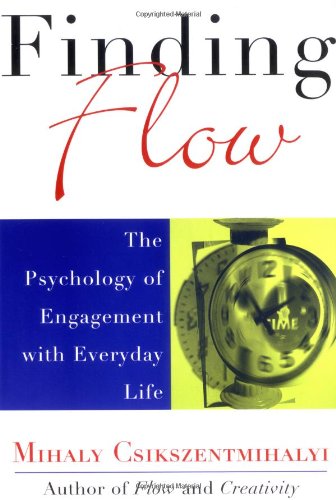
Hub Book Review: Finding Flow


findingflowYou have to give credit to Mihaly Czikszentmihalyi, a university professor who has managed to build a mini empire around the nebulous concept of Flow. We have already reviewed here at the Hub the original Flow as well as Creativity and Flow.

I’m pretty sure today’s review of Finding Flow will be my last but who knows? This particular book does have the virtue of brevity when compared to the other two: it runs just 180 pages, or 147 if you don’t count end matter.

As noted in the earlier reviews, I’m intrigued by the concept of Flow as it applies to Encore Careers and life after corporate employment. As many blogs in the Hub’s Encore Acts section have pointed out, aging baby boomers still have a potentially long and creative period ahead of them that lies between the traditional career and what used to be called Retirement.

So it seems to me that if late-bloomer Boomerpreneurs are going to make a success of this new stage of life, they’d better tap into the concept of Flow. It’s all tied in with passion and mastery, which is why I went to the well one last time with Czikszentmihalyi (pronounced, as the book helpfully notes on the back cover, “chick-SENT-me-high.”

He begins with a quotation from W.H. Auden: Continue Reading…

Retired Money: Should you worry a large TFSA will trigger a CRA audit?

MoneySense/Shutterstock

Should you worry that a large TFSA will trigger a CRA audit? My latest MoneySense Retired Money column looks at a legal debate between the Canada Revenue Agency and taxpayers who have succeeded too well in growing their Tax-free Savings Accounts (TFSAs) with shrewd investing. You can access the full story by clicking on the highlighted headline: Why the CRA is targeting some TFSAs in court. 

If you’ve contributed regularly to the TFSA since it began in January 2009 you now have $57,500 of cumulative contribution room. With decent growth, it’s easily possible to have accumulated $100,000 in a TFSA by now: in fact, the CRA told me for the article that of the 13.5 million TFSA accounts that existed by 2016, 18,000 have balances of at least $100,000 (a number that includes myself and my own Millennial daughter, thanks to a few good FANG stock picks).

A Globe & Mail article last week profiled several ordinary Canadian investors and financial bloggers who have TFSAs of at least $100,000. See How to Grow your TFSA: Tips from Financial Bloggers to Fatten Your Account.

My MoneySense article quotes an unnamed investor who is being audited because his TFSA has grown to $500,000, owing to  timely growth of some private technology companies. He doesn’t think $100,000 is enough to trigger an audit but suggests $250,000 may be. In other words, the CRA may be fine with TFSA doubles but five-baggers will invite scrutiny and ten-baggers most certainly so.

But the real controversy involves TFSAs that are run as de facto securities trading businesses. The Globe highlighted this latest crackdown in an earlier article in July but was merely the latest of a series of TFSA audit scares that have been surfacing virtually since after the first year the program existed.

Shrewd stock-picking is not “aggressive tax planning” 

Some of those earlier audits involved TFSAs that soared because they held private companies but my guess is that, as in my own case or that of my daughter, the vast majority of TFSA holders are neither day traders nor experts in investing in private companies. We only buy exchange-traded funds or blue-chip North American stocks, including the FANG tech giants (Facebook, Amazon, Netflix and Google). Continue Reading…

Retired Money: How to avoid pre-retirement financial stress syndrome

My latest MoneySense Retired Money column looks at how near-retirees can avoid what author Patrick McKeough calls “pre-retirement financial stress syndrome.”

That’s a syndrome he identifies in his new book, Pat McKeough’s Successful Investor Toolkit. McKeough is a regular contributor here at the Hub and you can find the full MoneySense review of his book by clicking on the highlighted text: Investing tips for retired Canadians.

The book is a distillation of McKeough’s long investment career, honed first at The Investment Reporter, and in recent years his own firm, The Successful Investor, and its stable of newsletters. As a member of his Inner Circle and TSI Network, I have long been a proponent of his common-sense approach to investing. He is remarkably consistent in his insistence that investors of any age rely mostly on a conservative portfolio of quality dividend-paying stocks spread among the five major economic sectors (Manufacturing & Industry, Resources, Finance, Utilities and Consumer). And, he never fails to remind you, steer clear of stocks in the crosshairs of what he calls the “broker/media limelight.”

His newsletters are focused variously on Canadian stocks and U.S. and international stocks, and in recent years he has increased his coverage of ETFs.

A cure for PRFSS: Work longer or refine your spending

So what is“pre-retirement financial stress syndrome,” or PRFSS? PRFSS strikes when mature investors realize they may not have enough savings to generate the stream of retirement income they’d been counting on. While some investors are searching for one last desperate “hail Mary” gamble, McKeough advises the opposite: aiming for safer investments.

And while it may not be what some may want to hear, he suggests those suffering from PRFSS adopt one or both of these two solutions: work longer and/or refine your spending. He challenges them to “turn frugality into a game.”

With his focus on stocks, it’s no surprise that McKeough is not keen on bonds, even for retirees and those on the cusp of it. Continue Reading…

Poll finds most wonder how friends or neighbours can afford lifestyles

It’s one thing keeping up with the Joneses but a poll from Edward Jones finds that 61% of Canadians wonder how their friends or neighbours can even afford their lifestyles. This is especially so among Millennials (aged 18 to 34), 71% of whom felt this way, while 66% of Gen Xers aged 35 to 44 were curious to understand how those around them finance their purchases.

Seems to me this gives new meaning to the phrase The Millionaire Next Door, a popular book on how frugality is a key trait in building wealth. Typically, the kind of millionaires in the book live modestly and their net worth may not be obvious merely observing the size of a given home and/or what’s parked in the driveway. Conversely, it can also be that an apparent “millionaire next door” has no net worth at all but is fuelling their conspicuous consumption merely with debt.

Either way, it appears many of us are influenced by what our associates are spending their money on.

Sadly, the Edward Jones poll found that the pernicious practice of looking at the purchases of others may influence consumers to buy beyond their own budgets: a whopping 93% said they experienced buyer’s remorse after such purchases and admit to regrettable spending habits. Among Millennials, 96% experienced buyer’s remorse but so did 90% of baby boomers.

Among the types of purchases most likely to generate regret were tangible purchases, which were cited as a source of regret in 83% of cases. Clothing or shoes were regretted by 35% polled, jewelry by 28% and electronics by 26%. Millennials regretted spending on clothing/shoes in 47% of cases, while boomers were more likely to regret spending on jewelry (34% of them did).

While Millennials famously are supposed to value experiences over stuff, across the Canadian population, 83% regretted making impulse tangible purchases, versus 71% for experiential purchases.

Build spontaneous spending into your budget

So what lessons does this survey furnish for those seeking ultimate financial independence? “If you know you enjoy spending money spontaneously, build this into your monthly budget,” said Roger Ramchatesingh, Director, Solutions Consulting at Edward Jones in a press release issued on Monday, “When it is unplanned for, it can add up over time and hurt other long-term goals such as retirement or the purchase of a home.” Continue Reading…