All posts by Pat McKeough

Is buying a house a good investment? Usually, but here’s a case where it wasn’t

Is buying a house a good investment? Recently we spoke to the son of one of our Successful Investor Wealth Management clients who has to make a decision about housing, but needs to look at it from a financial point of view.

He and his wife bought a small starter home on a tiny lot in an old part of downtown Toronto. They both work in the north end of the city, so they had a long commute. But they liked the neighbourhood, and a number of friends lived nearby.

New considerations came up after their first child’s birth.

As it happens, a family member owns an investment house in the north end of the city, in an area that’s renowned for having some of Toronto’s top public schools. It’s twice the size of their current home, half as old, worth three times as much, and is in livable condition. It has a driveway that can park three or four cars, plus a garage. In winter, it has room for an enormous backyard skating rink. In summer, it can accommodate barbeque get-togethers with 50 or more guests. The location makes the house an easier commute for both of them.

The family member/owner is willing to accept a yearly rent equal to 1.2% of the value of the home, which is less than his interest cost. He’s even agreeable to making modest improvements at his own expense, since he can write off the cost against his rental income. The house plays a key role in his estate plan, since it’s part of a long-term land-assembly project. He is willing to let them live there for as long as they want, or until he dies, with little if any change in the rent. He just wants a trouble-free tenant.

Is buying a house a good investment? Here’s a specific case where it wasn’t

They asked our advice on buying a house before, and they asked again when this sell-or-hold question came along.

Back in 2015, we told them the same thing we’ve repeatedly told other clients and Inner Circle members. Since the 2008/2009 recession, central banks in Canada, the U.S. and other countries have set off on a unique economic experiment. They have artificially pushed interest rates down to historically low levels, for two reasons: to keep the economy out of recession, and to make it possible to pay the interest costs on extraordinarily high and rising government debt.

Now, with this sell-or-hold decision to make, the situation has changed. House prices and interest rates have both gone up substantially. This means far more potential Toronto-area house buyers have been priced out of the market. In addition, the artificial interest-rate paradise is coming to an end. Interest rates have gone up and our view is that they will keep rising.

Our advice for this particular young family was to accept the sweet deal on the rental house, and sell the starter. They can save the money they’d otherwise pay on property taxes toward a down payment on their dream home. Their incomes are likely to rise, since they are in the prime of their careers, so they’ll have that much more to add to the dream-home fund. When they are ready to buy, here are some tips:

Is buying a house a good investment? 6 key real estate investing tips for Successful Investors

Tax pluses. Homeowners get a tax-free, rent-free benefit of having a place to live. Profits on sales of principal residences are also tax-free. Continue Reading…

Stock portfolio management and planning for your Heirs

Our work with stock portfolio management clients sometimes gives us a window into problems that can arise with the death of parents and the distribution of their personal belongings and financial assets.

For instance, siblings may assume they were supposed to get particular items of jewelry or furniture. When they learn that somebody else asked first, they can harbour a grudge that can last for decades.

Planning for your heirs: Head off sibling conflict with frank discussions

The best way to spare your family this problem is to head it off while you’re still alive. Tell your kids that you want to be fair to everybody. Ask them to send you a note or an email to express interest in any particular article. But don’t put too much emphasis on who asked first, and don’t feel you need to rush into making a list of who gets what. Some of your children may be slow to think of what items matter most to them. Or they may feel shy about asking for them.

Everybody should understand that if one child gets valuable household items from the estate, they may wind up receiving less cash.

Unpaid loans from parents can also cause dissension. Sometimes adult children run into money problems and wind up having to sell their home, for instance. Later, they may want to borrow the down payment to buy another home. If you grant that request, don’t simply write a cheque.

Instead, have a lawyer register a mortgage on the new home for the full amount of the loan. Explain to your child that this protects the money from attachment by creditors if new money problems come along, and keeps it in the family. You should also be aware (no need to mention it to your child) that this step also keeps the money in the family in the event of divorce.

Dissension can also arise when a child stays in the family home long after his or her siblings have moved out. Living at home and taking care of a parent can hold a child back from career advancement, and may get in the way of the child’s social or romantic life. But siblings may see it as simply taking advantage of free room and board. If you think it’s appropriate, you may want to add a line or two in your will that acknowledges the personal contribution of the stay-at-home child.

It’s hard to avoid all tension that grows out of these all-too-human conflicts. But if you think about them and talk about them with your children, things will go much more smoothly than if you leave them for the kids to sort out on their own.

Planning for your heirs: Invest based on your heirs’ timelines

If you have substantially more money than you’ll need for the rest of your life, and you plan to leave the excess to your heirs as part of your retirement planning, it makes sense to invest at least part of your legacy on their behalf. That is, invest based on their time horizon, not yours. And above all, choose investments with our Successful Investor philosophy in mind.

For instance, if your heirs are in their 40s, your retirement planning should involve holding at least part of your portfolio in a selection of investments that would suit investors in their 40s, and that follow our Successful Investor approach. Of course, you’d still want to invest conservatively. But you’d want to take advantage of the many years that 40-somethings have till they reach retirement age. Continue Reading…

The Future is not quite now: A calm perspective on gloomy predictions

Here are a couple of conversations I’ve been involved in recently. Does any of it sound familiar?

Conversation with a retired engineer. He asked, “What do you think about this driver-less cars business? Has anybody even considered how many people this will throw out of work? We have to do something about this! Otherwise, joblessness will go so high that it will cause a depression.”

Conversation with a middle-aged family doctor/real-estate investor. He said, with complete confidence, “I’m cutting back on my medical career and moving into real-estate development. Long before I want to retire, I expect my job to disappear due to competition from AI (artificial intelligence).”

When listening to predictions, especially gloomy ones like these, keep in mind that nobody can consistently predict the future. Also remember that the most widely accepted gloomy predictions are especially prone to fail. That’s because people, as individuals, react to and prepare for predictions of doom. They work on the problem before its predicted arrival time. Sometimes they offset it entirely.

Y2K was the ultimate example

The ultimate example came on the first day of this century, with the non-arrival of the so-called “millennial bug,” or Y2K for short.

In the late 1990s, computer consultants warned that at the stroke of midnight on December 31, 1999, computers around the world would freeze up because of a problem with their data-storage limits. Computers used to use just two digits to designate a year. So they wouldn’t be able to tell what came after 1999; ‘00’ could mean 1900 or 2000. The problem had a simple fix, however. By the last day of 1999, most computer owners had attended to it. Damage from the predicted crisis was negligible.

Today’s predictions — gloomy and hopeful — revolve around the expectation that computer speeds will continue to rise, and computer costs to drop, at much the same rate as they have for the past half century.

This trend has led to exponential growth in the processing power of computer chips, coupled with an exponential drop in their cost. This leads to casual-conversation predictions like the two I mention above: artificial intelligence will soon lead to legions of unemployed taxi, truck and bus drivers; and legions of unemployed family doctors will follow soon after.

The logical flaw here is that exploding computer power at shrinking cost is a technological advance. But there are social, legal and practical limits to how quickly business can translate these technological gains into real-world progress (or problems, depending on how you look at it).

Computer makers don’t need government permission to raise the speed of their chips. In contrast, makers of driverless cars face all sorts of problems, long before they make any money.

The shift to driverless vehicles will happen gradually, over a period of decades. After all, driving in traffic involves far more surprises than a champion Go player faces on the playing board. Drivers have to deal with changing weather, full sunlight and deep shadow, unpredictable human drivers with varying skills, unpredictable pedestrian web surfers, potholes, snow-covered street markings and so on.

The shift from human to AI doctors will occur at an even slower pace — in line with how long it takes to earn a driver’s license on the one hand, and a medical license on the other. AI will replace family doctors some time after it replaces the voice and chat help lines that people use when they have a problem with a computer, a cell phone or a utility bill.

Assume technological process leads to economic progress

People have a long record of guessing wrong about the impact of new technology, and on how long it will take for the new technology to become part of daily life. You’ll guess right much more often if you just assume that technological progress eventually leads to economic progress. Continue Reading…

It isn’t what it used to be: Prospects for interest rates and inflation

When I talk to serious, successful investors, few ask, “Do you think the central banks will raise rates two or three times by a quarter-point before the end of the year?” or “Do you think inflation will hit 3% in the next year?” They are more likely to ask things like, “What are the chances that interest rates and/or inflation will get back up to the peaks of the 1970s/1980s?”

That is a much more important question.  A quarter-point change in interest rates or inflation is a fluctuation. A return to the peaks of the 1970s/1980s would be a disaster.

No one can predict the future, of course. The easy way out on the question would be to say, “Oh no, that could never happen again.” But the productive way to address a question like this is to look at those earlier decades and to try to figure out what was special about them.

It seems to me that in the years prior to those decades, three specific political/economic factors worked together to unlock a lot of pent-up demand for money, goods and services, and funnel it into a narrow timeframe where it could have great impact. These factors helped spur the rise in interest rates and inflation that followed.

The first factor was that, during four decades between the early 1930s and the early 1970s, the U.S. managed to fix the price of gold at around $35 U.S. per oz.

Greenback became a world currency in three crucial periods

This helped set up the U.S. dollar as something of a world currency during three crucial, historic periods: the 1930s depression, World War II and the post-war boom. The role of world-currency issuer let the U.S. expand its money supply without burdening itself with a heavy load of domestic inflation — not burdening itself right away, that is. But eventually the $35 gold peg gave way, like a dam that bursts when the force of a rising river becomes too much. The breaching of that $35 barrier helped set off a worldwide wave of inflation, as the value of the U.S. dollar withered in relation to the value of gold. Continue Reading…

The Paper Boy and the Theory of Nuclear War: Valuable Investment Lessons

Looking back over the past few decades, I’d say that some of my most useful and profitable investment principles came from things I’ve read or experienced that had nothing to do with the stock market.

I’ve already written about my first experience as a substitute newspaper delivery boy, filling in at age 11 for the 13-year-old who delivered the papers on our street. He made it sound simple: “You pick up the papers from the route boss on the corner, and you deliver them to the houses on this list. You go around to the houses and collect the money at the end of the week. The next day, you pay the route boss for the papers you took, and you get to keep all the money that’s left over.”

Every word in that explanation is true. However, he left out one crucial bit of info: rather than pay cash to the paperboy, a third or more of the customers mailed in a check every month to the newspaper office. After the check cleared, the office mailed a check to the (regular) paperboy. This was my first experience with paid work (other than leaf raking, lawn mowing or snow-shoveling, for which I got paid at the end of the day). It provided an instant, valuable lesson: before agreeing to any sort of business deal, you need to know all the details, even if this forces you to ask awkward questions.

Focus on plain-vanilla stocks and bonds

Over the years, this lesson has kept me out of all sorts of money-losing investments and unfair or poorly designed business proposals. It also explains how I came around to the view that you should focus on “plain vanilla” stocks and bonds in your portfolio, and avoid complex investment products, especially those with an insurance component.

Investment products profess to offer a “deal” that has more profit potential and/or less risk than you get from plain vanilla stocks and bonds. In my experience, what you lose on the one side of the promise is less valuable than what you gain (if anything) on the other. The deal in investment products is, however, much more complicated than the deal on the plain vanilla alternative.

It’s easy to find references to the hypothetical gains and advantages of investment products: just look in the marketing brochure, or ask the salesperson. To find out the downside of the product, you have to dig through many pages of legalese/fine print. The seller always has an information advantage over the buyer.

As a group, these products are likely to provide a lower long-term return than what you’d expect from a portfolio of high-quality stocks. But they provide a higher return to the salespeople, compared to what they can earn by selling you a portfolio of high-quality stocks. So, over a few decades, my first newspaper delivery experience at age 11 led me to advise against buying the many types of investment products that expose investors to costly conflicts of interest.

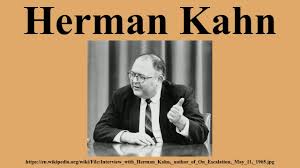
I learned a higher-level lesson about investing from the work of military-strategist/futurist Herman Kahn, author of On Thermonuclear War, Thinking About the Unthinkable and On Escalation. I first heard about Kahn in the early 1960s, when I had just entered high school. This was the height of the Cold War. Like many people back then, I worried that a nuclear war could conceivably break out at any time, with little or no warning. Scientists warned that if war came, “the living would envy the dead.” I tried not to think about it.

YouTube.com

In his book, Kahn said that thermonuclear war would not start overnight. Based on his study of military history, he said the world was more likely to go through 44 stages between the Cold War and World War III. He likened the 44 stages to rungs on a ladder, and divided them into seven subsets.

He labelled the first subset — rungs one through three — as “Subcrisis Maneuvering”; the second group, rungs four through nine, as “Traditional Crises”; the third, 10 through 20, as “Intense Crises”; the fourth, 21 through 25, as “Bizarre Crises”; the fifth, 26 through 31, as “Exemplary Central Attacks”; the sixth, 32 through 38, “Military Central Wars.”

Kahn refers to the passage from subset 6 to subset 7 — that is, from rung 38 to rung 39 — as “The City Targeting threshold.” He labels the final subset, number seven — rungs 39 through 44 — as “Civilian Central Wars.”

In Kahn’s ladder, the first use of nuclear weapons occurs at rung 23 (Local Nuclear War, Military). Civilians only start to become targets at rung 29 (Exemplary Attacks on Population). Civilians become a focus at rung 42, (Civilian Devastation Attack). Rung 43 is “Some Other Kinds of Controlled General War.” Rung 44 is World War III, but Kahn called it “Spasm or Insensate War.”

I found all this greatly reassuring. It gave me reason to believe that if war was coming, it would follow some sort of pattern, rather than come as a total surprise, like a global car crash. Of course, I was still in my teens. Adults differed widely in their attitude toward Kahn and his views.

Some people felt Kahn’s nonchalant writing about thermonuclear war marked him as a heartless monster. (On Thermonuclear War popularized the term “megadeath” — the death of one million individuals.) But Kahn was a jovial, gregarious individual, and this came through in his writing. If he had written in a morose, emotional tone, nobody would have read the book, and that would have been a tragic waste.

Others saw Kahn as an object of ridicule. They loved Stanley Kubrick’s political-satire/black-comedy film, Dr. Strangelove or: How I Learned to Stop Worrying and Love the Bomb. The film’s title character, Dr. Strangelove (played by Peter Sellers), is widely viewed as a parody of Kahn and his unflinching descriptions of the effects of war. It’s less widely known that Kahn collaborated with Kubrick on the script. Some of the film’s funniest lines make use of Kahnian terms, such as “Doomsday Machine.” Others are comical paraphrases of sentences in Kahn’s books. The project appealed to Kahn’s sense of humour.

Spotting unwise or unnecessary risks

Kahn’s work was widely read by high-ranking members of the U.S. and U.S.S.R. government and military. By describing and dissecting Kahn’s 44 stages, politicians and generals on both sides got better at spotting and avoiding unwise or unnecessary risks. In fact, many people give Kahn and his fellow “megadeath intellectuals” some credit for heading off World War III. Instead of world wars, major world powers shifted to regional proxy wars, like the Vietnam war, and the Soviet-Afghan war of the 1980s. Continue Reading…