All posts by Adrian Mastracci

Disciplined processes manage your family wealth

“The key to success is often the ability to adapt.”
― Anthony Brandt

Over our lifetime, we embark on fulfilling educational pursuits and one or more vocations. Then we proceed to spend, save and invest to achieve and sustain a variety of personal and family goals. I recommend pausing a few moments every now and then. The aim is to examine how conversant and comfortable we are with the disciplined processes of managing family wealth over the long run.

A straightforward definition of discipline is: “train oneself to do something in a controlled and habitual way.” Investors face a host of bumps and curves as they muster their best efforts in search of that mandatory discipline. Managing personal wealth requires extensive expertise and the ability to consistently apply it to a host of family situations over long periods. It is quite easy to become totally wrapped up with just investing the money. That can become a full time mission on its own.

What’s involved

My primary goal is to provide coordinated, objective and unbiased advice pertaining to a half-dozen wealth management components. The likes of risk management, retirement aspirations, long-term investing, estate planning, tax implications and business planning stand tall as your six foundations. I view these as the core requirements. Each family seeks customized processes to fulfill its path realized over many years.

My wealth management processes are about appreciating and understanding where clients are in their lives. Our discussions develop in several directions. Where they are heading? What is important to them? What are the family implications? What it takes to achieve the personal objectives. What is realistic to accomplish. What time horizon is available. The answers vary all over the map.

I summarize my six core foundations:

1.) Risk Management

Managing risk is top priority for successful wealth management: year in and year out. Investors have a variety of requirements for preserving and growing wealth. Today, a substantial portion of the family assets is invested in securities. Everyone can face increased market volatility. Keeping emotions out of the decisions is fundamental. Managing risk never stops during the investing lifetime. I focus heavily on client comfort with the risks taken. My processes emphasize three vital issues: ability, willingness and need to incur investment risks.

2.) Retirement Aspirations

Achieving successful retirement is a goal for most families. In addition to managing the assets, the planning determines whether sufficient capital is available to fund retirement. It also establishes the target investment returns required to accumulate the portfolio and meet retirement income needs. Investors need to be forthcoming about changes in their lives, concerns, and dreams. After all, retirement planning is both an art and a science. You may need to adapt to changing situations.

3.) Long-Term Investing

Long-term investing is the core service sought by investors. It’s the process of managing family assets like stocks, mutual funds, bonds, cash and real estate. It seeks to achieve and maintain a specific goal, such as retirement. My disciplined investing sets out policies and strategies before the tactics. The processes include assessments of risk tolerances, lifestyle requirements, identifying saving capacities and time horizons. A prudent asset mix is then designed and implemented. Broad diversification and quality investments are part of the plan. Managing daily distractions from the crushing weight of information overload and headlines is a constant quest. Continue Reading…

Think and invest like a Pension Manager

“Well done is better than well said.” —Benjamin Franklin

Investors are often on the lookout for improved and more sensible ways to invest and manage the family nest egg. I favour adopting the thinking and investing ways of pension plan managers. They are skilled at delivering reliable monthly pension income for decades to come.

Every investor’s objective is to create a “pension style” retirement nest egg: that is, a series of dependable portfolio draws that outlast the family. Let’s turn to pension plan practices for some portfolio guidance. Investors too can reap lasting benefits from the pension plan approach.

I adopted the “pension style” management system long ago. Unlike most investors, pension managers focus first on their policies and strategies. Then they attend to making the investment selections that fit their well thought out plan of action. They have been following this simple, effective, well-reasoned approach for ages.

I summarise a few essential pension plan tactics for your consideration:

Long term thinking

Pension managers are very skilled at long-term thinking. They understand that frequent market mayhem is a normal part of the long investment journey for both the bearish and bullish environments. Their plans think in decades to deliver pension benefits to each retiree. Time horizons of 30 to 50 years are not out of the ordinary for pension managers.

Manage investing risk

Pension managers pay very close attention to managing investment risks and resist temptations to willy-nilly incur unwanted ones. If a touch of aggressive investing makes sense, limits are established, such as up to 5% of portfolio capital. Pension managers accept the fact that there is no need to dread investment risk: they manage it instead.

Asset mix targets

Pension managers set their applicable asset mix targets before putting capital to work. They know that asset allocation delivers the biggest impact on portfolio returns: not market timing, nor superior stock selections. In addition, they revisit the suitability and rebalance the asset mix plan on a regular basis. Continue Reading…

10 pearls of wisdom to better investing

“The art of being wise is the art of knowing what to overlook.” — William James, American philosopher & psychologist (1842 – 1910).

Markets spend about two thirds of the time as bulls and one third as bears.

There is plenty of investment moxie to be learned from analyzing market volatility.

Preservation and growth of personal wealth works best on logic, not on emotion.

The good news is that becoming a better investor is not complicated.

Each pearl of wisdom presented helps guide the portfolio.
Together, they make a very powerful team.

Here is my tally of classic investing wisdom: Continue Reading…

Poking fun at investing clichés

“You sell when people are greedy and buy when people are fearful.” —Warren Buffett

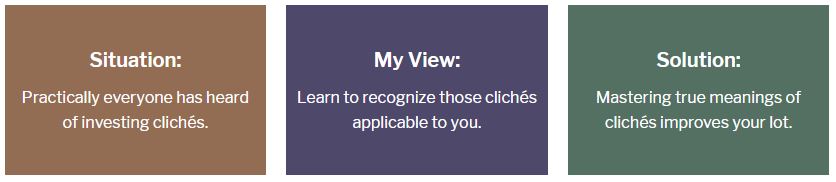
Do you ever wonder what the gurus are really saying when they speak in clichés? Typically in trying to draw your attention to what is happening in the markets.

Don’t fret. I often find myself wondering just what someone said or meant. I suggest poking a little fun at this topic is a valuable exercise.

As in practically every other part of life, the world of investing is full of clichés. Some are pearls of wisdom to behold.

Hopefully, poking a little fun at these investing clichés helps you better understand ‘guru speak.’

They are found throughout the internet. Let’s uncover some common clichés favoured by the pundits and what the translations really mean.

Guru speak gems
Here is my sampling of “guru speak” gems and corresponding translations that stand out for me:


1.) “It’s different this time”
Some wild and crazy logic is about to be let loose.


2.) “Markets never move in a straight line”

Take the ups and downs in stride.


3.) “You’re catching a falling knife here”

It’s going to get worse before it gets better.


4.) “Greed can be the achilles heel of investors”

Sell when you can, not when you must.


5.) “Markets can stay irrational longer than you can stay solvent”

You had better have some deep pockets.


6.) “All the weak hands are getting shaken out”

I’ve lost a lot of money on this, but I’m still right.


7.) “You have to be defensive here”

I have no idea what is going on in the markets.


8.) “My thesis is still intact”

I am so underwater on this investment, I see the ocean floor.


9.) “Bulls make money, bears make money, pigs get slaughtered”

Take the money and run.


10.) “It’s the start of a new quarter”

Expect new money to flow into the markets to keep things going


11.) “There are big headline risks right now”

Hide your cash under the mattress.


12.) “Buy on rumour, sell on news”

Buy as you hear something may happen, sell when the company confirms it’s happening.


13.) “The markets like it”

I have no clue why stocks are rising.


Hopefully, poking a little fun at these investing clichés helps you better understand “guru speak.” Listen attentively for the next ones.

The messages are typically short and simple. For example, Warren Buffett reminds us how to buy low and sell high.

I’ve only just scratched the surface.

Adrian Mastracci, Discretionary Portfolio Manager, B.E.E., MBA started in the investment and financial advisory profession in 1972. He graduated with the Bachelor of Electrical Engineering from General Motors Institute in 1971, then attended the University of British Columbia, graduating with the MBA in 1972. This blog is republished here with permission from Adrian’s website, where it appeared on May 29, 2018

Would you accept portfolio advice from William Shakespeare?

“In giving advice seek to help, not to please, your friend.” ― Solon, (638 BC–559 BC), Greek lawgiver & politician

You are probably wondering what on earth William Shakespeare, the highly renowned English poet and playwright, has to do with dispensing portfolio advice. After all, he was around more than four centuries ago. Let the short story unfold.

Investors think of portfolio management strategies as modern day creations. Particular emphasis is directed to findings of the last fifty years. This area of study is commonly referred to as “Modern Portfolio Theory,” or “MPT” for short.

For example, Benjamin Graham is considered the father of value investing. His bestseller book titled “Security Analysis,” co-authored in 1934 with David Dodd, is still a course staple at various business schools. As an aside, Warren Buffett was a student of Benjamin Graham.

Many investors focus their attention on books, magazines, newsletters, educational papers and blogs devoted to MPT issues. The internet, television, radio, print and social media outlets cater to an array of MPT needs. The list keeps growing daily by leaps and bounds.

Moreover, today’s investors and professionals have a wide assortments of MPT tools at their disposal. Virtually anyone can track, analyze, select, benchmark, monitor and implement every imaginable portfolio nuance. Conversely, it is very easy to become mired in MPT matters.

However, you may be surprised to discover that portfolio theory is far from modern. It does not have to be complex to be effective. Further, nobody needs to become overwhelmed in MPT.

In fact, portfolio theory sports a long and rich history, spanning centuries. Its fundamental pillars have remained much the same. Even though countless tweaks have been made over time.

Shakespeare’s insights

A while back, I revisited some plays that I had studied during my days of high school English classes. “The Merchant of Venice,” a comedy written over four centuries ago by William Shakespeare, (1564–1616), comes to mind.

I rediscovered one notable excerpt from that play. A concise and insightful situation. It ought to interest practically every investor who thinks long-term.

Let us turn the hands of time back to the days of Shakespeare and focus on the plight of Antonio, the Merchant of Venice. This passage was spoken early in Scene 1 of the play:

SALARINO:
But tell not me; I know, Antonio
Is sad to think upon his merchandise.

ANTONIO:
Believe me, no: I thank my fortune for it,
My ventures are not in one bottom trusted,
Nor to one place; nor is my whole estate
Upon the fortune of this present year:
Therefore my merchandise makes me not sad.

Stop right there. Read it once more. Were he living today, Shakespeare would make a shrewd portfolio manager. I would happily encourage him to become a member of our team. I would empower him to continue dispensing that same eloquent portfolio advice from his day.

Even four centuries ago, Shakespeare professed the sage benefits of diversification. Antonio’s portfolio had various ships, heading to several destinations, with different cargo and spread out over time. A high priority for portfolios continues to be the assessment of what is prudent and sufficient diversification for each case.

Shakespeare’s wisdom is classic, sensible advice for the nest egg. It is also logical and straightforward. Had the Nobel Prize existed in his day, Shakespeare would surely have been nominated for his portfolio insights. Plus, he had skills to blend portfolio strategy into his play.

Time tested practices

Classic investment practices from long ago point to considerable common sense. I highlight a few:

  1. Shakespeare’s portfolio insights have truly survived the tests of time. Something all investors aspire for the nest egg, especially retirement. Keep your eyes firmly on the objectives you seek. Slow and steady gets you to the desired ballpark.
  2. Refrain from reinventing the investment wheel. The more things change, the more they stay the same. The approach to your plan of action is not materially different today as compared to one from centuries past. You have access to far more options and added distractions.
  3. Methodical and logical decisions are best. Spread long-term investing risks by diversifying broadly. Develop and follow a sensible asset mix. Park your emotions at the door. It is a simple and effective base to adopt.
  4. His advice on diversification is core portfolio strategy. It helps achieve and sustain investing success while keeping complexity in check. As in Antonio’s day, it also reduces the chances of the nest egg making you sad.

My take is that present portfolios benefit from applying fundamentals developed in centuries past. Vintage portfolio theory, perhaps, but very modern in its early days. Your mission is to make sense of bumps, curves and potholes that develop along your chosen path.

The broadly diversified approach of yesteryear is still superb, timeless, invaluable advice for your MPT needs. Choose solid, yet simple, foundations that support your financial castle throughout the long journey.

I say accept the portfolio advice. Shakespeare would be proud.

Adrian Mastracci, Discretionary Portfolio Manager at Lycos Asset Management, started in the investment and financial advisory profession in 1972. started in the investment and financial advisory profession in 1972. He graduated with the Bachelor of Electrical Engineering from General Motors Institute in 1971, then attended the University of British Columbia, graduating with the MBA in 1972. This blog is republished here with permission from Adrian’s website, where it appeared on June 19, 2018.