Building Wealth

For the first 30 or so years of working, saving and investing, you’ll be first in the mode of getting out of the hole (paying down debt), and then building your net worth (that’s wealth accumulation.). But don’t forget, wealth accumulation isn’t the ultimate goal. Decumulation is! (a separate category here at the Hub).

Dogs of the Dow is themed ETF investing but flawed

Dog Breed Small Brabant AccountantInner Circle members often ask us about themed ETF investing strategies, and most of the time, we tell them we do not recommend investing in themes.

For example, some ETFs out there are based on the so-called “Dogs of the Dow” stocks. Essentially, the “Dogs of the Dow” ETF is based on a collection of the lowest-priced, highest dividend yielding stocks that trade on the Dow Jones Industrial Average and are updated yearly.

Rising interest rates will work against Dogs of the Dow ETF investing approach
The ALPS Sector Dividend Dogs ETF (symbol SDOG on New York; www. alpssectordividenddogs.com), is an example of an ETF that applies the “Dogs of the Dow” theory on a sector-by-sector basis using the stocks in the S&P 500.

As we mentioned above, the Dogs of the Dow approach involves buying the lowest-priced, highest-yielding stocks in the Dow Jones Industrial Average. At the end of each year, you pick the 10 stocks from the 30-stock Dow with the highest dividend yields. You then invest an equal dollar amount in each, hold them for one year and repeat these steps annually.

The ALPS Sector Dividend Dogs ETF picks five stocks from each of the 10 sectors as defined by the S&P 500 index—consumer discretionary, consumer staples, energy, financials, healthcare, industrials, information technology, materials, telecommunication services and utilities. The ETF picks the stocks with the highest dividend yields. Each holding is then equally weighted so that every company has a similar influence on the ETF’s total return. The end result is a portfolio of 50 large-cap stocks.

The Dogs of the Dow strategy worked well in the 1990s because interest rates were going down. This tended to raise all stock prices. But high-yielding stocks were affected more than most, because they attracted former bond investors who were switching into stocks.
Interest rates are now likely to remain steady, or they could creep upward. So we see little appeal in a Dogs of the Dow approach.

For that matter, we see little appeal in following any formulaic approach to investing. The one basic rule about things like this is that if it sounds too good to be true, then it isn’t true.

The ALPS Sector Dividend Dogs ETF holds a number of stocks we recommend in Wall Street Stock Forecaster (including McDonald’s, Kraft Foods Group, Wells Fargo & Co., Baxter International, Pfizer, General Electric and Intel). It also holds a lot of stocks we don’t recommend. But, more to the point, we don’t recommend using a Dogs of the Dow approach to picking stocks or ETF investing.

There is no “philosopher’s stone”

Continue Reading…

Millennials may need to save 22% of income just to retire by 70

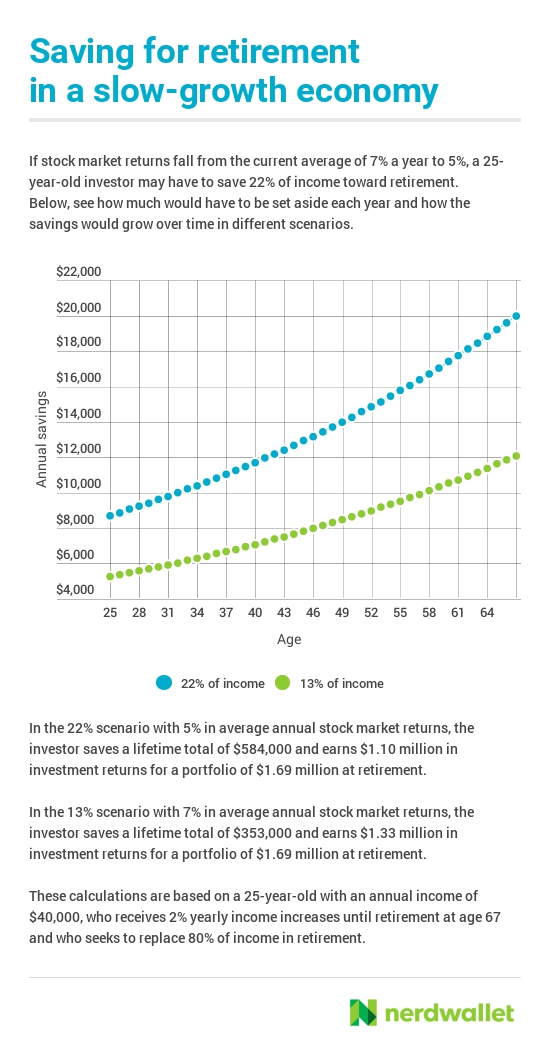
chart-1As my Financial Post blog today recaps, a new study being released today by the San Francisco-based personal finance site NerdWallet warns that just to retire by age 70, today’s millennials would have to save a whopping 22% of yearly income. Click on the highlighted text for the FP piece: Millennials may have less time on their side, U.S. retirement study shows.

The adjacent chart shows the math and how much millennials would need to save every year, depending on whether the stock market generates its historic 7% annual rate or the more pessimistic projections of 5%.

“Era of supernormal returns is over”

Continue Reading…

Capital gains tax is one of the lowest you’ll ever pay

Hand with pen pointing to GAIN word on the paper - financial and investment conceptsThere are three forms of Investment Income in Canada: Interest, Dividends and Capital Gains. Each Is taxed differently. Here’s a reminder of how smart investors use their knowledge to taxation rates, especially tax on Capital Gains, to protect their returns.

With stocks, you only pay capital gains tax when you sell or “realize” the increase in the value of the stock over and above what you paid for it. (Although mutual funds generally pass on their realized capital gains each year.)

Several years ago, the Canadian government cut the capital gains inclusion rate (the percentage of gains you need to “take into income”) from 75% to 50%. For example, if an investor purchases stock for $1,000 and then sells that stock for $2,000, then they have a $1,000 capital gain. Investors pay Canadian capital gains tax on 50% of the capital gain amount. This means that if you earn $1,000 in capital gains, and you are in the highest tax bracket in, say, Ontario (49.53%), you will pay $247.65 in Canadian capital gains tax on the $1,000 in gains.

The other forms of investment income are interest and dividends. Interest income is 100% taxable in Canada, while dividend income is eligible for a dividend tax credit in Canada. In the 49.53% tax bracket, you’ll pay $495.30 in taxes on $1,000 in interest income, and you will pay $295.20 on $1,000 in dividend income.

Three capital-gains strategies

Continue Reading…

Four psychological biases investors must understand

Concept of stress with gear in the head of a businessmanIn our last post we highlighted that behaviour might just be the biggest source of trouble for investors.  People just aren’t psychologically wired to make investment decisions that are good for them and often do things that are potentially harmful.

Our brains have evolved to create protection mechanisms that in many instances are helpful – just not when it comes to investing!  The subconscious creates short cuts designed to save us time when making decisions and to protect us from pain, both emotional and physical: basically, these short cuts help us perform better in “fight or flight” situations.  While many of these biases and their implications for investors have been documented by the likes of Daniel Kahneman, Amos Tversky and others, we think the following four stand out:

1.) Familiarity Bias

We tend to stick with what we know, whether that is products we buy, places we frequent or stocks in which we invest.  Presumably this heuristic evolved over time to help us make quicker decisions and keep us safe but when it comes to investing it can have the opposite effect.  For example Canadian investors tend to overweight their portfolios towards Canadian stocks, a common phenomenon globally but Canadians are among the most extreme examples of what’s known as “home bias.”

While Canadian investors might feel more comfortable owning the shares of companies they read about in the news most often and that are closely tied to our own economy, from an investment perspective they are taking on unnecessary risk by being overly exposed to specific companies in the oil, mining and financial sectors.  Canadians would be better off from a risk and reward perspective if they were to diversify more outside of Canada.

2.) Recency Bias

We tend to remember things better that happened more recently than we do things that occurred further back in time.  If you look at expert forecasts from Wall Street analysts going back in time, they tend to forecast very high returns just at or following market peaks (like the internet bubble) and low returns following market bottoms (like during the 2008/2009 financial crisis): clearly not very helpful and if so-called experts fall victim to the same biases, what chance do the rest of us have?  Markets are volatile and move in cycles:  anchoring on recent trends or sentiment might lead us to make decisions that result in the opposite of what’s good for us.

3.) Overconfidence Bias

Daniel Kahneman believes this to be the most dangerous of all behavioural biases and the most difficult to overcome.  Just like driving ability, people tend to believe they have a better than average ability to pick outperforming investments or investment managers.  This bias leads people to ignore overwhelmingly convincing evidence, often at their peril.

For example, despite the fact that data shows that paying high fees for active investment management leads to lower returns on average and greater uncertainty of outcomes, people continue to try to beat the market or find winning investment managers.  (Full disclosure, Chalten Fee-Only Advisors espouses an evidence-based low-cost, largely passive investment philosophy!).

4.) Herding

It’s a lot more painful to be wrong on your own than be wrong when everyone’s wrong.  Surely the herding mentality stems from some innate desire to feel included, to avoid being exposed whether right or wrong.  The result of herding in the investment world is that once trends develop there tends to be a “bandwagon effect” that becomes difficult for many investors to resist.  “Fear of missing out” or FOMO as it’s popularly acronym-ed these days can drive individuals to make irrational investment decisions they might normally avoid if deciding independently.

The net effect of the above is that people make investment decisions that are harmful.  Often the result is that investors buy into euphoric market peaks and sell out at the bottom of market panics.  It is no surprise that studies show that investment returns earned by individual investors are not only lower than market index returns but lower than those of the mutual funds in which they invest: investors just get in and out at the wrong time.

And if it’s not enough of a struggle that we have these psychological biases to battle against, most of the financial media and investment industry use communication and advertising practices that are specifically designed to exploit all of our psychological pitfalls!

How can you win?  To begin with, develop a investment plan that fits in with your overall financial plan.  Define parameters that address your ability, need and willingness to take risk and then use your plan as an anchor (in this case an anchoring bias is OK!) to keep you on track and avoid being swayed by both external noise and internal psychological biases.

graham-bodelGraham Bodel is the founder and director of a new fee-only financial planning and portfolio management firm based in Vancouver, BC., Chalten Fee-Only Advisors Ltd. This blog is republished with permission: the original ran on September 14th on Bodel’s blog here.  

Robo-Advisers disrupting wealth management industry but Service could determine how much

Male hands on the keyboard in front of computer screen with financial data and chartsAs my article in the print edition of Monday’s Financial Post goes into in some depth, the recently released DALBAR study on North American robo-advisers highlights several challenges the pioneering industry faces with new customers, or in poaching them from the established wealth management industry.

See the headline Service ‘gaps’ in robo advice: Dalbar study (page FP1). You can find the online version here under the headline ‘Robos are getting a pass’: Study points to gaps in automated investment advice.

Many older and wealthier clients may get “poached” from the traditional wealth management industry, whether retail mutual funds, banks, investment counsellors, full-service brokerage or other segments. Of course, in some cases, robo-advisers are landing “new” money from young people who may never have invested before. Millennials are a big focus of some robo-advisers (such as Toronto-based Wealthsimple).

Last Tuesday, the Hub ran a blog outlining the major points issued in the Dalbar press release, and we also published reaction from three Canadian robos: JustWealth, NestWealth.com, Wealthbar and the aforementioned Wealthsimple. See Becoming a Robo-Advisor Client may be challenging, Dalbar finds.

The 126-page study — which not all robo-advisers have seen — contains plenty of information that couldn’t be summarized in the FP piece. It begins by noting that these services are “one of the fastest growing segments in the wealth management space” and that they have “managed to capture significant share of wallet from the established wealth management providers in … a short period of time.” The report mentions that Wealthsimple has grown to $500 million in assets from a standing start in 2014.

The report has a relatively small sample size: 45 mystery shoppers  (15 US, 30 in Canada) were asked to sign up to various Robos. Almost half of them were in their 30s. To assess risk, Dalbar directed these mystery shoppers “to ask for high returns in a short time period to test risk response mechanisms.”

Below, I present some more highlights that have not yet been covered:

Robo firms covered in the Dalbar report

First, the report looked at five American robo-advisers and ten Canadian ones (interesting that there weren’t more US ones!)

The US firms were Betterment, Charles Schwab, Future Advisor, TradeKing Advisors and Vanguard. (interesting that the oft-cited Wealthfront is not in: Dalbar told me it was based on what clients chose.)

The Canadian firms were (in the order Dalbar listed them): BMO SmartFolio, Invisor, JustWealth, Modern Advisor, NestWealth, Questrade Portfolio IQ, RoboAdvisor Plus, Smart Money Capital, Wealthbar and Wealthsimple.

Why clients chose particular services

Asked why clients chose a particular service, 100% of Betterment clients cited convenience while 100% of Vanguard clients cited reputation. WealthSimple clients cited equally (25% each) advertising, convenience, executive team and reputation. Interestingly, 75% of BMO clients cited its bank affiliation, and 25% its reputation. Invisor was a 3-way split between advertisements, executive team and product selection. JustWealth was an even 4-way split between advertisements, reputation, convenience and — this is interesting — being the “first to return my initial contact.” The latter point also accounted for 25% for NestWealth, Wealthbar and Modern Advisor. For NestWealth, the other three reasons, all an equal 25%, were convenience, platform offered and reputation. For Questrade  Portfolio IQ it was 67% convenience and 33% reputation.

Reasons for Choosing vary with Client income levels

The report broke clients down into three clients with annual incomes that I’ll call low, medium and high: $60,000 to $75,000, $75,000 to $100,000 and $100,000 to $150,000 or more.

For the low-income clients, Convenience was most often cited, 30% of the time, followed by Platform Offered (26%) and Reputation (17%) and Pricing (9%).

For the middle-income clients, Reputation was most important, at 38%, followed by First to Return Initial Contact at 19%, executive team at 13%, and equal 6% allotments for Advertisements, Bank Affiliation, Convenience, Platform offered and Pricing.

For high-income clients, Reputation was most important in 33% of cases, followed by even 17% allotments to advertisements, bank affiliation, convenience and executive team. Remember these are small sample sizes, but none of the high-income clients even cited pricing, platform offered , product selection, or First to Return Initial Contact.

Motivations for trying a Robo-Adviser

Curiosity seemed to be a major driver for wanting to check out a robo service in the first place, Dalbar found, followed by lower fees and convenience. Not surprisingly, lower costs dominated for the high-income group, 83% citing it, followed by 17% time saving. For the middle-income group, 44% just cited the desire to try new technology; this was also cited by 30% of the low-income group. The two lower-income groups were also influenced by the fact robo-services let you start investing with relatively small amounts of money.

Cross-border differences in account opening times 

Time to open an account varied from five to more than 30 minutes in Canada. Canadian users needed up to six times more time to open than their US counterparts. 75% of US robo users needed just 10 or 15 minutes to open an account, while 70% of Canadian robo users needed 15 to 60 minutes.  Most Canadian users felt it took “too long” to open an account and US robos were perceived as being much easier to work with than their Canadian counterparts.

Dalbar singled out NestWealth as being most consistent, with most clients able to complete a risk assessment questionnaire in 15 to 30 minutes. US robo firms were faster but mostly because the questionnaires were shorter.

Aman Raina’s robo-experience

Continue Reading…