

Building Wealth

For the first 30 or so years of working, saving and investing, you’ll be first in the mode of getting out of the hole (paying down debt), and then building your net worth (that’s wealth accumulation.). But don’t forget, wealth accumulation isn’t the ultimate goal. Decumulation is! (a separate category here at the Hub).

Two free lunches: Diversification and Rebalancing

“Excellence is not a skill. It is an attitude.” — Ralph Marston

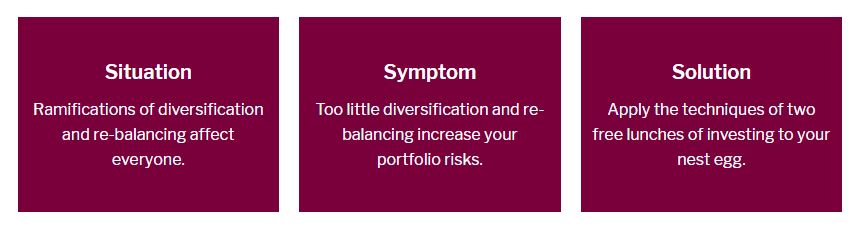
Diversification and Rebalancing strategies are two essential, time-tested portfolio tools. They improve your chances of achieving better consistency of long-term returns. Tasty free lunches are still being served in your investing patch.

Diversification spreads your risks among a variety of investments. Rebalancing makes periodic adjustments to bring allocations back in line with targets set within your road map. I assume that your road map is in place.

Experience shows that asset mix decisions have the greatest impact on your portfolio returns than any other factor. The foundation of investing your nest egg requires patience, discipline and clear investment policies.

Diversification is one necessary safeguard. You don’t want problems arising in any asset class to ruin your well designed portfolio. Diversification increases the odds of you being right more often. If some selections are suffering, others can help cushion the rest.

Initial allocations and weights of your portfolio selections will drift over time as markets rise and retreat. When drift becomes significant, it affects your investment profile and typically requires some re-balancing.

Periodic rebalancing strategies sell some assets and buy others within your asset mix. My preferred time to rebalance is when you inject new money into the portfolio or withdraw some. Use rebalancing techniques as portfolio tweaks, not for wholesale changes.

Possible ways

I highlight 10 ways to achieve portfolio changes: Continue Reading…

Life Insurance denied? Top reasons this could happen

By Lorne Marr, LSM Insurance

Special to the Financial Independence Hub

Life Insurance is designed to provide a financial safety net to the ones left behind in the unfortunate event of death. However, there may be instances when an insurance claim is denied. The best way to avoid this from happening is to follow the rules. Understand your policy and follow these simple rules to ensure your investment in your family’s future will be protected.

1.) Lying On Your Application

Leaving out certain items or fudging the truth a bit might sound harmless enough, but it could mean the difference between a payout and a denial when it comes time for your beneficiaries to collect. The application may seem large and some of the questions might sound like an invasion of privacy, but the insurance company is taking a big risk insuring you. They need as much information as possible in order to properly assess your situation.

Insurance companies can uncover any lies or secrets you may want to hide. Lying on your application is a breech of contract, which means your claim will be denied.

2.) Unintentionally Leaving Out Information

You are supposed to be completely honest when filling out an application. What if you unintentionally leave something out like a routine checkup? Even if your checkout came out clean, be leaving it out the insurance company might automatically assume you have something to hide.

Take your time when completing the application to ensure nothing is left out, no matter how minor it may seem. If you are unsure of an answer, find out. A simple call to your doctor will confirm the date of your last visit. By rushing or guessing, you could nullify your policy.

3.) Using an Under-qualified Agent

Most people will only need to complete one or two life insurance applications in their lifetime. Continue Reading…

How to set your Retirement savings target

How much to save for retirement depends on the type of lifestyle you’re   aiming for

How much to save for retirement varies for each investor. A fulfilling retirement is not simply a matter of accumulating sufficient wealth to give you peace of mind. It is equally a matter of knowing what you will do — in effect, ensuring that you will be as active and productive with your time as you were during your working days.

These days, more investors suffer from what you might call “pre-retirement financial stress syndrome.” That’s the malady that strikes when it dawns on you that you don’t have enough money saved to be able to earn the retirement income stream you were banking on.

To alleviate this worry, we recommend that you base your retirement planning on a sound financial plan. Here are the four key variables that your plan should address to ensure you have sufficient retirement income:

  • How much you expect to save prior to retirement;
  • The return you expect on your savings;
  • How much of that return you’ll have left after taxes;
  • How much retirement income you’ll need once you’ve left the workforce.

Consider taxes when determining how much to save for retirement

As for the tax structure, it keeps changing. But it’s safe to assume that you’ll pay a lower rate of tax on dividends and capital gains than on interest, and that you’ll generally pay taxes on capital gains only when you sell.

As for the return you expect, it’s best to aim low. If you invest in bonds, assume you will earn the current yield; don’t assume you can make money trading in bonds. For stocks, the market returned 10% or so yearly on average over the past 80 or so years. Aim lower — 8% a year, say — to allow for unforeseeable problems and setbacks.

Continue Reading…

A nation of financial illiterates?

By John Shmuel, Managing Editor, LowestRates.ca

Special to the Financial Independence Hub

Do you consider yourself financially literate?

When we posed that question to Canadians last month in an IPSOS survey, the overwhelming majority — 78% — said yes.

Canadians are clearly confident about their financial knowledge. But their actual knowledge, unfortunately, is lacking. When we followed up our initial question with a quiz, comprised of 15 intermediate questions about financial products, the majority of Canadians (57%) failed.

It should be noted that these weren’t simple questions. But they also weren’t questions that require special certification or an advanced knowledge of finance. One question asked whether there were financial institutions in Canada that offer free chequing accounts (there are). Another asked whether you needed a special license to buy stocks (you don’t).

Failure to know the answers to these questions shows that Canadians are confused about financial products. And financial institutions take advantage of that.

Let’s return to the question on chequing accounts. About 34% of those surveyed said they thought all banks charge you money to have a chequing account. Another 14% said they didn’t know the answer. With nearly half of Canadians not realizing free chequing accounts are an option, it’s no surprise many financial institutions continue to charge for them.

Then there is the issue of mortgages. Of our 15 questions, Canadians struggled with ones related to mortgages more than any other. For instance, we asked whether a mortgage term refers to the length of time you need to pay off your mortgage. 51% of Canadians answered incorrectly. Another 18% said they don’t know. (For those wondering amortization refers to the length of a mortgage, a term is how long variables such as your interest rate are in effect.)

So what?, you might say. What does a mortgage term have to do with being knowledgeable about finance?

It all comes down to empowerment. If you’re familiar with how a financial product works, you’re more likely to be confident in getting the best deal for that product. Knowing what a mortgage term is you probably know that you can negotiate mortgage rates, or that you can go online and see different rates from rival banks and brokerages. Continue Reading…

Business Owner suffering Pension Envy? Here’s a Remedy

Jean-Pierre Laporte

The Globe & Mail’s Report on Business has just published my piece titled A remedy for sufferers of pension envy, which you can access by clicking the highlighted text.

It describes the long-established Individual Pension Plan (IPP) and a newer variant called the Personal Pension Plan (PPP). The creator of the latter, Jean-Pierre Laporte (pictured to the left) estimates 1.2 million Canadian business owners could benefit from these plans, which are in effect Defined Benefit (DB) pension plans designed for professionals and business owners.

The newer PPP from Integris Pension Management Corp. is a hybrid in that it can be either a DB plan or a more market-sensitive Defined Contribution (DC) pension.

Trevor Parry

Several sources in the piece have written at more length on these topics here on the Hub. For example, see this blog from the Hub last November: How a Personal Pension Plan can mimic gold-plated DB pensions. Or see Trevor Parry’s most recent Hub blog, Making Canada Great Again. Perry sees both IPPs and PPPs as increasingly relevant in the current Canadian tax environment.

Tim Paziuk

One source I consulted for the piece but didn’t appear is financial advisor and author Tim Paziuk. Paziuk – of Victoria, BC-based TPC Financial Group Ltd. – laments the fact that “employees of the public sector and large corporations enjoy benefits and retirement plans that are unavailable to the private business owner.” As he noted in a recent Hub blog after the last federal Budget — On the Middle Class and Paying One’s Fair Share of Taxes — the pending Liberal working paper on the middle class and tax fairness doesn’t augur well for owners of corporations and even family members who enjoy “income sprinkling” from such corporations.

Fortunately new tools like the PPP and the not-so-new IPP give business owners a way to fight back. You can find on the web various debates between those who prefer the IPP and the PPP. For example, also quoted in the Globe article is Stephen Cheng, of Westcoast Actuaries, who has debated the plans with LaPorte here. Laporte’s reply can be found here: Comparing old IPPs to PPPs.

Motley Fool: Canadians overrate their financial literacy?

P.S. Here’s my latest blog for Motley Fool Canada. The headline pretty much sums up the story: Overconfident Millennials and Gen X flunk Financial Literacy Test, but Boomers only marginally better.

And while on the topic of financial literacy, I was gratified to be named one of Canada’s top online finance influencers, as conveyed by RazorPlan.com in this post.

Powered by the Financial Independence Hub.
© 2013-2026 All Rights Reserved.
Financial Independence Hub Logo

Sign up for our Daily Digest E-Mail!

Get daily updates from the FindependenceHub.com straight to your inbox.