Building Wealth

For the first 30 or so years of working, saving and investing, you’ll be first in the mode of getting out of the hole (paying down debt), and then building your net worth (that’s wealth accumulation.). But don’t forget, wealth accumulation isn’t the ultimate goal. Decumulation is! (a separate category here at the Hub).

RRSPs — Getting past the contribution inertia

By Aman Raina,  SageInvestors.ca

Special to the Financial Independence Hub

In the early part of the New Year we see, hear, and read a lot of messages regarding Registered Retirement Savings Plans (RRSPs). From every indication, they are important to have as a saving tool as we get older.

RRSP and Containers

Before getting to why it is important, a quick overview of the RRSP concept. The best way I can explain the concept of a Registered Retirement Savings Plan or RRSP, is that it is essentially a container. It can be a jar, a glass, a bathtub, anything that can hold something.

In terms of RRSP containers, I’ll keep this simple. You have several types to choose from:

Asset Specific RRSPs –can only hold a specific type of asset like a GIC or a mutual fund. You can hold multiple containers of Asset Specific RRSPs

Self-Directed RRSPs –can hold a variety of securities including individual stocks, bonds, ETFs, mutual funds, cash, GICs, Treasury Bills. They are much more flexible in terms of your options of what you want to put in your container. The banks and brokerages usually charge an annual fee for the privilege of using their containers, however if you have enough assets to put into the container or throw a lot of business there way, you can get it waived.

Continue Reading…

TFSA or RRSP? – The right answer for YOU

By Ed Rempel

Special to the Financial Independence Hub

TFSA vs. RRSP is one of the most common questions I am asked. If you want to know for sure which is better for you, then you need a financial plan.

Many articles have been written on this topic that list pros and cons with general opinions.

The truth is that:

1.) Rather than just having an opinion, there is a precise right answer specifically for you. To the extent that you know your present and future marginal tax brackets, you can calculate a precise optimal contribution for RRSP and TFSA for each year, as well as the optimal amounts to withdraw each year after you retire.

2.) The decisive factor is your tax brackets now vs. after you retire. Most people just assume they will be in a lower tax bracket after they retire, because their income will be lower. In many cases, that is not true.

When you include the clawbacks of government income programs that affect everyone over 65, many seniors are in shockingly high tax brackets!

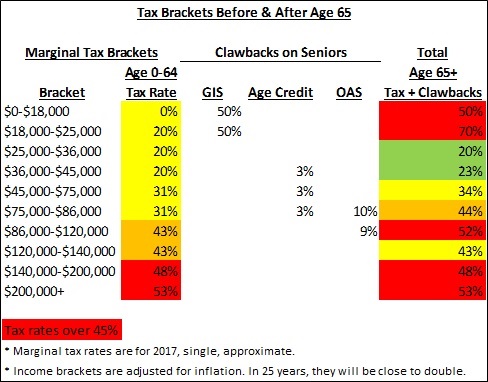
The clawbacks cost you actual money and are the same as a tax. The three main clawbacks are the 50% clawback on GIS for low incomes (under $20,000), 15% clawback on the age credit for middle incomes ($35,000-85,000), and the 15% clawback on OAS for higher incomes ($75,000-120,000).

The chart above shows the actual approximate tax brackets before and after age 65. Check out the tax brackets over 45% in red:

Understand the differences

You can own the same investments in your TFSA as your RRSP. The main difference is that RRSP contributions and withdrawals have tax consequences, while TFSA contributions and withdrawals don’t.

Therefore, the answer to TFSA vs. RRSP is primarily based on your marginal tax bracket today compared to when you withdraw after you retire: Continue Reading…

Banning Investment Commissions – moving beyond “if” towards “how”

On Tuesday,  the Canadian Securities Administrators (CSA) released a much awaited consultation paper, “Consultation on the Option of Discontinuing Embedded Commissions.”

We say “much awaited” half tongue-in-cheek.  Much in the same way that a large number of Canadians have no idea how or how much they pay for investment products / advice, we expect even fewer are aware of the potentially seismic shifts that are taking place in the regulation of investment advice and advisor compensation practices!

As the title of the paper suggests, the regulators are considering banning the practice whereby investment advisors are compensated by investment product dealers directly through the payment of commissions embedded in fees charged on products such as mutual funds, structured products and others.  Conflict of interest is the key issue that the paper’s summary highlights, as follows :

1.) Embedded commissions raise conflicts of interest that misalign the interests of investment fund managers, dealers and representatives with those of investors;

2.) Embedded commissions limit investor awareness, understanding and control of dealer compensation costs;

3.) Embedded commissions paid generally do not align with the services provided to investors.

The discussion is moving past “if” and heading towards “how” embedded commissions should be banned

Continue Reading…

Wealthsimple moves its Robo Adviser service upmarket

Wealth simple founder and CEO Michael Kitchen

My latest Financial Post blog looks at Tuesday’s announcement by Wealthsimple of a new premium service it calls Wealthsimple Black. See Robo-adviser Wealthsimple targeting more sophisticated investors with premium service.

Wealthsimple Black is aimed at investors who have accumulated at least $100,000 in assets with them and brings down the previous annual management fee of 0.5% to 0.4%: a threshold previously reserved for those with $250,000 invested in the automated online investment service (popularly known as Robo Advisers).

The new “premium” service includes personalized financial planning, tax-loss harvesting, tax-efficient accounts and access to more than a thousand airline lounges around the world.

The company now calls the previous version of the service available to investors with less than $100,000 “Wealthsimple Basic.” It charges the 0.5% management fee but manages the first $5,000 for free, and provides automatic portfolio rebalancing and dividend reinvestment, plus “on-demand” advice from portfolio managers.

Wealthsimple is largely a company founded by and targeting Millennials but the new premium service makes it clear it won’t say no to more affluent investors, including soon-to-retire Baby Boomers who are shifting from wealth accumulation mode to so-called Decumulation. In a press release, Wealthsimple founder and CEO Michael Kitchen (pictured above) made it clear the company is now targeting not just young beginning investors but “all investors, no matter how far along they are toward reaching their financial goals.”

Using Monte Carlo Simulations in your Retirement Planning


Wouldn’t it be nice for our retirement planning purposes if stocks consistently gave us eight to 10 per cent returns each year? After all, that’s what stock markets have delivered on average over the very long term.

Indeed, between 1935 and 2016 U.S. stocks returned 11.4 per cent annually, Canadian stocks returned 9.6 per cent annually, and international stocks averaged annual returns of 8.3 per cent.

I have an eight per cent target in mind when projecting investment returns for my own retirement plan.

The trouble is that stock returns are anything but predictable and so while they may average eight to 10 per cent over a 25-or-50-year period, each single year could deliver panic inducing losses, euphoric gains, or something in-between.

Since 1988, the S&P 500 had single-year returns as low as negative 37 per cent (2008) and also gained as much as 37.58 per cent in a single year (1995). Only in three of those 29 years did the S&P 500 deliver annual returns between eight and 11 per cent. The rest of the years are all over the place.

Why does this matter to your retirement planning? Because it’s not enough to just plug “eight per cent” into your retirement projections and call it a day.

What happens if stocks plunge by 35 or 40 per cent in year one of retirement, as they did to those unlucky enough to retire in 2008?

Enter the Monte Carlo Simulation

A Monte Carlo Simulation can reveal a wide variety of potential outcomes by taking into account fluctuating market returns. So instead of basing your retirement calculations on just one average rate of return, a Monte Carlo Simulation might generate 5,000 scenarios of what hypothetically might happen to your portfolio as you draw it down and markets fluctuate.

Let’s look at an example of a 60-year-old who retires with $750,000 invested in a standard balanced portfolio of 60 per cent stocks and 40 per cent bonds. This retiree wants to know how much is safe to withdraw from the portfolio each year and whether it can last 30, 40, or even 50 years.

We can do this with a Monte Carlo Simulation. I used Vanguard’s retirement nest egg calculator. We’ll start with a safe withdrawal rate of 4 per cent per year:

  1. How many years should the portfolio last: 30 years
  2. What is your portfolio balance today: $750,000
  3. How much do you spend from the portfolio each year: $30,000

The results: There’s a 93 per cent probability that this portfolio lasts 30 years.

When I re-run the simulation using a withdrawal rate of 5.3 per cent (spending $40,000 per year) there’s now just a 74 per cent chance the portfolio survives 30 years.

What happens if our retiree lives until 100? We’ll need to make the portfolio last for 40 years instead of 30.

Spending $40,000 each year means the portfolio has only a 62 per cent chance of surviving 40 years. If we go back to our original 4 per cent safe withdrawal rate ($30,000 per year) then our portfolio jumps back up to an 87 per cent survival rate.

In one interesting simulation, I increased the stock allocation to 100 per cent and changed the annual spending to $50,000 (or 6.7 per cent of the portfolio). The $750,000 portfolio has a 50 per cent chance of lasting 40 years. Not something I’d chance to a coin-flip!

How does a Monte Carlo Simulation work? According to Vanguard, they randomly select the returns from one year of the database for each year of each simulation.

Using those values, they calculate what would happen to your portfolio – subtracting your spending, adjusting for inflation, and adding your investment return.

This process is repeated one year at a time until the end of your retirement or until your portfolio runs out of money. After 5,000 independent simulations there’s a broad range of possible scenarios and clear patterns begin to emerge.

Final thoughts

For those of you close to retirement or that have recently retired, I strongly encourage you to speak with your financial advisor about running a Monte Carlo Simulation for your own portfolio using several different inputs that match your goals and projections. DIY investors can find calculators such as Vanguard’s online to run their own simulations.

Err on the side of caution so that you’re comfortable with the outcomes. If there’s only a 50 per cent chance that your portfolio lasts the length of your retirement, that’s not a plan, it’s a gamble.

In addition to running the Boomer & Echo website, Robb Engen is a fee-only financial planner. This article originally ran on his site on January 2nd and is republished here with his permission.



Powered by the Financial Independence Hub.
© 2013-2026 All Rights Reserved.
Financial Independence Hub Logo

Sign up for our Daily Digest E-Mail!

Get daily updates from the FindependenceHub.com straight to your inbox.