
Building Wealth

For the first 30 or so years of working, saving and investing, you’ll be first in the mode of getting out of the hole (paying down debt), and then building your net worth (that’s wealth accumulation.). But don’t forget, wealth accumulation isn’t the ultimate goal. Decumulation is! (a separate category here at the Hub).

The two main types of Financial Independence

By Vicki Peuckert Cook

Special to the Financial Independence Hub

If you are financially savvy and on your way to a secure retirement, you may already know the steps you should take to work toward financial independence. Maybe you’re already there.

But if you are climbing out of debt and just taking control of your money, financial independence (aka “Findependence”) might seem entirely out of reach. If you have kids, focusing on solving your own money problems may be complicated by your concern about their financial future too.

Financial independence means two different things at two different points in life. And they are both significant milestones. You and your adult children may even be working toward them at the same time!

Here are explanations of both kinds of financial independence and actions to consider to make the path to “FI” attainable, no matter where you are starting from.

Becoming Financially Independent from your parents

Adult children who no longer require any monetary support from their parents are financially independent. This doesn’t mean that a parent can’t provide some kind of financial aid if they choose, it means a child can meet their financial obligations without parental help.

With money concerns including five-figure student loans, rising rents, and considerable consumer debt, many young adults face an uphill battle when trying to leave their parents ‘financial’ nest. And parents may also be “sandwiched in” – helping their kids and providing support for aging parents while trying to save for retirement.

For the benefit of everyone involved, parents and adult children have a responsibility to each other to focus on changes and develop a plan to make financial independence a priority.

What can young adults do?

They can learn how to track expenses and make (and stick to) a budget. Making choices like sharing housing with friends and buying used cars or taking public transportation can also help 20-somethings tackle debt.

Over time, increased income from second jobs paired with making frugal choices like cooking at home, can provide the money adult children need to minimize and finally eliminate the need for parents to provide financial support.

What should parents do?

Parents should start setting limits on the assistance they provide their children. And they should work closely with them to create a plan to end all financial support over a set period of time. Parents need to realize they may actually be harming their kids by enabling their kids to make decisions that aren’t always focused on them becoming financially secure.

If a parent always steps in with a solution, their kids may not learn the importance of meeting their needs while putting off wants for the future. And this will only lengthen the time needed to reach financial independence.

Providing advice, emotional support, and helping adult children problem solve money troubles shifts the financial relationship to adults talking, rather than a parent instructing their child on what to do.

Becoming Financially Independent from Work

The other definition of financial independence is one that’s sometimes debated. But there is little argument that it should be a future goal of everyone. In general, reaching financial independence means you have enough income to pay for your living expenses for the rest of your life without having to work. Continue Reading…


Avoiding the “big mistake” — How Evidence-based investing saves long-term wealth

By Steve Lowrie, CFA
Special to the Financial Independence Hub
Buy low, sell high.

Sure, it’s a tired cliché, but it’s actually good advice.  Everyone knows it.  Most of us may even manage to do it by simply leaving well enough alone instead of constantly questioning our investments.  This is especially so if you’ve preceded your inactivity by setting up a solid plan and investing accordingly.

But here’s the challenge: Even the most stay-put investor is still at risk for making that rare “big mistake.”  It happens when seemingly game-changing news tricks you into falling for a different financial platitude: This time is different.

Even if you only deviate from your routine in the face of an extreme event, the financial damage done can last a lifetime.  One of the biggest, most recent anomalies was the Financial Crisis of 2008/2009.  At the time, many investors (and many advisors as well) wondered whether the markets would ever recover.

Although we are almost 10 years removed from this time, it was a highly emotional period for investors.  In fact, one of my favourite financial commentators — Nick Murray — refers to this period as The Great Panic. To put this into context, let me share a few real-life investor anecdotes.

Take “Joe,” for example, who reached out to me to inquire about my services in October 2008.  At the time, Joe had a $2.6 million portfolio.  He had a very stable and successful business and wasn’t planning to tap into his investments for a couple of decades.  His portfolio wasn’t perfect.  Some of his holdings had high expense ratios, and some of them could have been better managed.  But overall, they seemed relatively well diversified and well structured.  He was doing okay.

Still, Joe was thinking about abandoning his balanced approach and moving to cash.  I offered Joe this timeless advice:  When we’re in the thick of a bear market, nobody knows when or how it might reverse course.  But we do know it is highly likely it eventually will: often quickly and without warning.  If you try to time when to be in and out of the market for optimal effect, you must not only correctly guess when to get out, you’ve also got to predict exactly when to get back in.

Cashing out in 2008

So, November 2008 came and, along with it, a second major market drop. This was too much for Joe.  In late November, he called me and told me something like this:  “Thanks for your time.  However, this time really is different, and your history and evidence doesn’t matter.  I have sold my entire portfolio and moved all my investments into cash.”

I don’t know what happened to Joe after that, because we went our separate ways.  In the short run, he was right.  We didn’t know it then, but the third (and final) major drop in the equity markets arrived in January/February 2009.  Using historical index data and assuming a balanced portfolio of 60% Global Equities and 40% Global Bonds, liquidating his portfolio ahead of this final drop “saved” him from a loss in the range of $200,000.

Once again, using index data, had he simply held his portfolio he would have made back the “$200,000 loss” by May/June 2009 and then been almost 20% higher by November 2009.  In dollar terms, that is over $500,000 higher than he was in November 2008.

I doubt Joe had the nerve to reinvest anytime in 2009 …  it’s far more likely he waited until the recovery was in full swing, buying higher than necessary and sacrificing returns that could have been his by simply holding tight.  Or, for all I know, he’s still sitting in cash today.  If so, he has so far given up about $3 million in potential wealth … even after assuming reasonable fees for investment management, financial planning, and (most importantly in Joe’s case) behaviourial coaching. Continue Reading…

New mandatory risk rating is misleading Canadian investors

By Nick Barisheff (Sponsor Content)

Canadian securities regulators may be putting investors at risk. They implemented a new mandatory risk weighting system in September 2017 based on 10-year Standard Deviation. Every Canadian mutual fund and exchange-traded fund (ETF) must now include a risk rating based on the following:

Before implementing this policy, the Ontario Securities Commission (OSC) asked for submissions from the industry. These can be viewed here.

Over 50 submissions were received (mine included.) and out of those, three warned about the deficiency that Standard Deviation does not differentiate between upside and downside volatility.

Scott C. Mackenzie of Morningstar made a particularly succinct comment:

“A conservative investor’s portfolio that is missing a key sector or asset class, essential for prudent diversification (and risk reduction), may demand the inclusion of a small amount of a concentrated sector mutual fund or ETF. A single measure risk score for such a vehicle may be higher than recommended for the investor and they are consequently dissuaded from incorporating it. The irony and potential downside is that the risk of the conservative portfolio may actually be higher than otherwise would have been had the investor included the diversifying investment. “Diversification as a risk-reduction activity is a sensible approach, practiced by many, and supported by decades of investment research.” http://www.osc.gov.on.ca/documents/en/Securities-Category8-

Comments/com_20140312_81-324_mackenzies.pdf

There are two major flaws with the methodology:

  1. It does not differentiate between Standard Deviation and Downside Deviation; and
  2. It measures individual portfolio components rather than the overall Standard Deviation of the entire portfolio.

This policy will not protect investors from experiencing losses, but may prevent investors from structuring portfolios for reduced volatility, optimal performance and effective diversification. The resulting reduction in investment demand in sector funds will result in a negative impact for many Canadian public companies.

The overall weakness of this approach is best exemplified by the fact that Bernie Madoff’s fund had the lowest Standard Deviation in the industry for over 30 years – yet investors lost most of their money.

David Ranson of H.C. Wainwright & Co. published a report entitled “Why Standard Deviation Won’t Serve to Classify the Risk of a Portfolio.” This report details why Standard Deviation is a poor and overly simplistic approach to measuring the risk of a portfolio.

“The riskiness of an investment product cannot be represented by the Standard Deviation (volatility) of its historical returns, or by any other single statistic … On a real risk scale, cash could be assessed as risky and gold as safe.” 

http://bmg-group.com/wp-content/uploads/2017/12/why-standard-

deviation-wont-serve-to-classify-the-risk-of-a-portfolio.pdf

As an example of how flawed this policy is, Morningstar Canada lists 9,412 equity classes of mutual funds. Of these,1,932* have 10-year performance histories. The best-performing fund is the TD Science and Technology Fund, which achieved an 18.00% 10-year annualized return net of MER. A $10,000 investment in 2007 would now be worth $66,554*.

On the other side of the performance scale is the Brompton Resource Fund. It ranks as 1,932*(last) in performance and has experienced a-21.8% annual decline over the same 10-year period. A $10,000 investment ten years ago would now be worth only $643*.

*As of July 18, 2018

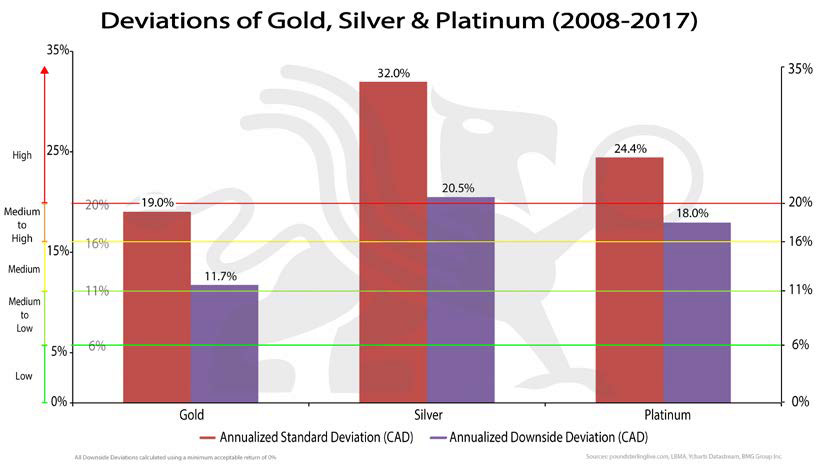
The 10-year (2008-2017) Standard Deviation for the TD Science and Technology Fund is 17.7% (MEDIUM to HIGH RISK) and for the Brompton Resources Fund it is 29.57(HIGH RISK)However, the Downside Deviation is 10.6% (LOW to MEDIUM RISK) for the TD Fund and 25.7% (HIGH RISK) for Brompton Fund.

It should be obvious, even to the unsophisticated investor, that the risk of these funds that are at opposite ends of the performance spectrum is not similar.

This flawed methodology is more pronounced when it comes to physical bullion funds such as the BMG Funds. According to this methodology, the Standard Deviation for gold results in a MEDIUM to HIGH risk rating. Silver and platinum would be rated HIGH RISK.

This new risk rating methodology is in direct contradiction to the suggested risk rating for gold established by the Basel Committee on Banking Supervision (BCBS). BCBS brings together regulators from 28 countries, and establishes rules governing the appropriate level of capital for banks. The current version of these rules, known as Basel III, is a key element of the international regulatory reform agenda put in motion following the global financial crisis of 2008. During the 2008 financial crisis, gold was used in international settlements as a zero-risk asset after many decades of being sidelined in the monetary system. Gold’s old emergency usefulness resurfaced, albeit behind closed doors, at the Bank of International Settlements (BIS) in Basel,Switzerland. Continue Reading…

Italian Economics: Watch Salvini

By Jeff Weniger, CFA, WisdomTree Investments

Special to the Financial Independence Hub

In April, the Italian public was so incensed by the country’s broken government budget, endemic graft and unaffordable inward migration that half of the general election vote went to two protest parties. On the left, the Five Star Movement topped all, with 32% support, while the right-wing League party took 18%. Since then, the League has gathered even more support. Its leader, Matteo Salvini, may now be the most powerful person in Italy.

Salvini’s answer to the European Question

With a wave of migration from North Africa and the Middle East in recent years, Italy finds itself dealing with culture clashes and a scramble to find the money to house and feed the new arrivals.

But amid all the talk of the migrant crisis, what has gone largely unnoticed is that both Five Star and the League have some economic policies that are irrational at best, dangerous at worst. With the news cycle focused on cultural issues, we are wise to remember that Salvini, currently positioned as the champion of nativist Italy, has communist roots. His economic belief system has shifted with age, but this is no solace to EUR longs.

Key planks

The coalition government’s common ground includes overturning the Fornero Law, which increased retirement ages, and putting a universal basic income of €780 (C$1,193) per month on the table. However, the coalition does interestingly entertain the idea of a flat tax. All of these together would conspire to blow out Italy’s 2.3% budget deficit-to-GDP ratio.

Positive backdrop

Italy’s 1.4% GDP growth may be anemic, but it is above water, and high by Italian standards; the norm this century is +0.4%. The manufacturing purchasing managers’ index, at 52.7, has essentially been in nonstop expansion since the first quarter of 2015.1 Unemployment is down to a still-troubling 11.1%, but it was nearly 13% in 2014. Investors must ask: what odd fiscal and/or monetary policies will voters demand if conditions become recessionary?

Start with one such policy, which Brussels fears, that is haunting the bond market and EUR.

The specter of a parallel currency

A “New Lira,” side-by-side with the euro. The state will not come out and say it at the moment, but that’s what the proposal for “mini-BOTs” will mean. If Five Star and the League do go down this path, mini-BOTs would be short maturity debt instruments that can be used to state obligations. On the other side of the ledger, owners of the mini-BOTs could use them to pay taxes. This risk has been haunting the bond market and EUR since the idea entered the conversation in mid-May.

For this privilege 

Figure 1 highlights in green the few bonds that yield more than two-year Canadian sovereigns. Australia and the U.S. generally yield more across the board, but investors have to reach for seven-year bonds in Italy to exceed Ottawa’s 2020 maturities.

Figure 1: Sovereign Yields (Highlighted Green if > Canadian Two-Year Government Bond)

Figure 1_Sovereign Yields

December looms

The stated aim of the European Central Bank (ECB) is to “keep prices stable, thereby supporting economic growth and job creation.” But in the last decade, what mattered is its implicit mandate: keep Europe together. The combination of fuzzier European economic data and the potential for Italian mini-BOTs could cause a “dovish” surprise by the ECB’s Mario Draghi, who is set to end the central bank’s €30bn bond purchase program in December.  Perhaps the surprise is an extension of the bloc’s zero interest rate policy for another year or so. That could harm EUR bulls.

European banks not yet indicating Contagion

One way in which European systemic risks can be priced is via bank credit default swaps (CDS). Figure 2 shows current CDS levels along with the peak fear points of the last five years. Continue Reading…

It isn’t what it used to be: Prospects for interest rates and inflation

When I talk to serious, successful investors, few ask, “Do you think the central banks will raise rates two or three times by a quarter-point before the end of the year?” or “Do you think inflation will hit 3% in the next year?” They are more likely to ask things like, “What are the chances that interest rates and/or inflation will get back up to the peaks of the 1970s/1980s?”

That is a much more important question.  A quarter-point change in interest rates or inflation is a fluctuation. A return to the peaks of the 1970s/1980s would be a disaster.

No one can predict the future, of course. The easy way out on the question would be to say, “Oh no, that could never happen again.” But the productive way to address a question like this is to look at those earlier decades and to try to figure out what was special about them.

It seems to me that in the years prior to those decades, three specific political/economic factors worked together to unlock a lot of pent-up demand for money, goods and services, and funnel it into a narrow timeframe where it could have great impact. These factors helped spur the rise in interest rates and inflation that followed.

The first factor was that, during four decades between the early 1930s and the early 1970s, the U.S. managed to fix the price of gold at around $35 U.S. per oz.

Greenback became a world currency in three crucial periods

This helped set up the U.S. dollar as something of a world currency during three crucial, historic periods: the 1930s depression, World War II and the post-war boom. The role of world-currency issuer let the U.S. expand its money supply without burdening itself with a heavy load of domestic inflation — not burdening itself right away, that is. But eventually the $35 gold peg gave way, like a dam that bursts when the force of a rising river becomes too much. The breaching of that $35 barrier helped set off a worldwide wave of inflation, as the value of the U.S. dollar withered in relation to the value of gold. Continue Reading…