General

A priceless Early Retirement

Billy and Akaisha on Naples, Florida beach

Billy and Akaisha Kaderli

Special to the Financial Independence Hub

Some say it’s impossible.

Others simply dismiss the notion outright even if they are curious. How do we live on less than $30,000 per year while traveling through Thailand, Vietnam, Mexico, Central America and other exotic locations? We don’t give up luxury, nor do we deprive ourselves.

So what is our secret?

Our approach is very simple: We have chosen not to dedicate our time and money to support a complicated infrastructure.

For almost three decades we have wandered the globe living in countless countries. We have purchased new computers and digital gadgets, refreshed our wardrobes many times over, received extensive medical care, and we have biked, hiked, scuba’d, taxi’d, bused, sailed and flown endless miles.

How is this possible?

Downsize the house, car, and Uncle Sam

Our housing expenses include our annual lifestyle fees, maintenance, repairs, and utilities for our home in the States, as well as hotel rooms or apartments we may rent while on the road. To ameliorate this cost, sometimes we house sit. We have been car free for years now, but our transportation costs include airline tickets, visas, passport renewals, taxis, Uber, boats, trains, and tuk-tuks.

If you look at your own expenses, you will see that housing and transportation take a good chunk of your income. Becoming mindful of what goes in to support these two areas of your life will be eye-opening. Take a close and honest evaluation of this state of affairs for yourself. Understand precisely where your money goes and why.

Another area that takes fiscal attention is taxes. Income taxes are something you can control by restructuring your portfolio. Interest from corporate bonds and short-term capital gains are taxed at income rates that are higher than qualified dividends and long-term capital gains [in the U.S.]. This restructuring is something to think about and can save you a significant amount of money yearly.

In most cases, housing, transportation, taxes and food/entertainment are the top areas of cash outlay in a person’s economic life. Modifying any or all of them — which is exactly what we did — will have a significant impact on your annual expenses.

Lunching in Guanajuato, Mexico

High living, low costs

All that being said, we have a great deal of fun living on less than $30,000 per year. Spending wisely, we get the most bang for our buck. For instance, living in a resort location in the States, we have access to a swimming pool, tennis courts, and a workout room without having to lay out cash for their purchase or maintenance. We eat high-quality meats, fish, fruits, and vegetables because we shop at farmer’s markets and watch for the rotating grocery sales to purchase when prices are attractive.

When we visit foreign countries, we live like the locals, eating fresh foods from the open markets, and we rent apartments, house sit or rent hotel rooms by the month. In this way we have maid service, gardeners, Wifi, and no utility expenses.

Walking instead of driving whenever possible, we also choose low-cost entertainment options such as tennis, hiking, biking, swimming, going to museums and art shows, and enjoying local festivals and celebrations. Volunteering for projects wherever we live, this provides us with new learning experiences and a sense of fulfillment. We share time with friends either cooking for them ourselves or going out to lunch instead of opting for higher-priced dinners. And when it’s time to hit the road, we take full advantage of current airline deals and travel packages.

Reaping the benefits of simplicity we place more emphasis on creating a life of meaning rather than a life of “‘stuff.”

Sunset at Naples Beach

What about you?

So you think you can’t make it on $30,000 yearly? How about $60,000 or $100,000 or more? All this means is that your net worth will need to be high enough to maintain these levels of spending.

No matter where you are in this continuum, you can profit from doing any of the following:

Simplify your personal infrastructure

Know where your money is going, and decide whether it’s worth it to you. Do you want to keep up the pace of your current spending? Make your funding priorities reflect your values.

Plan your retirement tax strategy now

Know there is a balance in the exchange of time and money

Do you want more money, or do you want more time? Your choice here will affect your future. Be clear about what you want.

Remember, the best things in life are free

Friendships and connection to society are based more on your attention and time, rather than on your money. Watching the sun set with a loved one — sharing life experiences together — creates memories that will far outlast anything you can purchase.

Billy and Akaisha Kaderli are recognized retirement experts and internationally published authors on topics of finance, medical tourism and world travel. With the wealth of information they share on their award winning website RetireEarlyLifestyle.com,they have been helping people achieve their own retirement dreams since 1991. They wrote the popular books, The Adventurer’s Guide to Early Retirement and Your Retirement Dream IS Possible available on their website bookstoreor on Amazon.com.


Top 10 Rules for successful Retirement Income Planning

By Doug Dahmer

Special to the Financial Independence Hub

As a Retirement Income Specialist, I have spent the past 10 years helping those transitioning from their savings years to their spending years to discover the secrets of how to optimize their future income streams, while minimizing the amount of taxes they pay. These years of experience have provided me with a great number of valuable lessons. I have reduced this learning to a list of top 10 success rules for retirement income planning.

In a world where (unless you work for a government agency – police, nurses, teachers, government employees etc.) the guarantees of a corporately sponsored retirement income stream have virtually gone the way of the dodo bird. Corporate defined benefit pension plans have been replaced with defined contribution plans and group RRSPs.

Upon retirement, the vast majority of baby boomers are now faced with the daunting challenge of determining how to convert a large lump sum of accumulated retirement savings into a recurring income stream that lasts as long as they do. These risks and responsibilities were previously carried out by disciplined and talented pension plan managers. They have now been quietly delegated to the individual – and this has occurred without providing the adequate tools to perform the tasks.

It is my hope that the following 10 rules are helpful to those who have been left to their own devices to cobble together a safe, secure retirement income.

1.) Take ownership in your future success

A plan is not a plan until, the people who have to live with the choices contained in the plan, have played an active role in crafting these choices. The level of commitment one has toward following the prescribed progression of choices contained in the plan is directly proportional to the confidence you have that these choices will lead to successful achievement of the life outcomes most important to you. By taking ownership in your own plan helps keep you focused on the aspects of your life you have control over — choices — while identifying the need to put protective mechanisms place to mitigate the potential damage of events that are beyond your control.

2.) Your Retirement Income Formula is not a static product

Retirement Income Planning is not a “One and Done” event. It is also not an exact science. Every pilot before leaving the ground files a detailed flight plan knowing full well that no flight has ever gone according to plan. The pilot must constantly monitor where they not only relative to their desired destination but also relative to their original flight plan. Retirement Income Planning, like flying, contains no roads to follow or signs to provide directions. Wondering too far off course can lead to mid-air collisions or running out of fuel. Confidence in your Retirement Income Formula comes from testing it, stressing it and constantly re-adjusting it, as life unfolds. Only by engaging in a planning process that evolves with your life, will you achieve success and security. As daunting as this may sound, like filing a flight plan, when you have access to the right tools this task can be made significantly easier.

3.) Link your life plan to your financial plan

The key to financial success in the second half of life is to directly connect your desired life plan to your investment plan. If your money managers do not have an intimate understanding of your year-by-year cash flow demands or the specific portfolios you plan to source these funds from, you are not getting the level of protection – or service – that you deserve.

4.) Create forward knowledge of how much you need and when

Better financial decisions will always be made when you have advance knowledge of the what, the when, and the how much of your desired lifestyle. People who blindly chase the unknown savings target of “more” are the people who make the most financial errors.

5.) Don’t trust your future to outdated ‘rules of thumb’

Conventional wisdom that served past generations well, is no longer applicable. Baby Boomers are in the process of redefining retirement. Governments are having to respond to the financial implications of a rapidly aging society. Within this state of flux, tremendous new opportunities exist for those who find them. Devastating risks await those who fail to recognize the new reality. Probably the largest mistake baby boomers are currently making is the date they choose to start their Canada Pension Plan. A poor start date choice can frequently cost the average couple well over $100,000 over the balance of their lives.

6.) Embrace variables, not averages Continue Reading…

Retired Money: Tontines moving from academia to Retirement marketplace

Annuity and Tontine expert Moshe Milevsky

My latest MoneySense Retired Money column, just published, looks at how the 17th century “tontine” scheme may help solve 21st century angst about outliving your money in Retirement. Click on this headline to retrieve the whole article: Why Ottawa needs to push for tontine-type annuities.

We have described Moshe’s pioneering work in annuities and tontines before: the York University finance professor and prolific author has published entire books on tontines and annuities. As he outlines in Pensionize Your Nest Egg, Milevsky has always emphasized the distinction between what he calls “real” pensions (guaranteed-for-life Defined Benefit pensions) and capital-appreciation vehicles like RRSPs or Defined Contribution plans, which have to be “pensionized” (or “annuitized”)before they can be considered to be “real” pensions.

Milevsky and three fellow Canadian co-authors have just published a paper partially funded by the pension section of the U.S. Society of Actuaries,entitled Annuities versus Tontines in the 21stCentury: A Canadian Case Study. (The other authors are Thomas Salisbury, Gabriela Gonzales and Hanna Jankowski). In it they make the case for the reintroduction of retirement investment income tontines (RITs) into the modern financial supermarket.

For those who haven’t seen the film The Wrong Box, tontines are mortality-linked investments that superficially resemble life annuities but were quite popular in Europe in the 17thand 18thcentury and later America. But they fell into disrepute by the early 20thcentury, in part because of the kind of sordid image they received, often popularized by novels and films like The Wrong Box. The “longest-living” winner takes the pot, which is why creative artists have often used this as a plot device involving skulduggery.

In essence, tontines pool capital and distribute all the capital and investment gains to those who live the longest: those unlucky enough to die early forfeit the capital (i.e. their heirs forfeit it), while those who live the longest benefit with super returns.

While a tontine revival could make sense around the world – the pension and longevity trends are almost universal – they make particular sense in Canada. The authors state they “believe that Canada has a dearth of products for hedging personal risk, compared to the U.S. market.” They know of no Canadian insurance company that offers a true deferred income annuity (DIA or ALDA), not do they offer a variable income annuity or equity-indexed annuities with living benefits: all available in the US. The closest we have are segregated funds, and they really aren’t that great as far as guaranteeing lifetime income, Milevsky told me. Continue Reading…

4 investment strategies every stock investor should consider

By Sia Hasan

Special to the Financial Independence Hub

Portfolio managers and analysts believe that no one investment strategy outweighs the rest. Instead, every game plan has its unique strengths and weaknesses. As such, it’s up to investors to choose the tactic that best works for them. It’s worth taking time to learn to develop strategies if you are considering investing in bonds or stocks. Some of the stock and bond investment strategies include quantitative, algorithmic trading, value investing, growth strategy, GARP investing, and collar options strategy.

Quantitative, Algorithmic Trading

Quantitative, algorithmic Trading involves selection of an investment based on mathematical analysis. In fact, investors don’t need to consider other factors such as how a business operates. All they need is to analyze different variables that correlate with each other to create an algorithm that can help predict how stock or bond prices will change over time. Quantitative, algorithmic trading is one of the newest investment strategies that have become popular in the past few years. It allows investors to engage in different investment styles and come up with a thesis, variables and set of data that they can use to identify and exploit market inefficiencies. It’s up to the investors to develop a model, test it with historical data, and implement it to see if it works. Algorithmic trading is ideal for investors with some mathematical and computer programming background.

Value Investing

Value investing is a strategy where an investor buys stocks that are grossly undervalued. Buying stocks that trade for less value than their net assets and cash profits allows the investor to limit the amount of money he or she could lose on an investment. The strategy is ideal for investors who believe that the market overreacts to emerging trends, resulting in a price decline that doesn’t correspond with an investor’s long-term fundamentals. The stock price could decline beyond its fair value when a market overreacts to bad news. As such, an investor can take advantage and buy stock, and wait for its value to return to its optimal level.

Growth Investing

Growth investing is a more aggressive investment strategy that focuses on capital appreciation. It involves investment in stocks or bonds that exhibit signs of growth even if their current share price seems high. Investors are anticipating that stocks and bonds will grow in value and offset the premium they will pay for the investment. However, this is an aggressive investment approach that investors regard as both highly rewarding and highly risky. Investors have to be confident about the growth and competitive strength of a company to justify that its share value will grow in the future. Growth investing strategy is ideal for futurists who are confident that stocks or bonds will increase in value over time.

Growth at Reasonable Price Investing (GARP)

GARP (Growth at a Reasonable Price) is a hybrid of growth and value investing strategies. However, analysts have often stated that value and growth-based investment strategies are joined at the hip. In fact, there is little difference between growth and value-based investment strategies. The growth of a company will always impact its fair value. It is far better to buy highly valued shares at a fair price than to buy undervalued shares at a lower price. GARP strategies enable investors to identify stocks and bonds that are priced reasonably. As such, they can benefit from the stock’s growth potential as well as enjoy protection against price deviation.

It’s important to note there is no one investment strategy that is best for everyone. What matters is whether the investment tactic is a good fit for your company or not. However, nothing is worse than being inconsistent with each of your investment strategies. You can hardly find the source of error that could be increasing your costs if you invest in different philosophy each time. However, it is vital to minimize your trading costs irrespective of the investment strategy you adopt.


Sia Hasan is a tech entrepreneur by day, and a freelance writer by night. Her passion lies in business technology, efficient and sleek programming, and customer relationship management. When she doesn’t have her nose pressed against her computer screen, you can find her spending time with the loves of her life, her two dogs, Pixel and Vector.

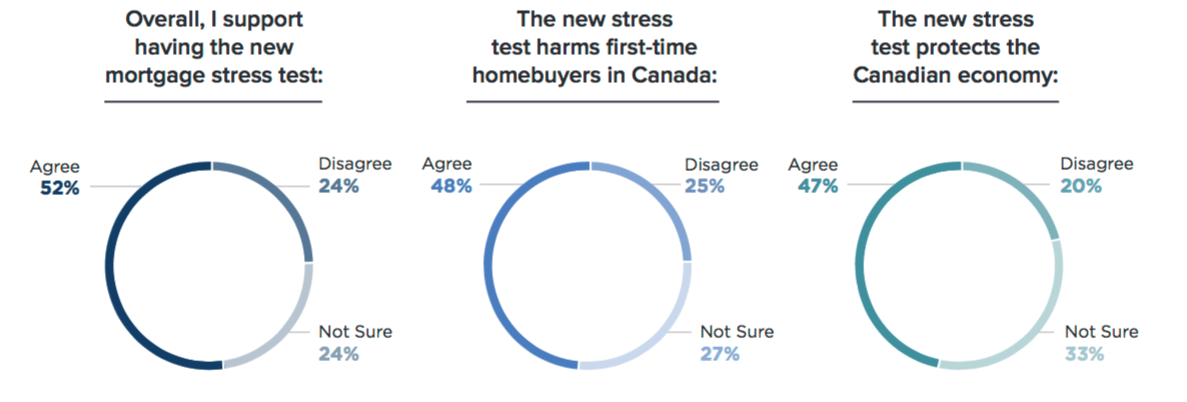
52% of Canadians support new Mortgage Rules

By Penelope Graham, Zoocasa

Special to the Financial Independence Hub

It has now been four full months since Guideline B-20 – a slew of new mortgage qualification requirements – hit Canada’s borrowers in the wallet.

Under the new regulations, those applying for a new mortgage, and who are paying at least 20 per cent down on their home purchase, must qualify at either the Bank of Canada’s benchmark rate (currently 5.14 per cent), or their mortgage contract rate plus 2 per cent, whichever is higher. While the mortgage payments will be made at the borrower’s actual rate, this is the government’s way of shock-proofing lending, ensuring borrowers can still make their payments should rates rise exponentially.

Experts have stated that Guideline B-20 would slash the average home buying budget by 20 per cent, and knock as many as 10 per cent of buyers out of the market altogether. Market conditions have proven softer in the months following the new rule, with national prices falling 10.4 per cent in March, and an exodus from more expensive home types to the lower end of the market, such as condos for sale in Toronto.

But have they truly dissuaded Canadian home buyers from entering the real estate market?

To find out, Zoocasa polled just over 1,400 Canadians from all provinces, as part of the second-annual Housing Trends Survey. Respondents were asked for their sentiments and experiences as a result of B-20, and the overall rising interest rate environment.

Majority not impacted by Stress Test

According to the data, the majority of recent home buyers have withstood the introduction of Guideline B-20 unscathed; of those who purchased a home between October 2017 (when the new rules were first announced) and March 2018, 48 per cent say there was no change whatsoever to their buying timeline.

However, 27 per cent reported they rushed their purchase as a result, while 6 per cent delayed buying. An additional 19 per cent who bought homes weren’t actually aware of the new mortgage rules at all.

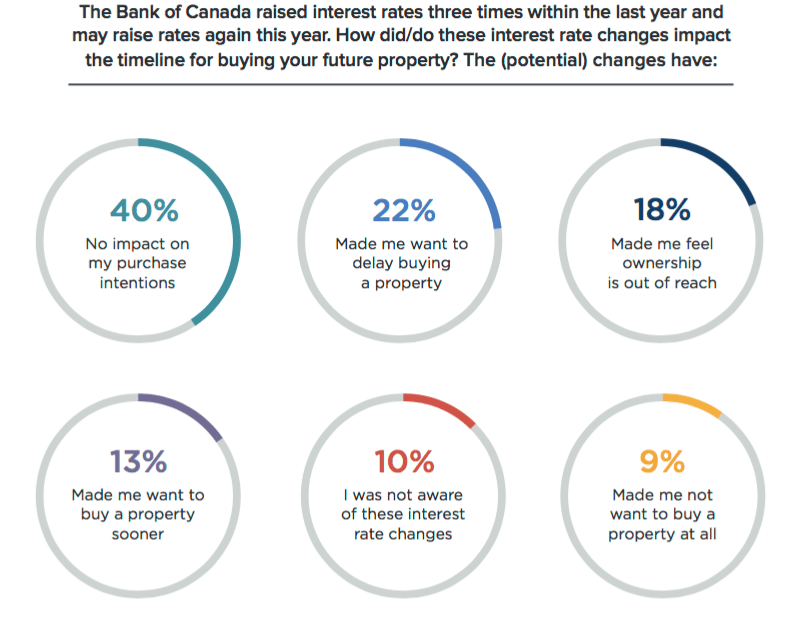
Also, the impact has been more significant on those who have no yet purchased their home: while 40 per cent stated B-20 hasn’t changed their mind about buying, 15 per cent will delay their home purchase, and a full 15 per cent now feel homeownership is out of reach altogether. Continue Reading…