He learned he had non-Hodgkin’s lymphoma, in 2008. (He is now 62).
Mr. Patrick struggled first with the decision about whether or not he should share the knowledge of his cancer with clients. He did and despite his fears to the contrary, none of his clients left as a result of this disclosure. One client even pre-paid, although Mr. Patrick still had to downsize his operation. He had a few employees: one of whom volunteered to leave while another agreed there would be no raise for a year.
Importance of providing clear instructions to spouse
Once it was clear he would be undergoing a (dangerous) stem-cell transplant, he made sure his wife had the paperwork on the life insurance, names of clients and where they could go for alternative service, and how to wind down the business if it came to that. All business owners should have a such letter for their spouse, he says.
After the nine months of treatment, he realized his hopes to immediately resume operating the business at full speed were a tad optimistic. Suddenly, health had become a priority over the business and he realized it would take a few years before his energy levels returned to the point he could work as hard on the business as he had before the cancer revealed itself.
Not coincidentally (given the wide publicity that comes with a story in the Times), his business — Stage 2 Planning Partners — focuses on retirement planning for business owners. I dare say he’s now busier than ever.
I recently connected with Jon Chevreau, who invited me to contribute with a guest blog here on the “Financial Independence Hub”. I am honoured to participate and hope that sharing my financial independence experience will be of value to you.
At the relatively young age of 43, my wife and I were able to leave the full-time workforce. We were fortunate to have achieved this by establishing a financial plan in our early 20s and then selecting investment strategies that could get us to our goals as quickly as possible.
As fresh university graduates, we had very little in the way of assets. We both started in engineering careers in Toronto. We had your typical expenses with a mortgage, two cars and raising two daughters. How did we save enough in 21 working years to be able to have the choice to not work now? The short answer is that we looked for opportunities to ensure that our savings were as high as comfortably possible and then we focused on ensuring those savings were growing well.
Term Financial Independence was less common 7 years ago
When I left full-time employment, over seven years ago, I told people I was “retiring.” The term financial independence wasn’t as common back then. Unfortunately, there is a negative connotation associated with the term retiring. People seem to picture rocking chairs, watching TV and boredom. I pictured free time, skiing, mountain biking, travelling and all the other things you could do in the world if you weren’t working for 40+ hours per week. I had a great job as an Engineering Manager but really enjoyed my activities in my personal time more than work. I think this is common for most of us.
Last year, my youngest daughter started her first full-time job. I realized that if she could learn from our financial journey, it would be a great benefit to her. By passing on many fundamentals learned on our path to early financial independence, she would have a great jump-start in obtaining her financial goals. I decided to write a step-by-step book, in a series of letters, so our daughters would have a good financial education base to start with. During my writing process, I realized that publishing my letters in an e-book that I titled, Destination: Early Financial Independence, could benefit others. The e-book is for both for people starting to invest and for those who have been managing their portfolios for some time. My wife often reminds me she is so grateful that I have documented this for her learning too. I share our personal roadmap from our first jobs to where we are today, managing our own portfolio in retirement with minimal time requirements, yet achieving above-average results.
Our steps can be replicated by others
I always believed the steps we took and the investment process we followed were all quite simple and the outcome could be replicated by others, if they only knew it could be done. When we “retired,” I knew a lot of friends and family thought we were crazy. They were all polite about it, but I could tell from their questions that they didn’t expect us to really stay retired. We would either run out of money or just get bored.
My prior work colleagues started a betting pool as to when I would go back to work. I am happy to report that no one ever won the pool. I wish when I started our financial planning, I had a book I could have referenced that said, “No Ross, you aren’t crazy. Your calculations are correct and you are on the right track. You have actually used conservative estimates and don’t need to worry about running out of money. It’s a beautiful Monday morning, go cycling!”
Fortunately, in the last couple of years, I have come across a number of firsthand accounts of people who have left the work force early, so I am now more confident it is a goal that can also be achieved by others. By documenting and sharing our story, including strategies and processes, I hope you will find many tips that will be helpful towards your Financial Independence!
Below, I have attached the details of how to obtain my e-book, if you are interested.
The book can be read with free e-reader software if you do not have a Kindle or Kobo device. Links to the free e-reader software is at the bottom of this blog.
Ross is a contributing writer for Canadian MoneySaver. Ross and Shal were featured in a Globe and Mail article, “Freedom 55? Couple couldn’t wait that long for retirement,” Oct 22, 2009.
This audio clip is from the More Than Money radio show from Calgary, recorded shortly after the Hub launched. The focus was on a MoneySense blog I’d written after the question “Will your retirement date be a surprise?” was posed in a Sun Life poll. But we also touch on the longevity theme that is the focus of the Longevity & Aging section here at the Hub. There’s also an update on the launch of the Hub and the recent e-books.
When you get to the show’s link, just press the small “Play” icon next to my name, or indeed the same icon next to any of the other guests’ names there.
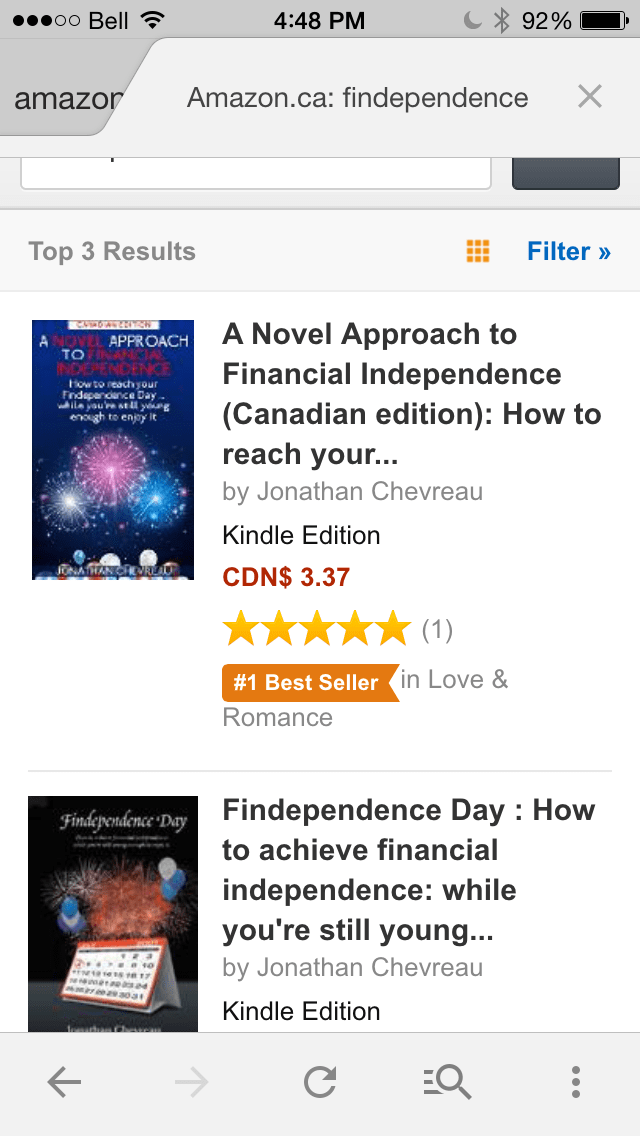
A Novel Approach to Financial Independence is one of the bestselling e-books in Amazon.ca’s Love & Romance category this weekend, as you can see in the screen shot to the right. Here’s the link to Amazon’s listing.
Love & Romance? What about personal finance? Well, I’ve always described the original Findependence Dayas a financial love story so it’s not as out of the box as it may seem at first blush. Click on the red link in the title above to find out more about the Romance plot that’s at the heart of the original novel.
The full book features a couple, Jamie and Sheena, who are 28 at the start and follows their ups and downs as a couple over 22 subsequent years. It takes a “life cycle” approach to personal finance and centers around Jamie’s declaration that he will become financially independent (“findependent”) by the time he turns 50. There are numerous setbacks along the way, including business failure and betrayal, separation, children and more.
As CTV Senior Financial Commentator Patricia Lovett-Reid says in the foreword to both the original book and the e-book, money troubles are often the cause of marital disharmony. You can read that foreword, by the way, for free because it’s near the start and Amazon lets you “look inside.”
e-book is a “Coles Note” synopsis of the novel
I liken the e-book to a “Cole’s Notes” synopsis of the original book, summarizing the plot but focusing more on the content on financial independence. It’s short (15,000 words) but costs only C$3.37. Amazon lets you designate purchases as gifts and with Christmas just around the corner, you have to admit it’s pretty cost-effective! Especially if you can change a young person’s life for the better, as we say in the ad below (also shown on the front page of Findependence.TV).
There is also a U.S. edition of the full novel available here, as well as a U.S. edition of the e-book, which you can find on the main page of this site.
Below is a guest blog by financial educator, Chartered Professional Accountant and money coach Patricia Gass, who tweeted me that “You inspired this” and granted permission to post on the Hub. I do that below with only slight edits and formatting tweaks because I can use all the help I can get at this stage, but please check out the actual blog at Patricia’s site, Let’s Talk About Money. She is @gasspatricia on Twitter.
Let us indeed talk about money! Naturally, I would have preferred that the title were “Findependence is the ‘New and Improved’ Retirement,” but we’ll have to go with what Patricia actually wrote. We can however agree that we both dislike the word Retirement. We suggested during Launch week that the word Retirement should itself be retired!
And that’s how Patricia begins her blog:
By Patricia Gass, CPA, CA
Patricia Gass
I’ve always hated the word RETIREMENT.
For me, this term comes with unpleasant images of failing health, unwanted naps and uninspiring leisure activities without purpose. Ouch! Maybe I’m too sensitive? Maybe it’s because my father lived only a year of his retirement “dream” before his sudden death. And for him, retirement was something he had longed for for quite some time. A hard-earned reward for being a productive and valuable employee for 45 years.
When I voluntarily left my corporate job several years ago, I didn’t know what to call myself. I tried the word “retired” but I would get strange and curious looks from people. “What do you do all day? You look too young to be retired” many would say. While I suppose the latter was meant as a compliment, it still made me feel uncomfortable. Less valuable to society. Idle and no longer needed. I must work on my mindset!
A new life chapter
But here’s the thing; I was happy … VERY happy! I left my job because I had a choice (financially speaking). My job was no longer giving me the satisfaction and fulfillment that I desired. I couldn’t imagine 5, 10 or even one more year of the same stuff. Achieving financial freedom (or close to it) opened up a whole new and exciting chapter of my life. I couldn’t wait to get started!
While I no longer needed to search for paid employment (although a little income is always nice), I knew I wanted to do something meaningful. Does paid employment mean greater value for society? The reality was that I wanted and needed time to figure out what meaningful meant to me. Little did I realize that the opportunity to help people, strengthen relationships, give back or volunteer would give me greater satisfaction than a higher salary!
The Gift of Time
From my own experience, the gift of time is a wonderful thing. That’s what you get when you achieve financial freedom. Money no longer becomes a big factor in your decisions. The world is full of endless possibilities … so many things to see, do, learn, explore and enjoy. Some need money, but not all do.
Financial freedom is a worthwhile goal at any age. I admire the many people today who are doing what it takes to make it happen. Especially the thirty and forty somethings that want it sooner, not later. Maybe one day, it will become fashionable to build wealth rather than spend it?
I think my husband (who is also happily “retired” and proud of it) said it best …
Retirement (aka financial freedom) is about doing more of what you love and less of what you hate.
I couldn’t agree more.
Thanks to Jon Chevreau and his new Financial Independence Hub (worth a visit!) for the inspiration for today’s post.
Proud founder of the blog, Let’s Talk About Money, Patricia Gass, CPA, CA, provides personal finance coaching and education to improve your money skills. Follow her on linkedin, twitter or pinterest.

 Posted By