Not to put any pressure on anyone trying to finish their Christmas Shopping, but Wednesday, Dec. 24 is also the last day Canadians can sell stocks for tax-loss harvesting purposes.
You need three days to settle trades so next week just before New Year’s will be too late. Christmas on Thursday is obviously a holiday and Canadian markets are closed Friday for Boxing Day.
Americans have a little bit longer, since U.S. markets will be open part of the day Friday.
If you missed the one-hour live web chat about Tax Free Savings Accounts (TFSAs) at the Financial Post, you should be able to read the transcript here. It was a fairly spirited chat, seeing as Garry and the Post have been breaking story after story lately about the CRA’s move to audit overly aggressive, excessively traded TFSA accounts with massive gains in them.
At the other end of the scale, and as Garry has pointed out, the big losers in TFSAs tend to be those who take the GIC default products and end up making it paltry 1 or 2% in interest income. Even worse, as GMP Richardson’s Chris Cottier has pointed out, are those making this pittance in the TFSA while paying out upwards of 20% in credit-card charges.
Also on the chat presenting the financial industry’s perspective was Rubina Ahmed-Haq. The chat was sponsored by PC Financial.
Below is the text for a speech I delivered Monday evening at Toastmasters Port Credit. I’ll be devoting some full blogs to Toastmasters in time, probably under the Entrepreneurship section, because it helps people of any age cultivate two critical skills: public speaking and leadership. Since the idea is to speak without notes, my actual delivery was not identical to what you see below. It has been adapted for the blog but in a few days I may put up a video of my performance, which was clocked at around eight minutes. I imagine this expanded version would take 15!
Jon Chevreau (Twitter).
Thank you Mr. Toastmaster, fellow Toastmasters and esteemed guests. As I look around this room, I see a mix of people: everyone from students and those just embarking on the workforce to people who are already retired.
I’ve worked as a financial journalist for more than 20 years and can tell you the word Retirement is a favorite word of both the financial industry and the media. It’s a handy way to depict a far-in-the future “dream” that conveniently helps banks, mutual fund companies, insurance companies and others sell various financial products, from funds to annuities. And we in the media are almost as fond of the term retirement: I’ve seldom witnessed a newspaper, magazine or web site that turned away financial advertising!
I’m 61 and you could call me semi-retired. But my message to the younger people in the audience, and even some of the middle-aged ones who fear they’ve not saved enough, is FORGET RETIREMENT!
Is this heresy? Not at all. Because there is a better term: Financial Independence. As some of you may know, a month ago I launched a new web site called the Financial Independence Hub and everything I’m saying here can be found at the site.
XY Planning’s Alan Moore
In fact, it includes a guest blog by Alan Moore of XY Planning Network in the US who posted a blog on exactly the topic I’m talking about here. The X and Y refers to Generations X and Y, so he is providing financial planning advice to millennials and young people. And he too is telling them to forget about retirement but instead to seek Financial Independence.
Aren’t the two terms the same thing? Not really. To me, Retirement is the full-stop retirement our parents or grandparents enjoyed if they were lucky. They got a job out of college, enrolled in a Defined Benefit pension that guaranteed a certain steady future stream of income, hung in for the gold watch for 30 or 35 years, then retired at the traditional retirement age of 65. They could now watch day-time TV, golf, nap, play bridge or putter in the garden to their heart’s content for a decade or three. This is what I call the “full-stop” sudden retirement.
Perhaps some of you here are now enjoying such a retirement. Like Mark over there.
Show of hands: how many of you younger people here think they’ll be able to rely on a DB pension when they’re as old as Mark or me? And how many think they’ll stay with a single employer long enough to collect a big enough pension that they’ll never have to work again?
To the young, Retirement is a remote unattainable concept
The problem with the term Retirement is that it seems so terribly far away for young people. The official retirement age keeps rising: it’s now 67 for younger folk instead of 65, if you’re talking about the eligibility age for Old Age Security, and I wouldn’t be surprised if it reached 70 at some point. So telling a 20-year old they should cancel their SmartPhone service in order to save money for a retirement half a century away is hardly an inspiring message, is it?
But that’s what all the retirement peddlers want you to do: put away 10% or preferably 20% of your income by practicing delayed gratification. They may tell you that you’ll need a million dollars or more in order to retire one day. Too often, sadly, young people hear that and figure it’s so impossible they may as well give up and spend it while they have it.
In other words, they are telling young people that in order to enjoy a decade or two of leisure when you’re old and grey, that you need to deny yourself pleasures like travel or eating out while you’re enjoying your youth.
Let me tell you, any of the grey hairs here would probably love to take their retirement savings and use it to book passage on a time machine that would let them relive the Swinging Sixties. If you’re 20 today, I imagine that your 70-year old future self would feel the same way about your life right now.
A more attainable goal
So what do I suggest as a substitute for the word Retirement? I call it Findependence, which is just a contraction of Financial Independence. I’ve written a book, Findependence Day, which is just the day you’ve reached Financial Independence. The ebook I talked about in my third speech here is a sort of “Coles Notes” summary of that book.
Financial independence is generally used to describe the state of having sufficient personal wealth to live, without having to work actively for basic necessities.[1] For financially independent people, their assets generate income that is greater than their expenses.
In practice, I think this means being able to survive without the single stream of income most call a full-time job.
Leaving the nest at 27 is NOT Financial Independence!
Defined this way, Findependence can occur decades before the traditional Retirement, so it’s a goal that young people may find is more worth shooting for. Interestingly, last week I blogged at MoneySense and at the Hub about a study about young people and their financial readiness to leave home. They used what I consider an incorrect definition of financial independence: that if they left the nest and stopped depending on the Bank of Mum and Dad, that they were therefore financially independent. If they could get a job and pay their rent, that was the definition, which resulted in the absurd headline that most millennials hope to be financially independent by age 27.
I don’t think so. Even with DB pensions, the earliest most people aspired to Financial Independence was 55, which is the earliest some pensions permit early retirement. Anyone hear of Freedom 55? That London life campaign was one of the most successful sales pitches for Early Retirement. Yet only a few government workers or business executives who strike it rich ever retire that early.
Why do billionaires keep working?
Why is that billionaires like Warren Buffett continue to work? Or young tech entrepreneurs like Mark Zuckerburg? Don’t you think Zuckerburg, who’s all of age 31 or so, couldn’t be findependent by now? Obviously, they have passion and are driven by purpose.
What does that tell you? Age 55 is way too young to “retire’ in the classic sense of doing nothing: playing golf, watching daytime TV, reading all day. Yes, many people THINK they’ll travel all the time once they retire but as I wrote on another blog last week, travel is overrated and expensive, and is really something you would only want to do some of the time, not ALL of the time.
Integrating the Three Boxes of Life
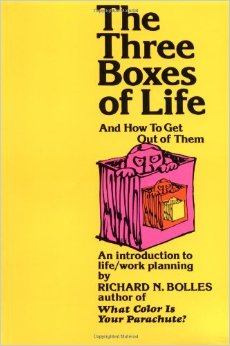
Findependence is about integrating education, work and play. On my sister site, Findependence.TV, I’m interviewed about a concept called The Three Boxes of Life, which is the title of a classic book by Richard Bolles. In the old days, we started life in the first box, Education, spent 15 or so years there, then graduated to the second box, Work. We stayed there for 35 to 50 years, and then came traditional Retirement, the third box of total play and leisure.
On the video, I talk about there being really only a single day: you work a bit each day and make money, you learn a bit each day and at the end of the day, you may “play” by getting some exercise, reading, watching TV or whatever.
On the site, there are blogs on concepts like mini-retirements and the four-hour workweek. Wouldn’t it make more sense to take the occasional mid-career sabattical or series of three-month vacations earlier in life, rather than saving it all for ten or 20 years of doing nothing when you’re too feeble to appreciate it? That’s why the subtitle of Findependence Day as well as The Financial Independence Hub is “While you’re still young enough to enjoy it.”
Plan for Longevity, not Retirement
Meta celebrates her 98th birthday. With Alizon Sharon (c) and Ruth Snowden (r).
Life expectancies are on the rise because of advances in medical science and more of us are practicing better health habits, with a focus on proper diet and exercise.
We can all expect to live a lot longer than we once thought, which is why the “Hub” ends with a section on Aging and Longevity. There you’ll find some blogs by Mark Venning of ChangeRangers.com, who coined the phrase “Plan for Longevity, Not Retirement.” I think it’s a great concept.
And it isn’t just a theoretical concept. On Sunday, we had a dinner party for a female friend of ours who celebrated her 98th birthday. She showed us a custom-printed card from – get this – her co-workers. You see, Meta still works two half-days a week at a local printing company. So she still spends a little time in the Work box. She also reads a lot, swapping books with my wife (Ruth, above), so part of her days are in the Education box. And she still travels and parties, so that’s the Leisure box.
The Globe and Mail has won the financial publication of the year award presented by the CFA Society of Toronto, which represents chartered financial analysts.
The award, only in its second year, is given to the Canadian publication whose work “helps consumers and advisers to gain a better understanding of the investment profession.” Other finalists were MoneySense and Canadian Business magazines, both published by Rogers Media. Here’s the Globe’s version of the announcement.
Two MoneySense writers won individual awards: Retirement columnist David Aston was named Journalist of the Year while MoneySense senior editor Julie Cazzin won the new Spirit of the Future of Finance Award. Here’s MoneySense’s version of the announcements.
I didn’t attend this year but Morningstar’s big annual gala that mostly pays homage to actively managed investment funds was held Wednesday night. As Morningstar reports here on its site, Morningstar analysts chose Calgary-based Mawer as fund company of the year for the second year running. It also won several individual awards.
Edgepoint’s Tye Bousada and Geoff MacDonald won foreign equity fund of the year.
Advisors voted (for the fourth year in a row) for Fidelity Canada as the Advisor’s Choice Fund Company of the Year.
Sun Life Financial won the IFIC Invesor Education Award.
In a posthumous award, Raymond Chang of C.I. won the Career Achievement award.
ETF skunks at the party?
Despite all the attention lavished on actively managed mutual funds and pooled funds, ETFs do get a cameo role. Vanguard Canada was awarded ETF Provider of the Year, while BlackRock Canada’s iShares won Best ETF Initiative for its iShares core series of ETFs.

 Posted By
  Not to put any pressure on anyone trying to finish their Christmas Shopping, but Wednesday, Dec. 24 is also the last day Canadians can sell stocks for tax-loss harvesting purposes.