Decumulate & Downsize

Most of your investing life you and your adviser (if you have one) are focused on wealth accumulation. But, we tend to forget, eventually the whole idea of this long process of delayed gratification is to actually spend this money! That’s decumulation as opposed to wealth accumulation. This stage may also involve downsizing from larger homes to smaller ones or condos, moving to the country or otherwise simplifying your life and jettisoning possessions that may tie you down.

Retired Money: Is your pension covered by a Pension Guarantee Fund?

My latest MoneySense Retired Money column just went up and covers the subject of  a Pension Guarantee Fund for employer-sponsored Defined Benefit pension plans. The United States and United Kingdom both have versions of these but as the piece points out, the only Canadian province to have one is Ontario.

Click on the highlighted headline to access the full article: What to know about the Pension Benefits Guarantee Fund.

Earlier this year, the Ontario Government announced that its Ontario Pension Benefits Guarantee Fund (PBGF for short) was boosting the amount of guaranteed pension (should a plan go bust) from the previous $1,000 a month to $1,500 a month. But as I point out, depending on how a plan is funded, because of partial payouts in the case of plan insolvency, this actually means pensioners are protected for somewhat more than $1,500 a month.

So, according to my sources, in the case of a pension fund that’s 50% funded on windup because of a bankrupt plan sponsor, someone with a $3,000 monthly pension would receive $1,500 from the funded part of the $3,000 pension, plus $750 from the PBGF, which tops up the unfunded part of the first half of the pension.

Established in 1980, Ontario’s PBGF covers more than 1,500 DB plans and 1.1 million members in the province. Participation is mandatory for most DB plans registered in Ontario. As the article notes, the amount of protection is somewhat less than in the US and UK: the US one covers a whopping $5,000 a month. Even so, $1,500 a month sure beats the non-existent guarantees of the other nine Canadian provinces.

What if your pension is not covered by a PBGF?

One source in the article suggests that those in pension plans carefully scrutinize the solvency of their employers’ plans. And if you’re in a DB plan and don’t have any PBGF, you might consider taking the commuted value and rolling it into an RRSP or equivalent vehicle, where you’d have more control over the fate of your retirement funds.

Continue Reading…

My RRIF playbook: what you need to know in 2017

“Retirement at sixty-five is ridiculous. When I was sixty-five I still had pimples.” — George Burns (1896–1996) Comedian, actor, singer and writer

There are three retirement accounts everyone ought to understand. They are the RRSP, the TFSA and the RRIF (Registered Retirement Income Fund).  I submit that the early part of each year is preferred to review the RRSP and TFSA. That leaves the RRIF to be dealt with well before year-end.

Start paying special attention to planning the RRIF, even if you don’t yet need one.

Be very mindful of the RRIF. Recognise its purpose and how it complements the other two accounts. Review it periodically to ensure it stays on track.

The RRIF is firmly entrenched as a prominent retirement planning vehicle, serving as an essential foundation of retirement nest eggs. For example, starting a RRIF at 71 implies long planning, often to age 90 or more: especially if there is a younger spouse or common-law partner.

Three conversion choices for RRSPs

RRIFs typically result from the aftermath of mandatory RRSP conversions. Three conversion choices include cashing the RRSP, purchasing a variety of annuities and using the RRIF account. The RRIF is most popular because it provides considerable flexibility. Avoid cashing RRSPs.

Continue Reading…

5 common senior financial traps and how to avoid them

Scott Terrio’s Twitter feed (@CooperTrustee) reads like a financial horror story. Terrio, an insolvency expert at Cooper & Co. in Toronto, uses the 140-character medium to share the multitude of ways seemingly well-off Canadians end up buried in debt and turning to debt consolidation, consumer proposals, and even bankruptcy.

Canada’s record household debt levels have been a cause for concern for years, but Terrio sees a new problem on the horizon. Canadian seniors are the demographic increasing debt at the fastest rate.

Take Dorothy, an 81-year-old widow who owns a home with a 1st mortgage from a secondary lender. She refinanced a couple of years ago to do house repairs ($18,000), assist her son with divorce legal fees ($37,000), and to help her grandson with tuition ($8,500).

When her partner died she was no longer able to make the mortgage payments. A friend from church referred her to a mortgage broker.

The broker suggested a reverse mortgage,  which would let her stay in her house without the monthly mortgage payment. But the money from the reverse mortgage wasn’t enough to pay out the 1st mortgage after fees and penalties. She needed a private 2nd mortgage at 12 per cent to pay the balance.

Dorothy co-signed a $26,000 car loan for her nephew and co-signed with her son for funeral expenses ($12,000) for her partner. Her son stopped paying, so Dorothy was pursued (100 per cent).

She then ran into tax trouble by not having tax on her OAS & CPP deducted for the first few years. She owes $21,000 in tax, much of it penalties and interest.

This scenario is becoming more common among seniors today.

“Many are in a unique quandary. They’re asset-rich, but cash-poor. Cash flow is tight. Pensions are fixed, and many have underestimated retirement costs,” said Terrio.

So what do they do? Many seniors cash out assets to make ends meet. Others raid their home equity and take out lines of credit. All have financial consequences.

We asked Terrio to share the top financial traps seniors fall into and how to avoid them:

1.) Tax problems

Most seniors were used to being paid by their employers in after-tax dollars. At pension time, many don’t have taxes deducted to offset their Old Age Security and Canada Pension Plan income and therefore end up spending taxable pension income.

Continue Reading…

Liberal tax policy: a question for Canadian voters

The second PM Trudeau

By Trevor Parry

Special to the Financial Independence Hub

Prime Minister Justin Trudeau, in his dogged defense of what are the most fundamental tax proposals made since the report of the Carter Commission (which gave us our modern Income Tax system) claimed last Thursday that it is wrong that someone earning $50,000 a year as salary pays more in tax than someone earning $300,000 in their corporation.

Many tax professionals have dissected this ridiculous statement and could in considerable detail discuss where Mr. Trudeau was in error.  In simple terms Mr. Trudeau would have you believe that the corporate shareholder lives in a different world where they are not affected by personal taxation.

According to the Ernst & Young tax Calculator an Ontario resident earning $50,000 would pay just under 30% on their income or $8,311 in taxation. The Ernst & Young Tax Calculator can’t factor in the value of a company or government funded health benefits program or pension plan.

If we turn to the corporate tax result, an active business earning $300,000 of profit in Ontario would be subject to taxation at 15%.  We don’t need a sophisticated tax calculator to determine that this equates to $45,000.  One should be baffled.

Corporate income also attracts personal taxation

Mr. Trudeau also is comparing apples and oranges.  Does the entrepreneur who owns the business pay themselves anything? Regardless of whether they take income as salary or dividends it will attract personal taxation.   Let’s say that they took a salary of $50,000, the same as Mr. Trudeau’s downtrodden employee.  They would also have paid $8,311 in tax.

They might have had to pay themselves considerably more in order to afford an RRSP contribution, as it is highly unlikely they have a pension plan in place.  If they decided to invest that $300,000 in their corporation any income or growth on that asset would be taxed almost at the same rate as an individual and when they withdraw the money as a dividend they would pay tax at the rate of 45.3%.

Perhaps the shareholder is as malevolent as Mr. Trudeau and “Red” Billy Morneau believe and they are deducting all of their lifestyle costs, including mortgage, food, transportation, vacations, toothpaste, etc. as a corporate expense.  They would be guilty of tax evasion and the Criminal Code has provisions for dealing with that.

Continue Reading…

Two notable books to guide your ‘Retirement’ journey

“Books are the bees which carry the quickening pollen from one to another mind.” — James Russell Lowell, poet and author

This week I highlight one of my best recommendations for Retirement. Invest in self-education with some quality reading. The critical factor is how to select just a couple of books.

Investors have a thirst for knowledge about their precious retirement journey. They seek detailed information to assist in navigating the capital accumulation process to achieve retirement. Then comes the desire of making that capital outlast the spending phase.

Walk into any well-stocked bookstore and the retirement section will seem like a maze. There are plenty of titles competing to become permanent occupants of your precious bookshelf space.

My two book selections provide insight and understanding into the design and management of the retirement nest egg. The authors are well known. The books complement one another.

The emphasis is understanding long-term principles, policies and best practices that steer the family’s retirement goals from dreams to realities. Getting fully acquainted with these two books helps craft better decisions about retirement. Something for everyone’s retirement toolbox.

Photo: Kia Meiklejohn

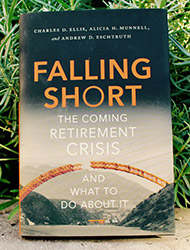
Falling Short: The Coming Retirement Crisis and What To Do About It, by Charles D. Ellis, Alicia H. Munnel, and Andrew D. Eschtruth

This century has clearly shown that we are living longer, health costs are rising and employer pensions are diminishing. That is the big picture applicable to retirees in the USA. However, similar arguments also exist for the Canadian retirement landscape.

The good news is that what is seemingly a dire retirement situation can be easily rectified by implementing a few coordinated steps. This book makes you appreciate the scope of that big picture. Working a little longer, saving a bit more, judicious use of government benefits and being smart about portfolio draws are some of the key answers that deliver.

The message for every retiree is that a successful retirement is about being empowered to look after the personal situation. At age 60, it is not unusual for retirement to last into the 90’s for at least one spouse.

Yes, long term retirement that spans decades is expensive. Sensible and methodical decision making is sound advice for all ages. It renders the scope of the big picture into realistic solutions.