
Victory Lap

Once you achieve Financial Independence, you may choose to leave salaried employment but with decades of vibrant life ahead, it’s too soon to do nothing. The new stage of life between traditional employment and Full Retirement we call Victory Lap, or Victory Lap Retirement (also the title of a new book to be published in August 2016. You can pre-order now at VictoryLapRetirement.com). You may choose to start a business, go back to school or launch an Encore Act or Legacy Career. Perhaps you become a free agent, consultant, freelance writer or to change careers and re-enter the corporate world or government.

Get ready for the shift: the Future of Work

TheShiftA big aspect of planning for retirement is health and longevity. Back in the summer, I devoted a blog at the Hub’s sister site to Mark Venning of ChangeRangers.com. Venning helps clients prepare for two things: making the shift from employment to entrepreneurship, and also to help prepare for a future of extended longevity and life expectancy. That’s “why the word ‘Retirement’ doesn’t work for me. It’s about longevity planning,” he told me, “My core message is plan for your longevity, not for retirement.”

That’s one reason the Financial Independence Hub includes sections both on Entrepreneurship and Aging & Longevity. But we’re not just a site for the Boomers: we take an “Ages & Stages” approach to financial independence, starting with material for Millennials and their focus on debt reduction, family formation and home ownership. Then by the time we reach those in mid-life (call them Gen X if you will), the focus is on Wealth Accumulation.

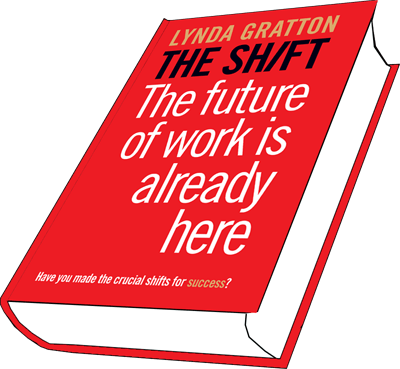
One of several book recommendations from Venning to his students — many of them terminated from full-time employment — is a book by Lynda Gratton called The Shift: The future of work is already here. It’s not brand new: my copy was published by Harper Collins in 2011. But it’s still relevant, especially to the generation of baby boomers, myself and Venning included, who are grappling with the issues of retirement planning.

Gratton, who is a business school professor, identifies five forces that are shaping the world of work, plus three “shifts.” They’re all worth summarizing here.

The 5 forces shaping our future

1.) Technology
2.) Globalization
3.) Demography and Longevity
4.) Society
5.) Energy Resources

The 3 shifts

1.) From shallow generalist to serial master
2.) From isolated competitor to innovative connector
3.) From voracious consumer to impassioned producer

For baby boomers and others who are nearing retirement, or moving into semi-retirement or self-employment, almost all of these forces and shifts need to be taken into consideration. In earlier blogs like this one — Never Work Again — we looked at the revolution in Internet marketing, which is based on both the Technology force and Globalization. When you can run a web-based business from anywhere in the world merely with a laptop computer and a smartphone, you know you’re embracing these forces.

Gratton’s points on demography and longevity seem particularly apt: this was the topic that most fascinated the team of researchers she tapped into for the book. “We quickly understood that technology is changing everything and will continue to do so, and that natural resources are depleted and carbon footprints must be reduced,” she writes. But demography and longevity “is intimately about us, our friends and our children … It’s about how many people are working, and for how long.”

 
The dark side: some boomers will grow old poor

In 2010, when Gratton was writing the book, there were four distinct generations in the workforce: the Boomers’ parents, the Boomers, Gen X (born between 1969 and 1979) and Gen Y (1980 to 1995). And coming up is Gen Z, born after 1995. Gen Y will be ascendent in the workplace by 2025 but increasing longevity means the Boomers and Gen X will still be hanging around, wanting to work and contribute in some capacity well into their 60s, if not beyond. Gratton also warns that “some baby boomers will grow old poor,” particularly if they don’t respond to the gift of extended longevity by embracing the forces and shifts that are confronting them.

laptop-millionaireBecause of globalization and technology, the privilege of being born in North America may no longer be sufficient advantage for those who don’t embrace The Shift. Books like The Laptop Millionaire describe how those with wealth can take advantage of outsourcing: for example, hiring English-speaking Filipinos as full-time virtual assistants for something like $250 or $300/month.

There is a dark side to these shifts: those not equipped to embrace change increasingly will have to compete for jobs or contracts with people half a world away who are technologically sophisticated and willing and able to work for much less than North Americans.

Gratton devotes big chunks of the book to fictional scenarios of the near future of work, some of them pessimistic, some of them optimistic. All in all, it’s well worth reading. It reinforced my own belief that “If you’re not sure whether you should retire or can afford to do so, then just keep working, preferably in a congenial line of work you can continue to practice well into your 70s.”

My road to Findependence: Guest Blog by Sheryl Smolkin

sherylholdingrufus.
Sheryl Smolkin and Rufus

By Sheryl Smolkin

Special to The Financial Independence Hub 

Almost 10 years ago, at age 54, I took early retirement from my job as a pension lawyer and Canadian research director of an international benefits consulting company. I locked the door of my downtown office for the last time on a Friday; on the following Monday I started my new career as editor-in-chief of an industry magazine.

My new job paid only about one third of what I earned before, but I left with a defined benefit pension (albeit reduced by about 30%) and retiree health benefits so I was prepared to take the risk in order to try something new.

With the benefit of hindsight, I can say it was a totally audacious move. I knew how to write peer-reviewed, factual client publications but didn’t have a clue about the economics of running a trade magazine or how to turn a bunch of disparate articles into a cohesive product.

Hard work but fun, and I learned fast Continue Reading…

Entrepreneur videos feature Chilton, Joyce, Laliberte

Good piece in Monday’s Entrepreneur section in the Post by Rick Spence (@rickspence on Twitter.) Rick describes a new series of videos from the Canadian Foundation for Economic Education, which seeks to raise financial literacy. The videos are each five or six minutes, and are entitled Entrepreneurship: The Spirit of Adventure. Initial interview subjects include David Chilton (@wealthy_barber) , Cirque du Soleil founder Guy Laliberte, and Tim Hortons co-founder Ron Joyce.

The new series follows one 20 years earlier, also created by CFEE president and financial literacy guru Gary Rabbior (@cfee1).

Teachers can stream the new video series here.

Catch the Wave: Cloud-based accounting

home-multiscreens-2By Jonathan Chevreau

The book The E-Myth Revisited makes some amusing points about small business owners. Almost to a man (or woman), they loathe accounting. They may enjoy marketing or creating new products or services, but keeping track of expenses, invoicing and the like? It’s the last thing they really want to do, which leads to the usual habit of procrastinating by shoving paper receipts into the proverbial shoe box, then presenting the whole shooting match to their accountant once a year.

But no accountant I know will accept such an arrangement, or if they do they’d have to charge a prohibitively high rate for the service. In practice — and I base this on running a personal corporation since 1999 — you at least have to put all the receipts and paperwork into folders representing the major expense categories, then summarize it all on a spreadsheet so the accountant can make some sense of it.

At one point, I experimented with shrink-wrapped accounting software, which typically cost a few hundred dollars. But I was never comfortable with it so stuck to the shoebox-and-spreadsheet routine. Until this summer, when courtesy of the very helpful folks at Knightsbridge, I discovered Accounting by Wave.

This software has several good things going for it. First, it’s free. Second, it’s cloud-based, so you can store all your info on “the cloud” and access it from whatever computer you have access to: there’s even an iPhone app. Third, it’s Canadian. And fourth, it’s relatively intuitive and easy to use. What more do you want?

Not surprisingly, the software has 1.5 million happy users, most of them the small businesses, consultants and freelancers the company has targeted. And wouldn’t you know it, right off the topic they promise “shoebox accounting stops now.”

Integrated with your business bank account

The software lets you input your corporate bank account information so right off the bat payments to your account and disbursements from it are automatically recorded. You’ll have to spend some time reconciliation expenses incurred via credit cards, cash disbursements and the like but an hour spent every week or two should suffice for most home-office setups like mine. And it sure beats dreading the annual spreadsheet ritual!

The software is quite proficient at keeping track of customers and invoicing, and it generates various reports on demand that show the current expenses, payments and accounts receivable. And yes, it lets you add HST. Again, there’s an element of garbage in, garbage out here, so the reports will only be meaningful if you’re staying on top of all the transactions and properly categorizing them.

How does this relate to Findependence Day?

Glad you asked! If you’ve followed this blog since May, you’ll know I believe in creating multiple streams of income, whether you’re gainfully employed, semi-retired or even fully retired. Part of that is Internet-based: refer to Robert Allen’s book, Multiple Streams of Internet Income, or any of the three books by Scott Fox. (His site is here, and latest book here).

But the other piece of the equation is running your own business and keeping track of all the moving pieces. As I’ve come to appreciate, a traditional “job” really comes down to serving and satisfying a single client, which in practice means “your boss.” The traditional corporate or government job largely shields the employee from accounting: all you need to worry about is submitting the annual T-4 slip with your annual tax return, claim the usual deductions and hope for a tax refund at the end of it.

The good thing about self-employment is that (hopefully) you don’t have any boss but yourself and instead of one huge mega-client, you have many smaller clients. You may lose one from time to time but the others can keep the ship afloat until another replaces it.  Seen that way, a “job” is the opposite of diversification: you have all your eggs in one basket and if your boss decides to smash that basket, you’ve got trouble.

This cloud-based software is a real boon to keeping on top of your business. Hopefully, all your earned income from multiple clients or products or services constitute a major part of your revenue stream. Of course, you should also have investment income, emergency savings and pension income (depending on your age), so that your “Findependence” isn’t riding on any one of these.