Hub Blogs

Hub Blogs contains fresh contributions written by Financial Independence Hub staff or contributors that have not appeared elsewhere first, or have been modified or customized for the Hub by the original blogger. In contrast, Top Blogs shows links to the best external financial blogs around the world.

Here are a million reasons to ignore 5 popular RRSP myths

A lot of Canadians seem to be harbouring misconceptions about the value of RRSPs (Registered Retirement Savings Plans) but I can give you a million reasons why it’s dangerous to believe the  five popular RRSP myths.  My latest two blogs in the Financial Post this week explain why.

In Thursday’s Post, also published in some regional dailies, I described how young people can easily save a million dollars as long as they start early enough. Click on the highlighted text for the online link: How to build a million-dollar RRSP: it isn’t as hard to get there as you think.

Yes, it’s the old story of disciplined saving year in and year out, and the magic of compounding, all aided by the lure of an upfront tax refund and a multi-decade deferment of taxes. Of course, eventually it will be time to draw an income and pay some tax on the RRIF but that’s a story for another day.

Whether a million is enough is open to debate but with today’s paltry interest rates and rising expectations for long lives, the need for annuities or some form of longevity insurance has become urgent. More on that shortly.

Exploding 5 RRSP myths

This morning, Friday,  the FP also ran a blog by me commenting on tax guru Jamie Golombek’s debunking of five common myths average investors harbour about RRSPs. You can find Golombek’s column here: The 5 biggest RRSP myths Canadians can’t stop repeating.

My take on it and a CIBC poll that accompanied the report, can be found here: Almost 40% of Canadians see ‘no point’ in investing in RRSPs — Here’s why they’re wrong.

In short, Golombek and I agree that the RRSP makes a lot more sense than investing only in taxable (non-registered or “open”) accounts. And while the TFSA is a compelling alternative to RRSPs for young people in low tax brackets, or for low-income seniors counting on living on Old Age Security, for the vast majority of middle- and upper-middle-income private sector workers lacking a Defined Benefit plan, the RRSP remains an essential tool for building wealth.

And as I also point out, if you’re in a high tax bracket, you don’t have to choose between an RRSP and a TFSA: you should maximize both!

Sizing up the Size Factor


Small-Cap Growth & Small-Cap Value begin to diverge in 2015

By Chris Ganatti, Wisdomtree Investments

Special to the Financial Independence Hub

It seems like everywhere across the investment landscape in these days there is talk about “factors.” While this isn’t necessarily a new discussion (research has been done for decades regarding the drivers of excess returns within equities), it is easier than ever to pick and choose the factors to which you would prefer exposure.

Size: popular but volatile

When people get excited about changes — changes in policy, changes in growth expectations, changes in political leadership — we’ve tended to see this excitement show up in the behavior of small-cap stocks. We saw this most recently during the “Trump trade,” with the bulk of the performance response coming between the November 8, 2016, election victory and the January 20, 2017, inauguration.

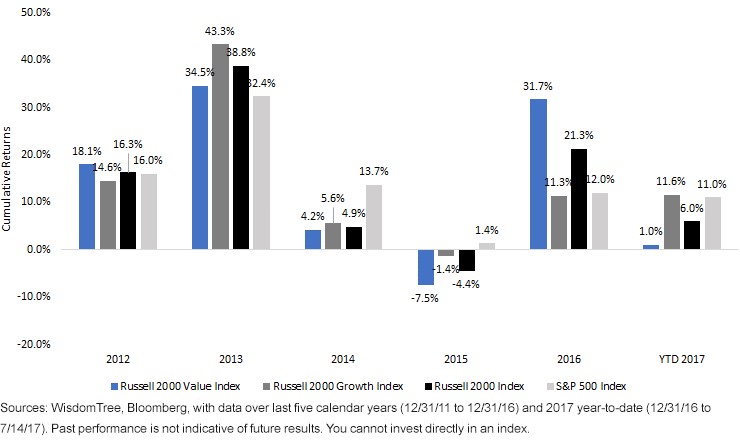
  • In 2012 and 2014, the Russell 2000 Value Index and the Russell 2000 Growth Index performed very similarly. Even the approximate 9% difference between these indexes in 2013 wasn’t particularly noteworthy because U.S. equity market indexes across the board tended to be up 30% to 40% that year.
  • The most recent “tough” year for small caps was 2015, and it was clear that the Russell 2000 Value Index was the laggard, as the Russell 2000 Growth Index was nearly flat. But 2016 saw greater than 20% outperformance of the Russell 2000 Value Index vs. the Russell 2000 Growth Index. In 2017 through July 14, these indexes have reversed again, with the Russell 2000 Growth Index now outperforming the Russell 2000 Value Index by 1,000 basis points (bps).

Value, Growth, Core…What’s the “Right” Choice?

Based on what we’re seeing in more recent index behavior, trying to time the shift between value and growth could carry with it a significant opportunity cost and the risk of being incorrect. Intuitively, one might say, “why not just own all the stocks?,” which could then lead to the Russell 2000 Index: very much the status quo choice. But as we mentioned before, it has never been easier to fine-tune exposure to a market segment through the use of factors.

Over the long term, did Size or “Size-Plus” lead to outperformance?

Continue Reading…

Early Retirement: It’s a Lifestyle, not a Vacation

Billy and Akaisha in the Highlands of Ecuador

By Akaisha Kaderli, RetireEarlyLifestyle.com

Special to the Financial Independence Hub

Ever wonder how it was for us in the beginning of living life without a paycheck?

In 1991, we understood that we were retiring with the idea that we would not be returning to work. If we had to, we would, but it was not part of the plan. We were not taking a break from work, we were leaving the working world all together. It was a little unnerving to be making such a clean break because we were out on our own with little emotional support from family and friends. Our retirement at age 38 challenged the belief systems of everyone we knew.

Important points

After all this time, the most important thing we want our Readers to know is: Don’t let anyone destroy your dream. Learn to be self-sufficient and self-motivating and you can create the life you want to live. If you desire something strongly and it makes you happy, don’t look to others for approval. Move in the direction of your dream.

Additionally, we want to inform you of the value of tracking spending. We’ve tracked our spending since our early years of owning a restaurant when we were in our 20’s. This has given us a sense of control over our finances and that brings self-confidence. If you track your spending you always know where you are financially, and if you know your net worth you can calculate what percentage you are spending. A rule of thumb is to keep your spending at 4% or below of your invested capital. If the market changes or your life circumstances change, knowing where you are with your money output is priceless.

What we wanted to achieve

Above all else, we wanted our freedom.

We had been working 60-80 hour work weeks with very little personal time or time with family and friends. While we consider ourselves to be productive people and we loved our jobs, this amount of time focused on work began to feel like a grind. I am sure many readers understand this feeling as we were not unique. We longed for large stretches of time before us that were unstructured so we could do as we wanted, when we wanted. So we traveled, read books, took classes, played music, took photos, and met new people – all on our own time schedule.

This pleased us greatly.

The greatest lessons we have learned Continue Reading…

How annuities can help fund a full lifestyle in retirement

By Jean Salvadore, Director, Wealth Insurance, RBC Insurance

(Sponsored Content)

Summary: While Canadians want to live a full lifestyle in their retirement, a majority (62 per cent) are worried about outliving their retirement savings. The majority are missing annuities in their portfolio that can help guarantee an income stream in their retirement. 

If you’re like most Canadians, your vision for retirement includes a full roster of activities such as travel, dining out and shopping for the things you want. But while many of us look to our retirement years as a time to enjoy life to the fullest, having enough money to support that lifestyle is a real concern. Canadians are living longer than ever before and, according to a recent survey by Ipsos for RBC Insurance, the majority (62 per cent) are worried that they’ll outlive their retirement savings.

In fact, even with various financial tools in place such as RRSPs and TFSAs, almost half of Canadians are still not confident that they will be able to afford the lifestyle they want. And perhaps not surprisingly, what’s most important to that lifestyle is keeping a sense of independence. Among those between the ages of 55 to 75, eight out of ten want to live at home for as long as they can and 72 per cent say it’s important to own a car. On top of that, almost three-quarters (68 per cent) would like to be able to travel at least once a year, shop for the things they want (62 per cent), and go out for lunch or dinner a few times a week (53 per cent). Continue Reading…

U.S. Tax Reform: What’s in it for Canadian businesses?

By Dan Lundenberg, BDO Canada LLP

Special to the Financial Independence Hub

For Canadian businesses that have been wanting to explore their prospects south of the border, the United States’ recent tax reforms could provide that impetus to finally make that happen.

In mid-December, the U.S. Congress agreed to aggressively cut its corporate tax rates from a maximum of 35 per cent to 21 per cent.  In addition, the U.S/ reduced its top personal tax rate to 37 per cent and this can be reduced for certain owners of pass-through entities to 29.6 per cent.  These changes open the door for Canadian business owners to invest or set up a shop in the U.S. without fear of higher taxation.

The U.S. tax reform comes on the heels of the Trudeau government’s move to roll out proposed tax changes that would make it more difficult for Canadian businesses to use private corporations to be tax-efficient. After receiving backlash from small business and industry groups, Finance Minister Bill Morneau in October unveiled a gentler tax plan geared to target mainly high-income Canadians.

But still, the revised tax changes would constrain the ability of businesses to implement tax efficient structures through income “sprinkling” with family members. Using small business corporations as a vehicle for making passive investments would also be more cumbersome under proposed changes.

While Canada is making it harder for private corporations to reduce taxes on certain income, the U.S. just widely opened its door to slash taxes for private businesses. In Ontario alone, assuming profits are paid to its shareholders, an integrated top rate of 54 per cent would apply. In the U.S., the tax hit in a pass-through vehicle would only be roughly in the mid-30s, depending on the state where the business is conducted.

Winners and Losers

So, what does this new U.S. tax environment mean for Canada?

Continue Reading…