
Hub Blogs

Hub Blogs contains fresh contributions written by Financial Independence Hub staff or contributors that have not appeared elsewhere first, or have been modified or customized for the Hub by the original blogger. In contrast, Top Blogs shows links to the best external financial blogs around the world.

Turning Financial Planning upside down

Doug Dahmer, CEO and founder of www.RetirementNavigator.ca has been a regular guest contributor to the Hub since its inception in November 2014. His focus is on Canada Pension Plan optimization, avoidance of retirement tax traps, and the creation of drawdown strategies during the decumulation side of financial planning. Some of these ideas have been used (with proper attribution) in various columns I’ve written in other media outlets, generally summarized here at the Hub.

However, Dahmer has been noticeably quiet lately. This blog explains why.

As the headline says and the adjacent image suggests, Doug is about to turn financial planning on its head. How? By democratizing access to financial planning, in the same way that Robo-Advisors democratized investing. This disruption of the planning industry is built upon a new planning platform called Better Money Choices.

Asked what motivated him to launch this venture Dahmer said more than 70% of Canadians say their greatest worries in life are centred around their financial futures. “Yet at the same time it is estimated that fewer than 15% of Canadians have a formal financial plan in place.”

As he talked to clients about this disconnect — why they resisted the idea of financial planning as an Rx to their financial stress — he discovered most people have no idea what true financial planning looks like.

Doug Dahmer, creator of BetterMoneyChoices.com

“The financial services industry has twisted the planning process into a tedious, time-consuming, onerous task that’s heavily biased toward the sale of financial products. What they hated most about planning, is that, more often than not, the conclusion to the process was always the same: spend less, save more, work longer, work harder. These recommendations were made while providing little in the way of  understanding of the specific rewards these sacrifices would deliver.”

In short, Planning did not relieve their level of stress, it actually increased it!

Money doesn’t buy stuff, it buys choices

True planning was never meant to promote the sale of financial products. It’s supposed to be a process that allows you to explore the lifestyle choices you are thinking about, so you can discover their future financial implications before you need to commit to them. “Armed with this insight, you can then decide whether you’re willing to make the necessary sacrifices to bring them to fruition.”

Your most valuable asset isn’t money. It’s Time — and how you choose to spend it

Dahmer’s financial planning philosophy  is based on the belief our lives are defined by the choices we make: the more good choices we make, the better our lives will be.  His new site, BetterMoneyChoices.com, lets people quickly, easily and securely explore their lifestyle choices so they can better determine what outcomes they should focus on.

Everyone’s personal resources – time, money, energy, relationships and talents – are limited in some way. That forces each of us to make choices to accept less of one thing in order to obtain more of the things that are most important to us. However, seldom is “more money” what we are seeking.

It’s time the financial planning sector evolved with the times

Dahmer says technology has given us many low cost/no-cost, self-serve tools that make almost all aspects of our lives easier, but not yet financial planning. “My mission is to change this. By putting the focus on how you want to live your life instead of how much money you can accumulate, and making it easy for you to determine which set of choices will bring you closer to what you value most, the technology behind the Better Money Choices process will revolutionize planning.”

His goal is to make it a quick, easy and engaging process to determine the trajectory our lives are tracking. “I want to convert the misnomers that planning is an event that translates into an exact science to the reality that planning is an ongoing, never ending process of making a set of best guesses – projecting those best guesses into the future – then re-engaging with life to learn more.”

Such a process requires frequently returning to our ever-living planning platform to check our progress and improve upon our guesses. “Once people understand what true planning looks like and the huge benefits that can accrue by adopting this approach for directing them to better choices, their disdain for planning will finally disappear and they will rely on their planning tools with the same natural inclination they reach for their google maps when it comes time to choose how best to arrive at their desired destination.”

Exact pricing has yet to be determined, but Dahmer’s goal is to have a monthly subscription that is comparable to Netflix or Spotify.

Beta Testing

Dahmer is currently running a beta test to get user feedback, prior to it being released publicly (currently scheduled for April 1st, 2018, coincidentally a week before I myself turn 65).

Doug has asked me to participate as one of the early beta testers and I have agreed to do so. In the past week, I have been “playing” with the software with our own personal data and I can tell you already it’s an eye opener. Over the next few weeks on the Hub, I’ll report back to you on my experiences with the software and the impact this novel approach to planning has had on my own plans for the second half of my life.

After all, I’m hardly unique in turning 65 this year: some 1,100 other Canadians now do so each day. (Incidentally, I’ll be collecting my first Old Age Security cheque late in May but, as per the guidance of Doug and his new software, I’ve elected to wait until age 70 to collect the Canada Pension Plan. This too has been reported in my columns in the country’s two major daily newspapers or MoneySense.ca )

If you’d like to be one of the first to know when the site officially launches, you can sign up at www.BetterMoneyChoices.com.


Gamechanger? Vanguard Canada launches 3 new Asset Allocation ETFs (plus my take)

Vanguard Investments Canada Inc. has announced the listing of three new low-cost Asset Allocation ETFs that give investors one-stop shopping to the firm’s globally diversified strategies. They began trading on the TSX today (February 1, 2018.)

Both investors and advisors are asking for “simple yet sophisticated single-ticket investment solutions that provide well-diversified global equity and bond exposure within a low-cost ETF structure,” says Atul Tiwari, managing director for Vanguard Canada. The new ETFs offer investors three different risk profiles and regular rebalancing.

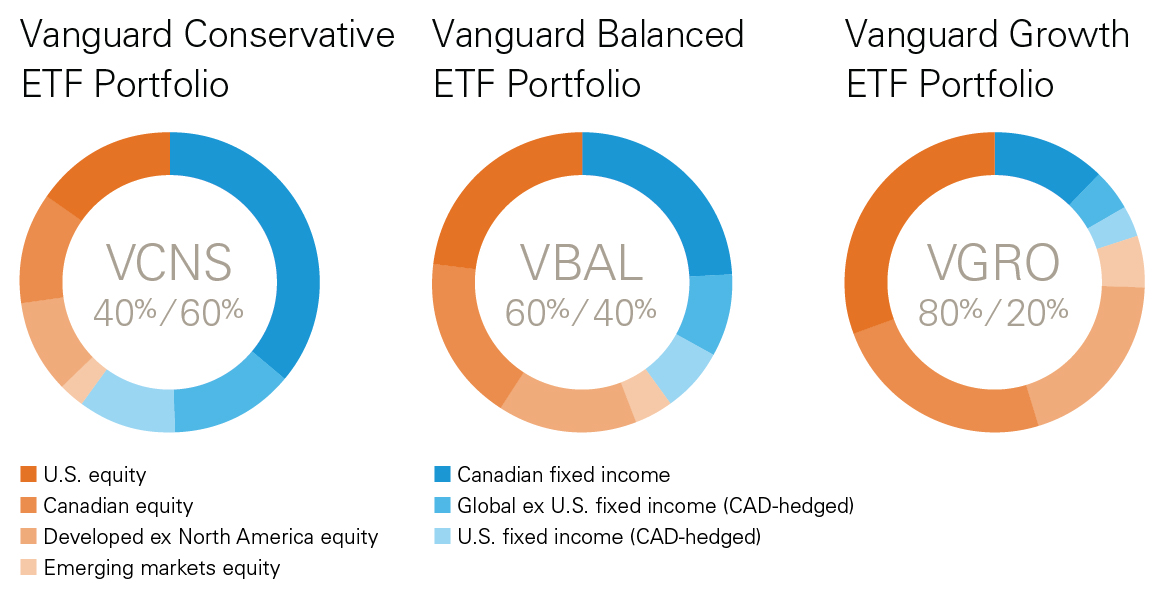
In effect, each ETF is a fund of funds although Vanguard describes them as having an “ETF of ETFs structure.” Each holds seven existing core Vanguard index ETFs (which I list in the postscript below). Each new ETF of ETFs has a management Fee of 0.22%. Vanguard says that when one of its ETFs invests in underlying Vanguard funds, “there shall be no duplication of management fees.” Spokesman  Matthew Gierasimczuk said “There are no duplicate fees beyond the 0.22 management fee, other than a basis point or two for operating expense and the trading fee for buying or selling the ETF.”

The three asset allocation ETFs cover the normal range from Conservative to Balanced to Growth, as reflected in the product names. Equity weights range from 40% for the Conservative offering, to 60% for the Balanced and 80% for the Growth.

Here are the 3 ETFs and their ticker symbols on the TSX:

Vanguard Conservative ETF Portfolio (VCNS) seeks to provide a combination of income and moderate long-term capital growth by investing in equity and fixed income securities with a strategic allocation of 40% equities and 60% fixed income.

Vanguard Balanced ETF Portfolio (VBAL) will provide long-term capital growth with a moderate level of income split 60% equities to 40% fixed income.

Vanguard Growth ETF Portfolio (VGRO) provides long-term capital growth by investing in equity and fixed income securities with 80% equities and 20% fixed income.

In a press release, Vanguard Canada head of product Tim Huver said the ETFs offer “a simplified and scalable solution for financial advisors, and a one-stop globally-diversified and transparent option for investors … Investors can rely on Vanguard’s global investment experts to continuously assess their portfolio’s exposure and rebalance it back to its intended risk level.” 

With the three new ETFs, Vanguard Canada now offers 36 ETFs, with C$14 billion in assets under management. Vanguard Investments Canada Inc. is a wholly owned indirect subsidiary of The Vanguard Group, Inc.

You can find more at Vanguard Canada’s website.

Postscript: My Take

After sleeping on this announcement, it strikes me as more significant than I had initially perceived. Continue Reading…

How to choose your financial oasis

By Lidia Staron

Special to the Financial Independence Hub

So, you have a job where you have to start at 9 a.m. in the morning and end at 5 in the afternoon. It pays a good amount; you’re able to enjoy life and you also have the capacity to pay the bills.

And then it hits you: you asked yourself the question, “Do I want to live here for the rest of my life? Or do I want to go somewhere else and live there instead?”

Questions such as these are pretty common, especially if you’ve reached your 30s. Some people quit their day jobs and turn to freelancing instead, because of the freedom to work from home. Do you want to do that?

In today’s article, I am going to talk about choosing your financial oasis. An oasis, by its definition, is a haven where everything is perfect. So, how do you choose yours? Read on to find out

1.)  Is it Better to Go Abroad?

One of the questions you need to ask yourself is if it is better for YOU to go abroad or not? I emphasized the word “you” because not everyone wants to go abroad due to a lot of reasons such as family, friends, your current job, among others.

Now, if you ask me, the answer to the question depends on where you live. If you live in a developing country where money is a bit harder to earn, then I highly recommend moving to another state or province.

Conversely, if you already live in a country or state that doesn’t have a lot of problems (especially when it comes to money and taxes), then I would suggest that you stay.

Again, this decision is entirely up to you. You have to weigh the pros and cons so that you can have a clearer mind to make the decision.

2.) Find a place with low Income Tax

If you do decide to move out of your country or place and into a new one, find a place where there is low income tax.

You see,  some countries take a huge chunk of your salary per month for taxes. Heck, they even take almost 30% of your salary just for taxes!

Ideally, find a place where income tax is not present. There are certain states in the U.S such as Washington, Florida, Nevada, and Texas that do not require Income taxes.

If you found a place where there is still an income tax, make sure that it doesn’t require more than 15% of your total salary.

3.) Find a place with a low cost of living

One of the criteria for moving into a new state is that it should have low-cost living.

There are certain places that do not have a huge cost of living, such as Iowa, Indiana, Oklahoma, Arkansas, to name a few. Continue Reading…

Franklin Templeton extends Canadian ETF family with Emerging Markets, Global Dividends

As my latest Financial Post blog this morning explains, mutual fund giant Franklin Templeton Investments Canada has expanded its ETF lineup with a pair of new “Smart Beta” ETFs and an actively managed balanced ETF. Click on the highlighted text for full story: Franklin Templeton boosts Canadian ETF offerings with Emerging Markets play.

As I note in the piece, Franklin Templeton has long had an Emerging Markets mutual fund, famously managed until last year by globetrotting fund manager Mark Mobius, who retires on January 31st after a 30-year career with the company. Franklin Templeton once had a closed end version of the fund but it was closed down in September of 2001, a company spokesman said.

The new Franklin LibertyQT Emerging Markets Index ETF (CAD) bears the memorable ticker symbol FLEM on the TSX, allowing Franklin Templeton to play catch-up to long-established Emerging Markets ETFs from rivals BlackRock Canada (iShares) and Vanguard Canada. You can find more about the new ETF family here.

FLEM is a four-factor “Smart Beta” ETF: the single biggest “factor” at 50% is a quality screen, along with 30% value, 10% momentum and 10% low volatility. Its largest single geographic weighting is South Korea at 15.4%, followed by 13.9% in China, 13% in India, 12.8% in Taiwan and 10.8% in Russia, according to Franklin Templeton vice president of ETF business development Amed Farooq.

The expected Management Expense Ratio (MER) for FLEM is 0.55%. The two other ETFs are The Franklin LibertyQT Global Dividend index ETF (FLGD/TSX, MER 0.45%) and an actively managed balanced ETF, Franklin Liberty Core Balanced ETF (FLBA/TSX), with an MER of 0.45%.

Time to “rebalance” from US equities to Emerging Markets?

Both the two new smart-beta ETFs provide a rebalancing opportunity for investors who feel US stocks have run up sufficiently to start taking profits. Earlier this month, famed investor Jeremy Grantham warned of one last market “meltup” for US stocks before another correction, and said his firm was rebalancing into Emerging Markets. You can find the full January 3rd article here: Bracing yourself for a possible near-term melt-up.

You can also find his comments made in a recent interview with Consuelo Mack’s WealthTrack show here.

I asked about this at the ceremonial opening of the TSX Monday morning, which focused on the ETF launches. Financial advisor John De Goey said he was doing just such a rebalancing for his clients and in an interview, Franklin Templeton senior vice president Dennis Tew said he knew of at least one advisor with a large book of business who likewise has been rebalancing from US income funds to Emerging Markets equities.

Balanced ETF managed by Franklin Bissett

Continue Reading…

Retired Money: Finally, a “Tontine” proposal for true Longevity Insurance

Even if they’ve saved a million dollars, retiring baby boomers lacking Defined Benefit plans and their inherent longevity insurance justly fear outliving their money. It’s been said some fear this more than death itself.

The latest instalment of my MoneySense Retired Money column looks at an intriguing proposal made this week by the CD Howe Institute. Click on this highlighted text for the full link: An annuity that pays off — if you live long enough.

CD Howe has proposed the creation of a “pooled risk insurance” scheme called LIFE, which has all the hallmarks of a 17th century concept known as the tontine.

Moshe Milevsky has long suggested tontines as one remedy for outliving our money

Annuity expert Moshe Milevsky — also a finance professor at the Schulich School of Business and author of books like Pensionize Your Nest Egg — says LIFE is a “great idea.” He actually made the case for the resurrection of “tontine thinking” three years ago in a book I reviewed at the time also at MoneySense: Tontine: Retirement Plan of the Future? 

The CD Howe paper (Headed for the Poor House) authored by Bonnie-Jeanne MacDonald doesn’t actually come out and call LIFE a tontine scheme but it certainly appears to contain the DNA of one.

LIFE stands for Living Income for the Elderly. The idea is that by sharing mortality risk, those who make it to age 85 start to receive monthly payouts for as long as they live, funded in part by the less fortunate members who die between 65 and 84. Apart from normal investment returns, the lucky survivors would enjoy the “added return” of the mortality premium.

Continue Reading…