Hub Blogs

Hub Blogs contains fresh contributions written by Financial Independence Hub staff or contributors that have not appeared elsewhere first, or have been modified or customized for the Hub by the original blogger. In contrast, Top Blogs shows links to the best external financial blogs around the world.

Weekly wrap; Getting Financially Real, Post-budget politics, 50 top financial sites

2015-carnivalA group of (mostly American) financial blogs and a few international ones have teamed up to create We are Financially Real, part of the 2015 Financial Literacy Awareness Carnival.

It’s hosted by Los Angeles-based Certified Financial Planner Shannon Ryan and her website, The Heavy Purse.

As you can see via this link, there’s a nice list of financial blogs participating, including Broke Millennial and its post, The Day I Got Bullish With Money, and many more from blogs like Club Thrifty, Color Me Frugal, Financially Blonde and Reach Financial Independence (now there’s a blog title we can relate to!)

shannon-ryan-pic
Shannon Ryan, CFP

“For the past three years, it’s been my privilege to host a Financial Literacy Awareness Carnival where I gather top finance bloggers to share their stories and motivate readers to become financially literate,” Shannon told the Hub via email, “Money is something every single adult handles, and too few make confident money decisions due to a lack of financial literacy. The mistakes they make, sometimes without even realizing it, have a lasting impact. It’s my hope through the carnival that we inspire readers to get Financially Real with their lives and reclaim their financial power.”

Budget Redux Continue Reading…

Hub readers embrace Budget’s $4,500 expansion of TFSA limits

Vector illustration of Man and woman avatars

By Jonathan Chevreau

Following last week’s federal budget, the Hub ran a piece making the case for immediately topping up annual contributions for Tax-free Savings Accounts (TFSA) from the existing maximum $5,500 to the proposed $10,000.

As we later reported in our weekly media roundup on Saturday, the Canada Revenue Agency and most major banks had by the end of the week confirmed it should be okay to make those contributions now, without having to wait for formal legislation later in the summer.

At the end of the earlier piece, I asked readers for comments. We reproduce them below, using initials where we’ve not gotten permission to use actual names.

We’ll start with Brad A:

Really appreciate your articles on TFSAs. I only make 25K a year & love TFSAs.  This whole talk about future lost revenue makes me cringe because there are many other loopholes/tax shelters that also create future lost revenue … principal residence real estate being just one.  Don’t get me started on subsidies for medical or business expenses etc. etc.  Having said this though, I’ve had enough trouble with Revenue Canada, that any time I get a brown envelope in the mail, my heart starts to pound.  So, for now, I’ll probably play the waiting game on the extra $4,500.  I don’t normally vote conservative but this election it’s going to be tempting because my TFSAs & RRSPs are about the only thing that will keep me out of poverty when I’m older.
Continue Reading…

Global study finds 15% of Canadians plan never to fully retire but many will embrace semi-retirement

By Jonathan Chevreau

Financial Independence Hub

nonameA global study on retirement finds 15% of Canadian workers don’t expect to ever fully retire, but many plan to downshift gradually into semi-retirement.

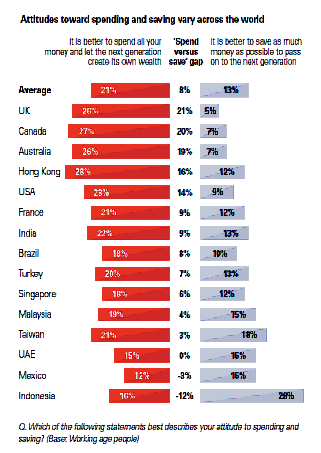
Compared to 14 other countries surveyed, Canadians do well in reaching their later-in-life goals, even if they have to spend all their wealth and leave less to their children.

HSBC’s latest global report — The Future of Retirement, Choices for later life – surveyed 16,000 working-age and retired people, including 1,000 Canadians.

When asked about their attitude towards spending and saving, 27% of working-age Canadians say “spend all your money and let your children create their own wealth.”

The study also found Canadian retirees are much more likely to reach their later-in-life goals than some of their counterparts in other countries. 44% of Canadian retirees have reached “at least one of their retirement hopes and aspirations,” well above the global average of 24).

Mixed sentiments on semi-retirement Continue Reading…

Unified & Defined: finally, some plain-English definitions for financial planners

Here’s my latest MoneySense blog, which looks at a new book that provides unambiguous definitions of common terms like financial planning. Click on The New Definition of Financial Planner for the MoneySense blog.

Below is a guest post by Cary List himself, president and CEO of the Financial Planning Standards Council (FPSC). We thought we’d give Hub readers the take on the new book right from the horse’s mouth!

Unified & Defined: Let the Canadian Financial Planning Definitions, Standards & Competencies Be Your Guide to Sourcing the Right Professional

By Cary List, CA, CPA, CFP®

President & CEO, Financial Planning Standards Council

Special to the Financial Independence Hub

cary-list-6
Cary List, FPSC

Studies have clearly demonstrated that Canadians are not getting the financial help they need from qualified, professional financial planners. This is partially the result of a lack of understanding of how to identify a qualified financial planner and of what they should expect of a financial planner and/or a financial plan.

Today’s unregulated financial planning environment leaves many of us vulnerable and at risk of receiving advice from individuals who call themselves financial planners but who have not had to attain any qualifications specific to the financial planning practice and who are not held accountable to any oversight body related to the financial planning advice they offer.

Anyone outside Quebec can still call themselves a financial planner

Continue Reading…

Moving from Accumulation to Decumulation can be traumatic!

Depositphotos_43929901_xsGood MoneySense blog today by fee-for-service planner Jason Heath. In Scared to spend your retirement savings?, Heath touches on a theme I suspect many baby boomers are going through as they prepare for the transition from full-time work to semi-retirement and ultimately full retirement.

I can relate to the anguish expressed by the subject of the piece, a single man now 56 who hopes to retire by 62 after a three-year transition phase of part-time work.

After 30 to 40 years of working, saving and investing — much of it tax-driven behaviour based on RRSP/IRA contributions and contributing to employer pensions — there’s a real paradigm shift involved in moving from the “Wealth accumulation” mindset to the “Decumulation” one.

That’s why Continue Reading…