Building Wealth

For the first 30 or so years of working, saving and investing, you’ll be first in the mode of getting out of the hole (paying down debt), and then building your net worth (that’s wealth accumulation.). But don’t forget, wealth accumulation isn’t the ultimate goal. Decumulation is! (a separate category here at the Hub).

Borrowing to invest? Beware of rising interest rates.

Del Chatterson

By Del Chatterson

Special to the Financial Independence Hub

Your financial advisor is probably not recommending it and you may be naturally averse to more borrowing, but it is hard to ignore the basic principles of financial leverage from Finance 101. (The principles have not changed, since I first taught the course in 1972!)

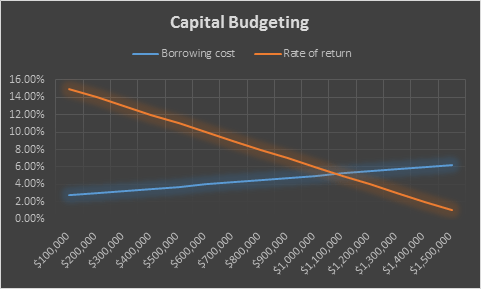
As explained in a chapter on Capital Budgeting, companies and investors should continue to invest in projects until the marginal cost of capital equals the marginal rate of return: assuming you select projects in order from the highest return to the lowest return and that the cost of borrowing increases with the total amount of loans outstanding.

So in the example chart shown to the right, you would borrow and invest up to $1.0 million, which is the point where the expected rate of return declines to meet increasing cost of borrowing at about 5%.

You may have confirmed the theory from your own experience. Your current portfolio has a few investments that are achieving better than 10% or 12% returns, most congregate around the long-term average of 7% to 8% and a few continuing disappointments are returning below 5%, or worse.  Your lowest cost of borrowing is probably the mortgage you signed in 2015 at 2.5% or a car loan at 1.9%, but your subsequent borrowing for a personal line of credit is at 3.25%.

Continue Reading…

Liberal tax changes would spark exodus of Canadian entrepreneurs

By David J Rotfleisch, CA, CPA, JD

Special to the Financial Independence Hub

The proposed changes to the Income Tax Act that the Minister of Finance, the Honourable Bill Morneau, has released have real-world implications. The consultation period ends October 2, 2017, so now is the time to make your voice heard. Call or email your member of Parliament, or Minister Morneau directly.

I recently had a meeting with a high-tech entrepreneur in an internet-based business. He is very conservative and has not carried out any tax planning. His wife helps him but he does not do any income splitting with her. He has about $1 million in his corporate bank account for possible business use, but has not invested it and just earns minimal bank interest. The hype about the proposals has caused him to take notice of his tax affairs and meet with me.

I told him that under the new proposals income splitting with his wife, other than a fair salary for services performed, will be prohibited. His wife will probably not be able to participate in the lifetime capital gains exemption. If he decides to invest his retained earnings, there may be an additional tax on his income. He is now thinking about lifestyle and whether he wants to leave the country. I fully expect to prepare a memo for him about becoming non-resident.

Minister Morneau’s proposed tax changes will have the effect of causing an exodus of Canadian entrepreneurs for more business-friendly jurisdictions.

I had lunch with accountants a few days ago and they reported the same types of conversations with high-tech clients. They are considering leaving the country. Now, some won’t because of the education of their children, to be close to aging parents, adult children,or because they like their Canadian lifestyle. Others will decide it’s more important to maximize after-tax income and that it makes sense to move offshore.

70% of Canadians work for firms with 100 or fewer employees

Remember,  statistics show that the vast majority of Canadians — 70 per cent — who are the economic engine of this country, work for companies with between 1 and 100 employees: the very targets of these new measures, and who are able in many cases to pack up and leave.

This is not just the view of tax professionals. Ryan Holmes, the CEO of social media internet company Hootsuite, was reported as saying on Sept 14, 2017 that the proposals are causing a lot of concern to business owners and that “I think you need to be very favourable at the small end of the market.”

I was recently contacted by a Liberal MP who is very opposed to what his government is doing. He has an entrepreneurial background and he realizes the impact of these proposals.

Continue Reading…

Toronto Rentals vs. Hong Kong: A matter of perspective

There’s been plenty of discussion recently surrounding Toronto’s hot housing market. First-time buyers are being priced out and young prospective home buyers are being pushed further and further away from the city’s desirable centre. With all this talk, it’s easy to get caught up and lose perspective, but lucky for you, I’m here to remind you to count those blessings (however meagre they may be).

Sure, the housing situation in cities like Vancouver and Toronto may be less than ideal, and yes, something should be done to improve the way things are going. However, there are far more dire housing situations in other top-tier cities, which, when compared to Toronto, really make everything here seem — dare I say –breezy?

Related Read: INFOGRAPHIC – July GTA Sales Plunge 40%

Taking A Global Rental Perspective

Take, for instance, Hong Kong. As those who’ve read my posts on Findependence Hub may know, I lived in Hong Kong teaching English. It is one of the most bustling, vibrant cities I’ve ever experienced, but I can only defend it so much once the subject of housing prices comes up. Year after year, Hong Kong tops all the lists of ‘most expensive housing,’ and having rented there for a year, I have to concede defeat on that point. For what you get in Hong Kong, there is much to be desired.


Chevreau’s Hong Kong apartment was tight on square footage.

Chevreau’s Hong Kong apartment was tight on square footage

If you’re like most millennials and looking to break into the housing market for the first time –- perhaps in a Toronto condo –- you’ve most likely experienced the disillusionment that inevitably comes when you realize the prices you’re looking at paying, even after this summer’s price correction. In the city of Toronto, the average price per square foot, or PPSF, is around $649 with an average home cost of around $550,000. This number spikes to $800 PSF if you’re looking to put down roots in ‘downtown Toronto’ (anywhere south of Bloor, west of Yonge, east of Bathurst).

Related Read: 5 Ways to Get Ahead in the Toronto Rental Market

Continue Reading…

What rising interest rates mean for the stock market, and how to cope

By Matthew Wilson

Special to the Financial Independence Hub

We’ve all seen the headlines: “Interest rates are on the rise.” The United States has raised rates three times since December and the Bank of Canada is now on the move after seven years of silence. Here’s what you need to know and how to prepare:

How high will rates go?

Before we start worrying about how this impacts our investments, let’s first look at how high we can expect them to go.

To do this we simply need to open the history books and look at (on average) how many times the Bank of Canada has raised interest rates when entering an increasing rate cycle. They never simply raise rates once and be done with it; they typically raise in a continuous cycle over the course of several years. Here’s what I mean:

  • 1999–2000: 4 rate hikes
  • 2002–2003: 5 rate hikes
  • 2004–2007: 10 rate hikes
  • 2010: 3 rate hikes

So, on average, whenever the Bank of Canada starts a cycle of raising interest rates we can expect to see approximately 5–6 increases.

It’s safe to say we won’t get back to the days of 16% interest rates as seen in the early 90’s, but we can expect to get back to the 3%–6% range that we saw throughout the early 2000’s.

Between 1990 and 2017 Canadian interest rates have averaged 5.92%, so as we currently sit at 0.75% we have quite a way to go. Here’s what I mean. Please refer to the graph that’s at the top of this blog.  As you can see we are just starting to come off the bottom: early days!

When do higher rates start to impact investments?

Just because interest rates are moving higher doesn’t necessarily mean bad news for the stock market, at least not yet.

Take the US for example. In their last four rate increase cycles they raised interest rates 10 times (on average) during each cycle. The US stock market (S&P 500) moved up an average of 23% during each of these cycles.

So, it’s not all doom and gloom, but there is a point at which we need to start getting concerned.

This tipping point typically comes once we get into the 4%–5% range. Why?Because as we near the end of a rising interest rate cycle it can start to slow down the economy in a number of different ways:

Firstly, it means higher borrowing costs for corporations and consumers, (i.e. higher mortgage rates, auto loan rates, lines of credit, etc). For corporations, this means less profit because they are spending more money on interest.

Secondly, it means more competition between bonds and equities. Right now you can get stock dividends paying a nice 4%–5%, but as bonds get up into this same range we start to see an outflow of cash from the equity markets and into the bond markets – seeing as bonds are incredibly less volatile, and if they are paying the same yield, people will naturally go with the less risky investment.

Essentially, bonds start competing with the equity markets, and with so many baby boomers retiring on fixed incomes they can’t afford the volatile swings of the stock market so they switch to bonds.

How long until we need to start worrying?

As mentioned above, markets don’t typically start to feel the impact of rising interest rates until we reach the 4%–5% range.

Continue Reading…

Are Investment Fees for suckers?

By Chris Ambridge, Transcend

Special to the Financial Independence Hub

Providing a service costs money, but paying a fee deemed as an unnecessary amount has come under attack from consumers at all levels. Think banking fees, or the perception of “hidden fees” on phone bills to brokerage and investment fees. Consumers are demanding more value and in some cases winning the battle.

There is more scrutiny on fees than ever before. Studies have shown many investors either believe they do not pay anything or have no idea what they do pay (Hearts & Wallets: Wants & Pricing — What Investors Buy & Competitive Ratings — 2016).

But everyone understands nothing in life is free and clients have a right to know what they pay.

 The long-view of investment fees  

For centuries, if an ordinary person had any liquid wealth the best they could hope for was meagre interest on their cash. Then, as the concept of companies developed, the notion of profiting from an equity investment emerged and stock exchanges were established in seventeenth century Europe to trade equities.

In Canada, much of the early development was raised in the London market, with public shares of large companies such as the Hudson’s Bay Company. The Toronto Stock Exchange (TSX) was created in 1861, and 17 years later the TSX was the second official stock exchange in Canada.

Commission-based Investing

At this time, being a stockbroker was a comfortable, genteel and very lucrative profession. By providing investors with access to markets, brokers earned fixed commissions of about 2% or more per trade. This lasted until May 1975, when negotiated commissions were introduced, leading to increased competition and a decrease in direct share ownership. Currently only 17% of the Canadian financial wallet is invested directly in stocks, down from 30% in 1990 when it was second in importance only to short-term deposits.

 Asset managers on the rise

 For less well-heeled investors, the first modern mutual fund was created in Canada in 1932. They were slow to catch on and grew very little between 1930 and 1970. However this was reversed in the 1970s when investors wanted greater stability following the oil crisis. Continue Reading…