Building Wealth

For the first 30 or so years of working, saving and investing, you’ll be first in the mode of getting out of the hole (paying down debt), and then building your net worth (that’s wealth accumulation.). But don’t forget, wealth accumulation isn’t the ultimate goal. Decumulation is! (a separate category here at the Hub).

How Millennials’ financial priorities differ from previous generations

By Gabby Revel

Special to the Financial Independence Hub

There is some truth and some fiction to the idea that millennials are not responsible with their finances. On the one hand, today’s youth is particularly adept at saving money and meeting their financial responsibilities on a monthly basis. However, millennials appear to have less foresight, as they’re not as interested in planning for their financial future as Generation Xers and Baby Boomers were.

Financial freedom

The most important element of a paycheck for millennials is the financial freedom it offers them. A study by Bank of America and Merrill Edge discovered that this generation is better at saving money compared to other generations, but what they choose to spend this money on differs greatly from older workers.

This same study discovered that 63% of millennials value financial freedom above all, meaning they set aside a certain amount of money to continue living their lifestyle of choice. This means planning for social trips or vacations, eating out at fancy brunch restaurants on Sundays and using Uber as one of their primary forms of transportation.

A survey by BMO Wealth Management found that 26% of millennials  —  ages 18 to 34 — believe “saving more” is their most important priority with finances. A further 25% value reducing and eliminating debt at the top of their list, while 20% want to invest effectively, 17% focus on budgeting and 5% believe in spending on personal needs or goals above all. All in all, millennials are reinventing the wheel in regards to where their finances should go, but they might pay the price moving forward.

Disregard for retirement

 A chunk of today’s youth has yet to begin planning for retirement, as they’re not thinking about what their needs will be in the future. Some believe Social Security (or in Canada CPP/OAS) will get them through their golden years, which only nets the average retiree about $1,300 per month nowadays. Others buy into the carpe diem or YOLO mentality that’s been instilled within millennials.

Continue Reading…

“I’m nearing Retirement and the stock market is at an all-time high. What should I do?”

On October 19 Fortune published an article with the headline:

“30 Years after Black Monday, the Dow Hits an All-Time High”. 

The article goes on to speculate:

“only time will tell if we have another crash ahead of us. But in the meantime, investors seem to think that skepticism and caution may be just what we need to avoid one.”

Connecting the all-time high to the Black Monday crash from over 30 years ago smacks of the kind of fear-driven nonsense that characterizes much of financial markets journalism these days.  The article raises the temperature further by pointing out that:

“this marks the fourth thousand-point milestone for the Dow this year, painting a very different picture than what was seen in 1987.  According to the Wall Street Journal, the Dow had never before hit more than two of these milestones in a year.”

Transforming meaningless data points into blood-pressure-raising insights is a coveted skill for both market journalists and stock market analysts alike.  After all it’s their jobs to get people to act: stock analysts to compel trades, journalists to direct readers/viewers to the skilled money managers that advertise in their pages or on their programs.

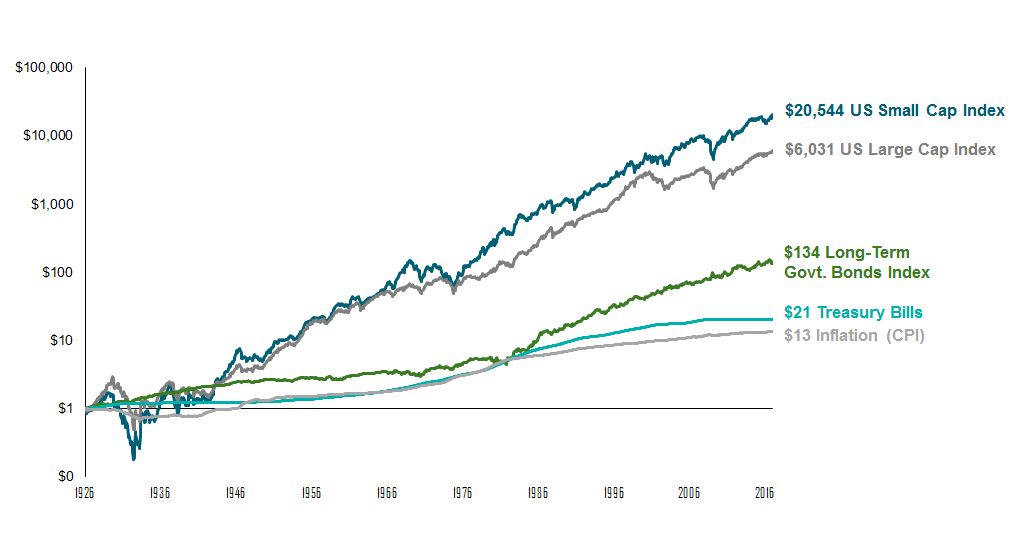
I’d be a poor headline writer.  The first one I came up with, “Dow Hits an All-Time High more than 500 Times Since 1987 Crash” wouldn’t inspire much fear or anything else.  The fact is that markets go up most of the time as is clearly displayed in the index data series shown at the top of this blog,  courtesy of Dimensional Fund Advisors. Continue Reading…

10 ways to spot investment opportunities before the herd piles in

By Dakota Findley

Special to the Financial Independence Hub

If you learn how to spot investment opportunities early, you could significantly increase the profits you make. Fortunately, doing this isn’t as hard as many people believe. Here are the ten essential components of spotting investment opportunities before everyone else jumps on the bandwagon.

1.) Find a Problem Solver

In 2009, Professor Raffi Amit of the University of Wisconsin noted that “Customers don’t buy technology. Customers buy products that add value.” These two sentences are vital to understanding which investment opportunities are worth pursuing.

An effective problem-solver is a company that:

  • Has identified one or more problems that a potential market is experiencing,
  • Has a plan, product, or service designed to address that problem, and
  • Can implement their solution in a scalable and cost-effective manner

In other words, you’re not just looking for companies to invest in: you’re looking for businesses that will be selling what customers are looking for.

2.) Learn to Understand the Criteria for an Investment’s Success

A 2011 study found that firms receiving angel investments (capital provided mainly for business startups) were about 25% more likely to survive for at least four years than companies that did not receive such funding.

The reason this fact matters is that a good early investment is one that gets enough funding to succeed. If your investment isn’t sufficient to help an opportunity succeed and nobody else is buying in, then it doesn’t matter how good their ideas are.

3.) Assess Your Risk Tolerance

How much risk are you willing to take on? We’ll be blunt with you: many early investments fail. Perhaps they didn’t get enough funding to succeed, or they suffered from poor management by people who were good at making products but not so good at running a company.

Whatever the reasons for failures, though, you’ll need to learn how to ass                                ess both how risky a given investment is and how much you can afford to lose.

As a good rule of thumb, you should never invest more than you could safely afford to lose.

4.) Practice Patience

Continue Reading…

WealthBar Q&A: How one Robo-advisor handles Retirement Income Planning

WealthBar CEO Tea Nicola

What follows is a sponsored Q&A session between Hub CFO Jonathan Chevreau and Tea Nicola, Co-Founder and CEO of WealthBar, a robo-adviser.

WealthBar provides financial planning with lower-fee ETF portfolios and actively managed Private Investment Portfolios.

Through their financial advisers, easy-to-use online dashboard and financial tools, they are making investing more accessible for Canadians from coast to coast.


Jon Chevreau

Jon Chevreau: Welcome, Tea. While many so-called robo-advisers seem to focus on young people building wealth, what about the end game? How do you handle the shift for older investors from accumulation into spending your savings in retirement? 

Tea Nicola: Once a client who is accumulating assets decides that retirement is on the horizon and they let us know, we lead them into the retirement transition process. At this stage, they probably have a pretty good idea as to what they would like to spend after taxes. Their goal is to understand now if their savings and all their sources of income will be enough to fund their retirement years.

The conventional wisdom is to collect all the sources of income that the client will have and analyze it year by year. This step is essential to make sure that the goals are met. That includes the monthly cash flow for basic expenses, the annual travel budgets and one-off purchases as well as any legacies that they may desire.

We then make sure their savings can meet all those goals. If there are shortfalls, we adjust the savings rate to meet the goals by the time they want to stop working. Then, we iterate this every six months or so, both before and after the retirement date. We do this to make sure the transition is smooth and that routines are appropriately established.

Jon: You’re talking about managing expectations?

Tea: I would call it being realistic about expectations. For instance, we need to be careful about talking about a monthly income when it comes to drawing down on retirement savings.

What we typically see is an uneven drawdown, with extra spending in the first few years of retirement. The client is in a rush to do all the things they held off on while working. So, they go on world tour, get a golf membership, enjoy some fine dining, or generally treat themselves to something special. But after a few years, their spending habits ‘normalize.’ The initial exuberance declines and their expenses follow suit. You get cases like one client in her 90s, who is literally worth millions, who now has monthly expenses of about $2,000 a month.

With that in mind, our financial plans help clients to achieve the goals they want to achieve, without necessarily boxing them into a lifestyle category that doesn’t really apply for most of their retirement. This involves very realistic, practical planning that I would say goes into a bit more depth than other robo-advisers, or even many traditional wealth management firms.

Jon: Sometimes you’ll hear a kind of magic number bandied about for how much people need to retire. $1 million. $2 million … Is there a guideline that really makes sense?

Tea: It depends on the person, which is why financial planning needs to be tailored for each individual. Just like with salaries, we know that someone making $75,000 can feel like they’ve got as much money as they could possibly need. Continue Reading…

A snapshot of Canadian investors’ appetite for risk: Vanguard’s Canadian risk speedometers

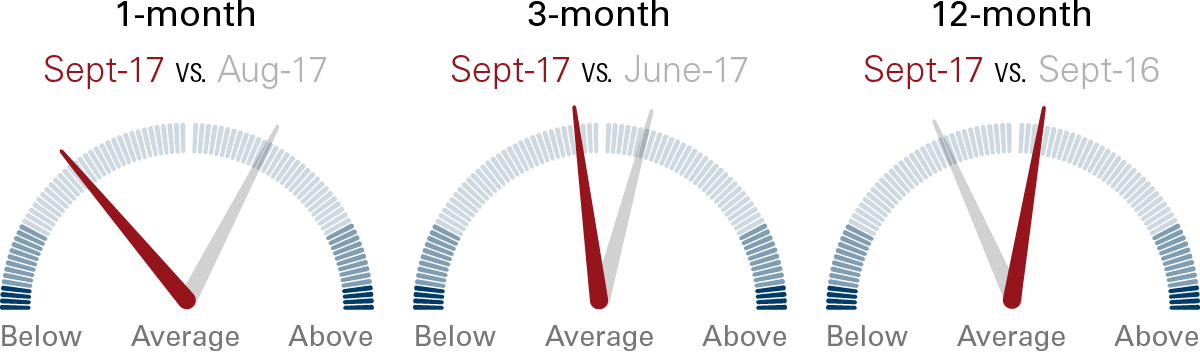
Figure 1: Vanguard’s Canadian risk speedometers, September 30, 2017

By Todd Schlanger, Senior Investment Strategist, Vanguard Canada

(Sponsor Content)

As part of Financial Literacy Month in Canada, we are proud to announce the launch of Vanguard’s Canadian risk speedometers.

These speedometers were originally designed by my colleagues in the United States to provide a factual representation of how investor risk appetite is trending today, relative to the past.

In order to generate the speedometers, we calculated net cash as a percentage of total assets under management, (in this case, within the universe of Canadian mutual funds and ETFs) into high-risk and low-risk asset categories. We then looked at the relative cash flows into high- versus low-risk asset classes, relative to history.

The end result is a risk measure that can be tracked through time and displayed in a risk speedometer index, as shown in Figure 1 over the 1-, 3-, and 12-month periods ending September 30, 2017. When risk appetite is above its historical average — such as over the 12-month period — the needle is to the right of centre, indicating higher risk appetite. When the needle is to the left of centre, risk appetite is below average. In addition to the current risk appetite readings, we also display the prior 1-, 3-, and 12-month readings for comparison.

Notes: Vanguard’s risk speedometers measure the difference between net cash flows into higher-risk asset classes and lower-risk asset classes, in this case within the universe of Canadian mutual funds and ETFs. The lighter-shaded areas represent values that are within one standard deviation of the mean, which means they occur roughly 68.2% of the time (34.1% higher and 34.1% lower). The middle shades represent readings between one and two standard deviations from the mean, occurring 27.2% of the time (13.6% higher and 13.6% lower). The dark edges represent values more than two standard deviations from the mean, occurring the remaining 4.6% of the time (2.3% higher and 2.3% lower). Speedometer values for previous periods may change from what was initially reported as the current value in prior periods because of changes made in Morningstar, Inc., data, and to the updating of the five-year average.

Along with the risk speedometers, we will be providing underlying asset category details (the top winners and losers in each category) in terms of net cash flows and changes in assets under management that resulted in the current risk appetite readings, as shown in Figure 2 (for the same periods, ending September 30, 2017).

Figure 2: Highest net inflows and outflows Continue Reading…