Building Wealth

For the first 30 or so years of working, saving and investing, you’ll be first in the mode of getting out of the hole (paying down debt), and then building your net worth (that’s wealth accumulation.). But don’t forget, wealth accumulation isn’t the ultimate goal. Decumulation is! (a separate category here at the Hub).

Retired Money: Finally, a “Tontine” proposal for true Longevity Insurance

Even if they’ve saved a million dollars, retiring baby boomers lacking Defined Benefit plans and their inherent longevity insurance justly fear outliving their money. It’s been said some fear this more than death itself.

The latest instalment of my MoneySense Retired Money column looks at an intriguing proposal made this week by the CD Howe Institute. Click on this highlighted text for the full link: An annuity that pays off — if you live long enough.

CD Howe has proposed the creation of a “pooled risk insurance” scheme called LIFE, which has all the hallmarks of a 17th century concept known as the tontine.

Moshe Milevsky has long suggested tontines as one remedy for outliving our money

Annuity expert Moshe Milevsky — also a finance professor at the Schulich School of Business and author of books like Pensionize Your Nest Egg — says LIFE is a “great idea.” He actually made the case for the resurrection of “tontine thinking” three years ago in a book I reviewed at the time also at MoneySense: Tontine: Retirement Plan of the Future? 

The CD Howe paper (Headed for the Poor House) authored by Bonnie-Jeanne MacDonald doesn’t actually come out and call LIFE a tontine scheme but it certainly appears to contain the DNA of one.

LIFE stands for Living Income for the Elderly. The idea is that by sharing mortality risk, those who make it to age 85 start to receive monthly payouts for as long as they live, funded in part by the less fortunate members who die between 65 and 84. Apart from normal investment returns, the lucky survivors would enjoy the “added return” of the mortality premium.

Continue Reading…

Here are a million reasons to ignore 5 popular RRSP myths

A lot of Canadians seem to be harbouring misconceptions about the value of RRSPs (Registered Retirement Savings Plans) but I can give you a million reasons why it’s dangerous to believe the  five popular RRSP myths.  My latest two blogs in the Financial Post this week explain why.

In Thursday’s Post, also published in some regional dailies, I described how young people can easily save a million dollars as long as they start early enough. Click on the highlighted text for the online link: How to build a million-dollar RRSP: it isn’t as hard to get there as you think.

Yes, it’s the old story of disciplined saving year in and year out, and the magic of compounding, all aided by the lure of an upfront tax refund and a multi-decade deferment of taxes. Of course, eventually it will be time to draw an income and pay some tax on the RRIF but that’s a story for another day.

Whether a million is enough is open to debate but with today’s paltry interest rates and rising expectations for long lives, the need for annuities or some form of longevity insurance has become urgent. More on that shortly.

Exploding 5 RRSP myths

This morning, Friday,  the FP also ran a blog by me commenting on tax guru Jamie Golombek’s debunking of five common myths average investors harbour about RRSPs. You can find Golombek’s column here: The 5 biggest RRSP myths Canadians can’t stop repeating.

My take on it and a CIBC poll that accompanied the report, can be found here: Almost 40% of Canadians see ‘no point’ in investing in RRSPs — Here’s why they’re wrong.

In short, Golombek and I agree that the RRSP makes a lot more sense than investing only in taxable (non-registered or “open”) accounts. And while the TFSA is a compelling alternative to RRSPs for young people in low tax brackets, or for low-income seniors counting on living on Old Age Security, for the vast majority of middle- and upper-middle-income private sector workers lacking a Defined Benefit plan, the RRSP remains an essential tool for building wealth.

And as I also point out, if you’re in a high tax bracket, you don’t have to choose between an RRSP and a TFSA: you should maximize both!

Sizing up the Size Factor


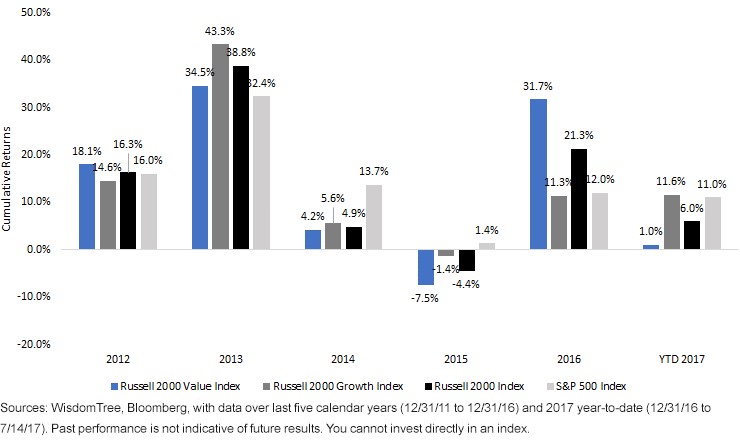
Small-Cap Growth & Small-Cap Value begin to diverge in 2015

By Chris Ganatti, Wisdomtree Investments

Special to the Financial Independence Hub

It seems like everywhere across the investment landscape in these days there is talk about “factors.” While this isn’t necessarily a new discussion (research has been done for decades regarding the drivers of excess returns within equities), it is easier than ever to pick and choose the factors to which you would prefer exposure.

Size: popular but volatile

When people get excited about changes — changes in policy, changes in growth expectations, changes in political leadership — we’ve tended to see this excitement show up in the behavior of small-cap stocks. We saw this most recently during the “Trump trade,” with the bulk of the performance response coming between the November 8, 2016, election victory and the January 20, 2017, inauguration.

  • In 2012 and 2014, the Russell 2000 Value Index and the Russell 2000 Growth Index performed very similarly. Even the approximate 9% difference between these indexes in 2013 wasn’t particularly noteworthy because U.S. equity market indexes across the board tended to be up 30% to 40% that year.
  • The most recent “tough” year for small caps was 2015, and it was clear that the Russell 2000 Value Index was the laggard, as the Russell 2000 Growth Index was nearly flat. But 2016 saw greater than 20% outperformance of the Russell 2000 Value Index vs. the Russell 2000 Growth Index. In 2017 through July 14, these indexes have reversed again, with the Russell 2000 Growth Index now outperforming the Russell 2000 Value Index by 1,000 basis points (bps).

Value, Growth, Core…What’s the “Right” Choice?

Based on what we’re seeing in more recent index behavior, trying to time the shift between value and growth could carry with it a significant opportunity cost and the risk of being incorrect. Intuitively, one might say, “why not just own all the stocks?,” which could then lead to the Russell 2000 Index: very much the status quo choice. But as we mentioned before, it has never been easier to fine-tune exposure to a market segment through the use of factors.

Over the long term, did Size or “Size-Plus” lead to outperformance?

Continue Reading…

U.S. Tax Reform: What’s in it for Canadian businesses?

By Dan Lundenberg, BDO Canada LLP

Special to the Financial Independence Hub

For Canadian businesses that have been wanting to explore their prospects south of the border, the United States’ recent tax reforms could provide that impetus to finally make that happen.

In mid-December, the U.S. Congress agreed to aggressively cut its corporate tax rates from a maximum of 35 per cent to 21 per cent.  In addition, the U.S/ reduced its top personal tax rate to 37 per cent and this can be reduced for certain owners of pass-through entities to 29.6 per cent.  These changes open the door for Canadian business owners to invest or set up a shop in the U.S. without fear of higher taxation.

The U.S. tax reform comes on the heels of the Trudeau government’s move to roll out proposed tax changes that would make it more difficult for Canadian businesses to use private corporations to be tax-efficient. After receiving backlash from small business and industry groups, Finance Minister Bill Morneau in October unveiled a gentler tax plan geared to target mainly high-income Canadians.

But still, the revised tax changes would constrain the ability of businesses to implement tax efficient structures through income “sprinkling” with family members. Using small business corporations as a vehicle for making passive investments would also be more cumbersome under proposed changes.

While Canada is making it harder for private corporations to reduce taxes on certain income, the U.S. just widely opened its door to slash taxes for private businesses. In Ontario alone, assuming profits are paid to its shareholders, an integrated top rate of 54 per cent would apply. In the U.S., the tax hit in a pass-through vehicle would only be roughly in the mid-30s, depending on the state where the business is conducted.

Winners and Losers

So, what does this new U.S. tax environment mean for Canada?

Continue Reading…

How to pass on Money values to your kids

By Matt Matheson

Special to the Financial Independence Hub

(Part 2)

When we had kids, both my wife and I discussed how to be intentional about teaching them about money. We’ve read books, articles, and looked at resources online.  We wanted to be sure that they knew what a healthy relationship with money looked like in the areas of faith, family, and work ethic. We wanted them to know what a truly wealthy life looks like.

Our plan to do this was to model handling our money responsibly. And we wanted to give them real-world opportunities where they could begin to make financial decisions on their own, at first in a supported environment, and later on, independently.

With our first child, our daughter Gemma who’s getting ready to turn 5, we’re in stage 1 of teaching her to be a wise manager of her money. She’s being supported, taught and encouraged to make good choices with her money. She’s also being given lots of opportunity to fail with money. Also known as non-catastrophic failure, it is an essential element to learning, and one many kids are being robbed of by overprotective parents.

So how are we doing it? By teaching her the basics of how to give, save and spend…in that order.

Give

Gemma has been on commission for about four months and it’s been going quite well.  Every Saturday she gets paid $1.50 in six quarters. Some people may think that’s cheap, but I prefer frugal. 

My wife decorated three old loose tea containers with fancy wrapping paper and glitter letters to store her bounty.

The first thing we do when she gets paid is put 25₵ in the Give container. As people of faith, we tithe a percentage of our income to our local church and other charities.  We want to instill the value of generosity and gratitude in our children, and so before we’ve spent or saved, this money goes into the Give fund.

Recently, we went out and used her money (she has stockpiled $4) to buy some gifts for an Operation Christmas Child shoebox. Before we went out I showed her a short video and we talked about how some kids don’t have much money, and how we can give to them.  It was awesome to see her picking out the items for the box and growing her giving muscles right before my eyes.

Save

The next place money goes is to her Save container.  It gets three quarters, the most of any jar.  Before she’s touched any cash to spend, this “invisible money” disappears into her saving fund so she doesn’t even miss it.

We want to impress upon her the value of delaying gratification. We want her to experience the joy you get from passing on the temporary good feeling of spending now, for the amazing feeling of satisfaction and self-control you have when you buy something you’ve been saving up for.

Right now, she’s not saving for a car, university, or a down payment on a house.  We’re not that crazy.  She saves for larger purchases that she wants but can’t buy on impulse and that we’re not going to cave in and get her on a whim.

A Teachable Moment

A few weekends ago, she and I were hanging out and she let me know that she had seen a Spirit Riding Free toy that she wanted to buy. (For those who don’t know, it’s a Netflix show, which is pretty solid for little kids. Continue Reading…