General

How to find a stable career

By Sarah Davies

Special to the Financial Independence Hub

Perhaps the only thing more important than wealth or power is stability. Things come and go all the time when a situation isn’t stable, and it’s hard to plan an uncertain future. Obtaining a career that provides stability is a must. The workforce is changing, and so are the kinds of jobs that are available. If you want to settle in to your desk and never need to find another one, you might need to change the attitude you bring to work with you. Soon enough, you’ll find yourself with a stable job and the tools you need to prepare for your financial future.

Let the numbers guide you

When deciding on a career path, look at projections. As technology continues to change the world, something big is going to happen. Certain jobs won’t exist anymore, and jobs we never had a need for previously are going to pop up. Some paths are more stable than others, and you want to pick one that’s still going to exist in ten years. While the positions themselves may change with time, simply being familiar with and experienced in the industry can keep you afloat.

Think about what you want, versus what you need

There’s objective stability, and there’s subjective stability. For example, there will always need to be customer service representatives. That is a career that won’t go away. But can you always be a customer service representative? Will it drive you crazy after a while? Will your patience wear thin? Stability needs to come from both sides. You have to find a career path with longevity, but it needs to be a career path that you’ll be happy with for the long haul. Consider your future self when making a decision.

Develop versatile skills Continue Reading…

Two notable investment books to build your long-term Wealth

“Books are the bees which carry the quickening pollen from one to another mind.” — James Russell Lowell, poet and author

Last week I highlighted two books that help manage your family’s retirement aspirations. This week I turn my sights onto two books that shape investment success over the long run: all about taking charge of investing in your self-education through quality reading.

I’ve selected two books that provide great insights into stewarding your long-term wealth. The authors are well known in the wealth management profession.

The books emphasise simple, yet fundamental recipes of investing: something for everyone’s investment toolbox when the bulls and bears make their presence known.

The Elements of Investing

Burton G. Malkeil and Charles D. Ellis


My initial pick is a gem written by two leading, seasoned authors of many books. Both have contributed heavily to the profession of managing wealth. The investing process is condensed into five short chapters, all in layman’s language.

The authors make the point that everything starts with savings. It is their position that each of us can make sound investing decisions. The process does not have to be complicated.

Rather, it is a highly disciplined approach to investing. All the rules you need to know and implement are explained. I visualise the book as a clear, concise and practical guide for the long road ahead.

The easygoing writing style emphasises keeping the approach to investing as simple as possible. My perspective concurs with the view that the book is a prudent, logical road map.

Continue Reading…

Investing so you don’t get lost — or detoured by financial hitchhikers

By Darren Coleman

Special to the Financial Independence Hub

Investing is like driving a car. Every now and then you feel lost, and need to make sure you’re headed in the right direction:  your destination.

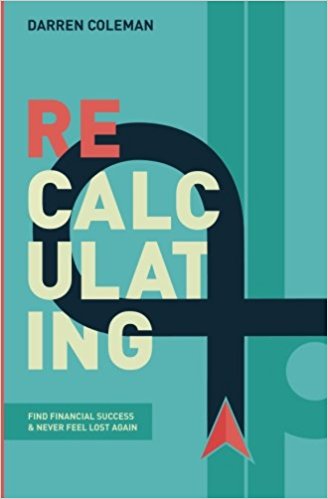
That’s why I wrote the book ‘RECALCULATING – Find Financial Success and Never Feel Lost Again’ which makes use of my years of experience counseling clients about their money and assets.

Indeed, when it comes to directions, a car’s GPS makes things easy if you get lost; it just says ‘recalculating’ and you’re off again, hence the title of the book. So while driving is something we all do, we often encounter obstacles: potholes, detours, flat tires, not to mention unexpected passengers.

Take a couple we’ll call Tim and Janet. They’re nearing 60: he’s a financial executive, and she’s been focused on raising their two children to adulthood; one of them they are helping with a down payment on a house and the other is still in university, and they pay the tuition. What’s more, Janet’s parents are in their mid-80s and their health is starting to fail. So, while this couple is on the cusp of their own retirement, they are still playing Mom and Dad, while also taking care of an elderly Mom and Dad.

And they feel lost.

During my almost 25 years as a professional Financial Advisor and Certified Financial Planner, I often meet people who aren’t where they thought they would be. That’s why they come see me. Some of them are off course and unsure of how to get back. They may be ahead of their plans, behind, or just not sure. Even people who are very successful in their careers are often stressed and much of that comes from a 24/7 financial news cycle that assumes we are more financially savvy than we really are.

Supporting financial hitchhikers

With Tim and Janet, the dilemma concerns ‘financial hitchhikers’ —  passengers they didn’t plan on taking along for the ride on that journey known as financial planning. In this case, their kids aren’t really hitchhikers because they’re already in the car, so let’s call them First Class Passengers and the journey is built around them. Janet’s parents we can call Second Class Passengers who may need temporary assistance.

Continue Reading…

What financial help is available to American seniors?

Photo by Alexandre Debiève on Unsplash

By Jessica Walter

Special to the Financial Independence Hub

As we approach retirement, we hope financial strains will be a thing of the past and that we’ll be able to enjoy our senior years by focusing on the things that make us happiest. However, the reality for many of us in North America is quite different.

According to SeniorLiving, nine out of ten Americans who are 65 and older, receive Social Security and the average senior citizen, aged 65-74, has an income of just $36,320 [all figures $US]; a figure that drops to $25,417 for those aged 74 and over. As confirmed by the most recent U.S. Census Bureau, 9.3% of Americans aged 65 and older are living in poverty; an increase from 4.2 million to 4.6 million between 2015 and 2016.

With such worrying circumstances to contend with, many senior citizens will want to find out what kind of financial assistance is available to them in order to better plan for the years ahead.

Housing

Meeting mortgage payments or having enough money to cover rising rental costs can be one of the most pressing financial concerns for senior Americans. The U.S. Department for Housing and Urban Development (HUD) offers financial assistance and resources related to reverse mortgages, federal housing programs, affordable rents and units for the elderly.

Healthcare

Continue Reading…

How Millennials can learn from the seniors in Grace & Frankie

Lily Tomlin, Sam Waterston, Jane Fonda at the Grace & Frankie Season 2 Premiere Screening in Los Angeles.

Can Millennials learn life lessons from seniors? I think so, or at least from TV depictions of them.

As an avid watcher of anything Netflix is showing, I came across Grace and Frankie when the first season came out in 2015.

I wouldn’t usually choose this show for myself, seeing as all the main characters are over 70, I figured I wasn’t exactly in the target market. This was a show geared toward people my parents’ age or more, and what could I possibly gain from watching something made for old people!?

However, it was a slow weekend, and I’d already caught up on Orange Is the New Black, so what did I have to lose? If it was good, I’d find a new show to watch, and if it was too far out of my wheelhouse, I’d email my parents and pass on the ‘new show you’d like’ info to them.

I think a lot of the time people my age tend to take for granted that most media is aimed at us, with characters from all walks of life but generally in the same age range. This has the unfortunate consequence of leading us to believe that:

a) we’re the only generation that matters and

b) we will continue to be young and adventurous and the only generation that matters.

If you haven’t yet marathon-ed Grace & Frankie, allow me to break it down for you. Grace Hanson and Frankie Bernstein’s husbands are law partners, and, as it turns out, life partners. The husbands — played by two veteran actors who are 75 or older, Martin Sheen and Sam Waterston — have decided after 20 years of hiding their love that it’s time they get on with it, which leaves the wives in quite an unfortunate predicament. ‘Grace & Frankie’ revolves around these two women — played by Jane Fonda (79 years young) and Lily Tomlin (77) respectively — rebuilding their lives and learning to live their ‘new normal’.

One of the most important lessons millennials should take away from this show is that no matter how much we plan for our financial futures, nothing is set in stone. It is always important to plan for the un-plan-able. We are not invincible, and we are not immune to hardship.

A Victory Lap for both the 70-ish actors and the characters they play 

Though both the lead characters had successful careers in their pasts, what I find most inspiring about these women is that they aren’t allowing themselves to feel obsolete. They find new relationships, new hobbies, and most interestingly, a new business venture that they’re passionate about pursuing.
Continue Reading…