
General

Retired Money: How to boost retirement income by 50%

PUR Investing’s Mark Yamada

My latest MoneySense Retired Money column looks at an academic paper written by two Canadian investment pros, which explains how retirees can boost retirement income by as much as 50%. You can find it by clicking on the highlighted headline here: How to boost your retirement income by 50%.

In the recent Fall issue of the Journal of Retirement, PUR Investing Inc. president and CEO Mark Yamada and colleague Ioulia Tretiakova, the firm’s director of quantitative strategies, published a paper titled “Autonomous Portfolio: A Decumulation Investment Strategy That Will Get You There.” Click here for a summary.

Yamada and Tretiakova observe that the combination of rising life expectancy, minuscule interest rates and declining availability of employer-sponsored Defined Benefit pension plans is making retirement an anxious proposition, especially for the Baby Boom generation that is even now starting to storm the barricades of Retirement: 10,000 Baby Boomers retire every day in the United States, and roughly 1,000 a day in Canada.

Little wonder that one study (Allianz 2010) found 61% of those aged between 45 and 75 were more afraid of running out of money than of dying! Sure, you can decide to work a little longer, which lets you save more and cuts down the years you’ll need to withdraw an income, but there’s a limit to how long you can work (or find willing employers or clients). Ultimately, health and time are not on your side!

The full article describes Yamada’s Decumulation Investment Strategy, which is designed to let retirees better manage both retirement income and the probability of ruin.

Dynamic Constant Risk & Spending Rules

Unfortunately, the investment industry relies on historical risk and return data to project future returns, somewhat like navigating a car by peering through its rear-view mirror. Yamada aims to keep portfolio risk constant by reducing portfolio risk when market volatility rises and to increase portfolio risk when volatility falls (hence the term DCR, which stands for Dynamic Constant Risk). Continue Reading…

Debunking myths about Smart Beta and ETFs

By Jeff Weniger, CFA , WisdomTree Investments

Special to the Financial Independence Hub

This is part one of a four-part blog series addressing the attacks on smart beta and ETFs. Today we address the supposed academic consensus that the only recourse for investors frustrated with active management is to turn to market capitalization-weighted index funds.

“That’s the way it’s ‘always’ been done”

In much of our research we lay out our case that much of the impetus for trillions of dollars to continue tracking market capitalization-weighted indexes appears to be little more than “that’s the way it’s ‘always’ been done.”

In this blog series, we’ll address the most common lines of attack against smart beta and ETFs.

For clarity, our discussion of smart beta will refer to this excerpt from the Financial Times:

Smart beta strategies attempt to deliver a better risk and return trade-off than conventional market cap weighted indices by using alternative weighting schemes based on measures such as volatility or dividends.1

The truth is that the “active management versus passive market cap-weighted indexing” argument is a classic false dilemma. Continue Reading…

Large taxable foreign portfolio? Watch $100K and $250K thresholds for CRA’s T1135 form

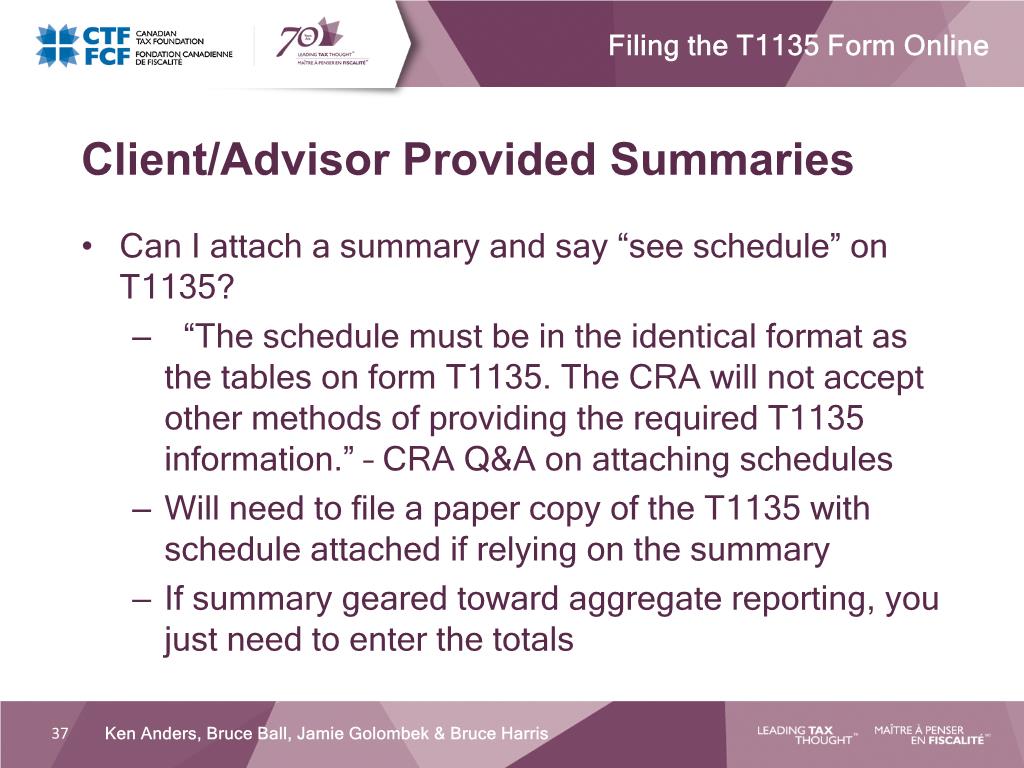
If you’re a Canadian investor with a large taxable foreign portfolio, you need to be aware of your cost base, since exceeding $100,000 of so-called Specified Foreign Property (SFP) has to be reported to the Canada Revenue Agency.

This is examined in my (monthly) High-Net Worth column for the Globe & Mail Report on Business which was published online on Friday and was in the physical paper Wednesday, Nov. 15. You may be able to retrieve it by clicking on the highlighted headline: Pay Close Attention to Your Foreign Assets to Avoid Tax Troubles. (Depending on how often you access the site, access may be restricted to subscribers. I’ve summarized the main points below.)

If you file your own taxes, you may have noticed an innocuous looking “box” you may or may not tick each year that ask whether you own “Specified Foreign Property.” If you have a cost base of more than $100,000 of SPF you have to tick that box and fill out a CRA form called the T1135. For most Canadian investors the relevant investments will probably consist primarily of individual US stocks, ADRs and/or foreign equity ETFs trading on US and other foreign stock exchanges.

There is also a higher threshold of $250,000 you also should be aware of because this entails even more detailed reporting and paperwork, and the article suggests you may wish to avoid reaching that higher threshold. The $100,000 and $200,000 thresholds are per individual, not household, and again, it’s based on cost base not current market value.

Failure to comply can entail serious penalties.

How to stay below the threshold and still have foreign content

If you would rather not deal with more CRA paperwork and capital gains hassles, I’d argue you should try to stay below the $100,000 threshold, in which case you don’t have to tick the box on your tax return. Continue Reading…

CPP will be there for future generations, CPPIB head reassures Advocis

CPPIB president and CEO Mark Machin

My latest Financial Post blog looks at the misplaced perception that the Canada Pension Plan (CPP) might not be there for future generations. Click on the headline to retrieve the full article: No reason to fear CPP’s stability, CEO Machin says, but people do it anyway.

Mark Machin is president and CEO of the Canada Pension Plan Investment Board (CPPIB.)  Speaking Tuesday to financial advisors attending Advocis Symposium 2017 in Toronto, he said “unlike virtually every other industrial country in the world,” Canada “has solved its national pension solvency issues.”

While you could argue that even America’s Social Security system is not solid for the next generation of American retirees,  the CPP is on a solid actuarial footing. Canada’s chief actuary says CPP is sustainable over 75 years, assuming a 3.9% real [after-inflation] rate of return: CPPIB’s 10-year annualized real rate of return is 5.3%.

Despite this, many Canadians — and perhaps some of their advisors — continue to profess their belief that the CPP won’t be around for them by the time they retire. 64% believe either that CPP will be out of money by the time they retire, or don’t know whether it will be there to pay them in retirement, Machin told Advocis.

Half of retirees greatly rely on CPP

However, in practice, Canadians tend to have more faith in the CPP than they claim: 42% of working-age Canadians expect to rely on the CPP when they retire (up from just 13% 15 years ago). In 2016, more than half of Canadians who are actually receiving CPP said they rely “to a great extent” upon it.

Continue Reading…

How Group Annuities can help employers protect Defined Benefit pensions

Source: Mercer Pension Health Index published October 2, 2017

By Brent Simmons, Sun Life Financial

Special to the Financial Independence Hub

Recently, employees and retirees of Sears were stunned to learn they may not receive all of their defined benefit (DB) pension when it declared bankruptcy. They learned their pension plan was underfunded and the company had requested that it be allowed to stop making the contributions required by Ontario laws. The plight of Sears employees and retirees has left many Canadians wondering if their DB pension plan is healthy and if their DB pension is safe.

The pension challenge

With a DB pension plan, a company promises their employees a pension for life and is responsible for paying the pension: whatever the cost ends up being. The problem is that low interest rates and choppy equity markets have made the funding level of many pension plans look like a roller roaster ride. This can be seen in the chart at the top of this blog.

Another challenge facing pension plans is that Canadians are living longer, meaning that pensions need to be paid for a longer time. A common rule of thumb is that one year of additional life expectancy at age 65 can increase the cost of the pension plan by 3% to 4%.

In a tough economy, the need to contribute to a pension plan can often come at a time when a company’s core business is also facing financial difficulties. If a company becomes bankrupt, then the company likely won’t be able to pay the contributions owed to the pension plan and employees may indeed face a shortfall in its pensions.

How Group Annuities protect their employees’ pensions 

The good news is that a growing number of Canadian companies are taking steps to protect their employees’ pensions. They are buying group annuities to transfer the financial risk of their pension plans to insurance companies, which are subject to strict regulations and must have funds on hand at all times to pay promised pensions. With a group annuity, an insurer assumes responsibility for providing the pensions to a company’s retirees in exchange for a fee, and the retirees continue to receive their promised pension.

Continue Reading…