General

Using annuities to create your own personal Pension In Retirement

The reason why retirement planning is so difficult is because the one variable we need to know – how long we have to live – is impossible to predict. Sure, we have mortality tables and family history to help guide us, but statistically speaking, half the population will outlive their median life expectancy.

That makes longevity risk – the risk of running out of money before you die – a very real threat to your retirement. And yet many Canadians ignore this threat by not saving enough during their working years; retiring before they’re financially ready, taking Canada Pension Plan benefits too early, withdrawing too much from their RRSPs, and so on.

Nearly half of Canadians are worried they won’t have enough money to live a full lifestyle in retirement, according to a recent survey by RBC Insurance. They interviewed 1,000 Canadians aged 55 to 75 about their retirement readiness and came out with some interesting findings.

The retirees, or soon-to-be-retirees seem to want it all, according to the poll, yet many will lack the savings to do so:

  • 80 per cent want to live at home for as long as they can
  • 72 per cent said it’s important to own a car.
  • 68 per cent said it’s important for them to be able to travel at least once a year
  • 53 per cent want to go out for lunch or dinner a few times a week

Having enough money to support their desired lifestyle is a real concern, highlighted by the fact that 62 per cent of those surveyed are worried about outliving their retirement savings.

The one retirement income tool that didn’t appear on the radar was an annuity. Just 12 per cent said they are using or plan to use one in retirement.

How Annuities Can Help In Retirement

An annuity provides a predictable income stream for life – much like how a defined benefit pension, CPP, and OAS pays benefits for as long as you live. Nothing protects you from longevity risk quite like a guaranteed lifetime income.

It’s puzzling why more Canadians don’t choose to turn even a portion of their savings into an annuity – to pensionize their nest egg, to borrow a phrase coined by financial authors Moshe Milevsky and Alexandra Macqueen.

Lack of knowledge around annuities definitely plays a role. While nine in 10 Canadians polled by RBC know they don’t need to invest their entire retirement savings into an annuity, just 28 per cent know that an annuity doesn’t have to be managed once it has been purchased. Continue Reading…

Retired Money: Finally, a “Tontine” proposal for true Longevity Insurance

Even if they’ve saved a million dollars, retiring baby boomers lacking Defined Benefit plans and their inherent longevity insurance justly fear outliving their money. It’s been said some fear this more than death itself.

The latest instalment of my MoneySense Retired Money column looks at an intriguing proposal made this week by the CD Howe Institute. Click on this highlighted text for the full link: An annuity that pays off — if you live long enough.

CD Howe has proposed the creation of a “pooled risk insurance” scheme called LIFE, which has all the hallmarks of a 17th century concept known as the tontine.

Moshe Milevsky has long suggested tontines as one remedy for outliving our money

Annuity expert Moshe Milevsky — also a finance professor at the Schulich School of Business and author of books like Pensionize Your Nest Egg — says LIFE is a “great idea.” He actually made the case for the resurrection of “tontine thinking” three years ago in a book I reviewed at the time also at MoneySense: Tontine: Retirement Plan of the Future? 

The CD Howe paper (Headed for the Poor House) authored by Bonnie-Jeanne MacDonald doesn’t actually come out and call LIFE a tontine scheme but it certainly appears to contain the DNA of one.

LIFE stands for Living Income for the Elderly. The idea is that by sharing mortality risk, those who make it to age 85 start to receive monthly payouts for as long as they live, funded in part by the less fortunate members who die between 65 and 84. Apart from normal investment returns, the lucky survivors would enjoy the “added return” of the mortality premium.

Continue Reading…

Here are a million reasons to ignore 5 popular RRSP myths

A lot of Canadians seem to be harbouring misconceptions about the value of RRSPs (Registered Retirement Savings Plans) but I can give you a million reasons why it’s dangerous to believe the  five popular RRSP myths.  My latest two blogs in the Financial Post this week explain why.

In Thursday’s Post, also published in some regional dailies, I described how young people can easily save a million dollars as long as they start early enough. Click on the highlighted text for the online link: How to build a million-dollar RRSP: it isn’t as hard to get there as you think.

Yes, it’s the old story of disciplined saving year in and year out, and the magic of compounding, all aided by the lure of an upfront tax refund and a multi-decade deferment of taxes. Of course, eventually it will be time to draw an income and pay some tax on the RRIF but that’s a story for another day.

Whether a million is enough is open to debate but with today’s paltry interest rates and rising expectations for long lives, the need for annuities or some form of longevity insurance has become urgent. More on that shortly.

Exploding 5 RRSP myths

This morning, Friday,  the FP also ran a blog by me commenting on tax guru Jamie Golombek’s debunking of five common myths average investors harbour about RRSPs. You can find Golombek’s column here: The 5 biggest RRSP myths Canadians can’t stop repeating.

My take on it and a CIBC poll that accompanied the report, can be found here: Almost 40% of Canadians see ‘no point’ in investing in RRSPs — Here’s why they’re wrong.

In short, Golombek and I agree that the RRSP makes a lot more sense than investing only in taxable (non-registered or “open”) accounts. And while the TFSA is a compelling alternative to RRSPs for young people in low tax brackets, or for low-income seniors counting on living on Old Age Security, for the vast majority of middle- and upper-middle-income private sector workers lacking a Defined Benefit plan, the RRSP remains an essential tool for building wealth.

And as I also point out, if you’re in a high tax bracket, you don’t have to choose between an RRSP and a TFSA: you should maximize both!

Sizing up the Size Factor


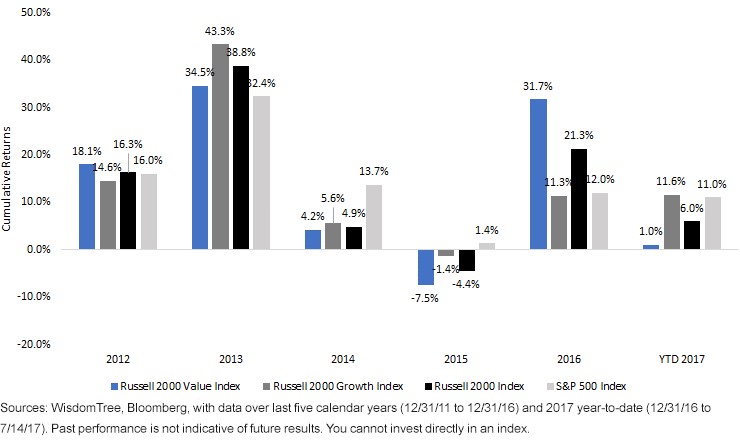
Small-Cap Growth & Small-Cap Value begin to diverge in 2015

By Chris Ganatti, Wisdomtree Investments

Special to the Financial Independence Hub

It seems like everywhere across the investment landscape in these days there is talk about “factors.” While this isn’t necessarily a new discussion (research has been done for decades regarding the drivers of excess returns within equities), it is easier than ever to pick and choose the factors to which you would prefer exposure.

Size: popular but volatile

When people get excited about changes — changes in policy, changes in growth expectations, changes in political leadership — we’ve tended to see this excitement show up in the behavior of small-cap stocks. We saw this most recently during the “Trump trade,” with the bulk of the performance response coming between the November 8, 2016, election victory and the January 20, 2017, inauguration.

  • In 2012 and 2014, the Russell 2000 Value Index and the Russell 2000 Growth Index performed very similarly. Even the approximate 9% difference between these indexes in 2013 wasn’t particularly noteworthy because U.S. equity market indexes across the board tended to be up 30% to 40% that year.
  • The most recent “tough” year for small caps was 2015, and it was clear that the Russell 2000 Value Index was the laggard, as the Russell 2000 Growth Index was nearly flat. But 2016 saw greater than 20% outperformance of the Russell 2000 Value Index vs. the Russell 2000 Growth Index. In 2017 through July 14, these indexes have reversed again, with the Russell 2000 Growth Index now outperforming the Russell 2000 Value Index by 1,000 basis points (bps).

Value, Growth, Core…What’s the “Right” Choice?

Based on what we’re seeing in more recent index behavior, trying to time the shift between value and growth could carry with it a significant opportunity cost and the risk of being incorrect. Intuitively, one might say, “why not just own all the stocks?,” which could then lead to the Russell 2000 Index: very much the status quo choice. But as we mentioned before, it has never been easier to fine-tune exposure to a market segment through the use of factors.

Over the long term, did Size or “Size-Plus” lead to outperformance?

Continue Reading…

Early Retirement: It’s a Lifestyle, not a Vacation

Billy and Akaisha in the Highlands of Ecuador

By Akaisha Kaderli, RetireEarlyLifestyle.com

Special to the Financial Independence Hub

Ever wonder how it was for us in the beginning of living life without a paycheck?

In 1991, we understood that we were retiring with the idea that we would not be returning to work. If we had to, we would, but it was not part of the plan. We were not taking a break from work, we were leaving the working world all together. It was a little unnerving to be making such a clean break because we were out on our own with little emotional support from family and friends. Our retirement at age 38 challenged the belief systems of everyone we knew.

Important points

After all this time, the most important thing we want our Readers to know is: Don’t let anyone destroy your dream. Learn to be self-sufficient and self-motivating and you can create the life you want to live. If you desire something strongly and it makes you happy, don’t look to others for approval. Move in the direction of your dream.

Additionally, we want to inform you of the value of tracking spending. We’ve tracked our spending since our early years of owning a restaurant when we were in our 20’s. This has given us a sense of control over our finances and that brings self-confidence. If you track your spending you always know where you are financially, and if you know your net worth you can calculate what percentage you are spending. A rule of thumb is to keep your spending at 4% or below of your invested capital. If the market changes or your life circumstances change, knowing where you are with your money output is priceless.

What we wanted to achieve

Above all else, we wanted our freedom.

We had been working 60-80 hour work weeks with very little personal time or time with family and friends. While we consider ourselves to be productive people and we loved our jobs, this amount of time focused on work began to feel like a grind. I am sure many readers understand this feeling as we were not unique. We longed for large stretches of time before us that were unstructured so we could do as we wanted, when we wanted. So we traveled, read books, took classes, played music, took photos, and met new people – all on our own time schedule.

This pleased us greatly.

The greatest lessons we have learned Continue Reading…