General

“So what do you make of bitcoin?” – question from a curious investor

Bitcoin, blockchain, initial token offerings  … yikes!  As financial headlines dedicate an increasing amount of coverage to this relatively new area, it’s left many investors scratching their heads.  What is bitcoin?  Do I need to know about this?  Am I missing out on an opportunity?   Below we present a question and answer that we hope investors might find helpful.

From a curious investor: 

So what do you make of bitcoin?  I am interested in your views on it as both an ‘investment’ and as a game changer.  Much to my annoyance, although I believe the world banks are inflating the money supply and the price of hard assets, this has not shown up in the price of gold.

I do not understand it at all. A friend of a friend has become a millionaire and yes he sold enough to make it real money …

Our response

While we’re by no means experts, we’ve thought about this and where we’re at with bitcoin is that while it may be a game changer, we wouldn’t invest in it as an asset in its own right.

Let me back up a bit.

The underlying technology that allows for the creation of bitcoin and other crypto-currencies , blockchain, is complex but the concept is not complex.  Essentially, rather than having a centralized system such as an accounting system or bank where the data is all held and processed centrally, blockchain allows for the data and processing to be decentralized.

They refer to it as distributed ledger technology.   It’s out there on the web, accessible to anyone but encrypted and secure.  Digital or crypto-currencies are just a really interesting application of this blockchain distributed ledger technology.  Up until now, it’s really only been national central banks that have been able to issue currencies and lots of middlemen (banks, brokers, other lenders) have developed to help manage the system and they all take a little off the top to help keep the system running.  Digital currencies can be huge disrupters of this status quo, cutting out middlemen and removing the central banks from the process entirely (maybe).

Bitcoin just happens to be the leading crypto-currency at this point.  There are lots of other ones as well as what’s referred to as crypto-tokens which not only serve as a medium of exchange but also have some other utility attached to them like they allow you to buy something or to receive a service (loyalty programs are a bit like this).  It’s still very early days in terms of any of these being a reliable medium of exchange.  For example for bitcoin the average transaction settlement time is around 45 minutes and often can be days.  Imagine being at the grocery store and wanting to pay with bitcoin from your digital wallet and you have to stand there for 6 hours before the grocer gets confirmation that you have sufficient bitcoin and can transfer it to the grocer’s digital wallet.  Your ice cream would have melted by then.  People also want a medium of exchange to be stable.  Bitcoin and other crypto currencies are wildly volatile.

Blockchain is a game changer

That said, I do believe the people that say blockchain and the application of it to crypto-currencies is a game changer.   I don’t know where it ends up or even if bitcoin will remain as the main crypto-currency but this could be a massive change.  Continue Reading…

What is a Mortgage Vacation?

By Sean Cooper

Special to the Financial Independence Hub

Do you enjoy going on vacation? Who doesn’t? So, the term “mortgage vacation” has to be something similar, right? When you hear mortgage vacation, you’re probably picturing yourself laying on a warm, sandy beach, drinking an umbrella drink. Well I hate to break it to you, but although you got the vacation part right, you forgot the most important part: the mortgage part.

A mortgage vacation is a feature that lets you skip paying mortgage payments for up to a few months, but with a catch. You have to prepay the amount in advance. In an era where savings rates are near record lows and household debt is near a record high, mortgage vacations have become a popular feature with mortgage lenders. Who needs to save for a rainy day when you have a mortgage vacation?

A mortgage vacation can help you out when you run into financial difficulty or when you want to use your cash flow towards something else. But as the saying goes, there’s no such thing as a free lunch. By planning ahead of time, you can avoid taking a mortgage vacation and still be on your way to burning your mortgage.

What is a Mortgage Vacation?

If you’re like most homeowners, you’re introduced to mortgage vacations in this way. You get a letter in the mail from your lender letting you know that you’ve been approved for a mortgage vacation. Yippee! The banks market mortgage vacations like they’re a privilege for their best clients, but as I mentioned earlier, there’s a catch. Hidden in the fine print is what happens when you skip your mortgage payment. Continue Reading…

When you retire where do all your friends go?

This question comes up at presentations I make on Victory Lap Retirement. A strong social network is key to our happiness and longevity. Friendships enrich our lives, so we should always look to build our social network and build relationships with people we care about.

The challenge for all of us is that we are so busy working and nurturing our families, we can sometimes underinvest in our friendships. Our relationships with friends can also suffer when we are stressed out and in some cases pull back from friends; after all, who wants to be a “downer” to our friends?

One of the biggest mistakes you can make is sacrificing your time with friends, just so you can work longer to save for your retirement. The risk is when you finally get there, you may end up wondering where all your friends have gone. We all have times in life where we have to invest time at work, which means not spending time with friends and family. Don’t lose sight of your friends and make it a priority to invest time strengthening your friendships, especially as you get closer to retirement.

Everyone has two groups of friends: work friends, the group you spend a great deal of time with; and your outside or real friends, people that know you warts and all, and accept you for who you really are.

Work Friends

If you take an inventory of your relationships, you may be at risk of a lonely retirement if you find the majority of your social network is from work. Continue Reading…

U.S. Inflation: A case of high anxiety?

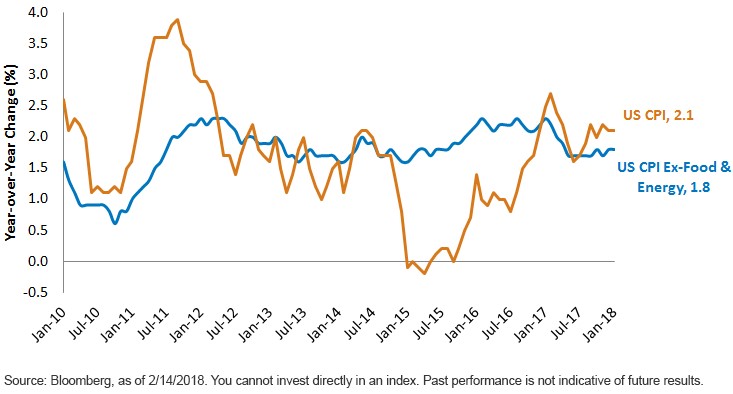
U.S. CPI vs. U.S. CPI ex-Food & Energy Year-over-Year Change from 1/31/2010 to 1/31/2018

By Kevin Flanagan, WisdomTree Investments

 Special to the Financial Independence Hub

There is no doubt that inflation fear has reared its ugly head early in 2018, impacting the money and bond markets in rather noteworthy fashion. Some key headline-grabbing measures, such as wages and the Consumer Price Index (CPI), have come in above consensus forecasts to start the year, fueling a case of high anxiety for the fixed income arena. Naturally, the million (or should it be billion?) dollar question is: Are these heightened inflation fears warranted?

As we entered the new year, consensus forecasts for inflation were that readings at both the overall and core (ex-food and energy) levels would essentially remain unchanged. Interestingly, economists’ projections have been revised upward of late and now post slightly elevated readings. Indeed, the CPI is now expected to come in at a year-over-year rate of +2.3%, or 0.2 percentage points (pp) higher than the prior projection. The alternate measure, the personal consumption expenditures (PCE) price index, has been changed to a +1.9% increase (also up 0.2 pp), with the core PCE gauge being lifted 0.1 pp to +1.8%. The bottom line is that these revised estimates now all look for some modest increase from 2017 levels.

What about the Federal Reserve (Fed)? For now, all investors have to go by is the policy makers’ December projections. The March FOMC meeting, scheduled for March 21st, will be the Fed’s next chance to make any potential adjustments to their prior forecasts.. The preferred measure is the PCE price index, and the policy makers provide projections for both the overall and core PCE gauges. The Fed’s central tendency estimate is similar to the revised market consensus, with a range of +1.7% to +1.9% for each index. It should be noted that both the economists’ and the Fed’s current PCE projections still fall below the +2.0% target laid out by the policy makers.

Let’s take another look

So, let’s take another look at the aforementioned wages and CPI numbers. Continue Reading…

Millennial financial plans include emergency funds but not insurance  

By Alyssa Furtado, Ratehub.ca

Special to the Financial Independence Hub

Millennials face financial insecurity through precarious work, soft wage growth, and student debt, but they do seem to be planning ahead for financial emergencies; they’re just not turning to insurance as a safety net, according to a new survey.

A poll of 1,000 Canadians by Ratehub.ca found millennials are saving an average of 35% of their pre-tax income, with 36% of respondents stating their emergency fund is a priority. By comparison, 33% of Generation Xers and 27% of Baby Boomers said an emergency fund is one of their key savings goals.

However, Canadian millennials aren’t as likely to turn to insurance as a source of emergency relief as their generational counterparts. Just 22% of millennial renters have tenant insurance (also known as contents or renter insurance), the survey found, compared to 31% of Generation Xers and 44% of Baby Boomers. Renters aren’t legally required to have tenant insurance, but many landlords will ask for proof of coverage before the lease is signed.

Tenant insurance not only helps renters protect the value of their possessions, but it can also cover the costs of repairing damage to their rental unit and the building. For example, if a renter’s toaster catches fire and causes damage to their unit and neighbouring units, tenant insurance could help cover the cost of the damages.

Millennials less likely to have health or dental coverage

Due to the fact that many millennials work part-time, are self-employed, or have contract positions, they’re also the least likely of the three generations to have extended health or dental insurance: 23% of those surveyed said they have this coverage, compared to 28% of Generation Xers and 32% of Baby Boomers. Continue Reading…