
General

Poking fun at investing clichés

“You sell when people are greedy and buy when people are fearful.” —Warren Buffett

Do you ever wonder what the gurus are really saying when they speak in clichés? Typically in trying to draw your attention to what is happening in the markets.

Don’t fret. I often find myself wondering just what someone said or meant. I suggest poking a little fun at this topic is a valuable exercise.

As in practically every other part of life, the world of investing is full of clichés. Some are pearls of wisdom to behold.

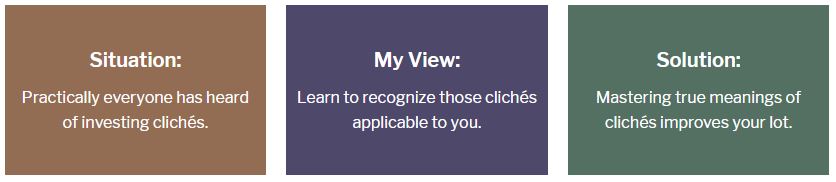
Hopefully, poking a little fun at these investing clichés helps you better understand ‘guru speak.’

They are found throughout the internet. Let’s uncover some common clichés favoured by the pundits and what the translations really mean.
Guru speak gems
Here is my sampling of “guru speak” gems and corresponding translations that stand out for me:


1.) “It’s different this time”
Some wild and crazy logic is about to be let loose.


2.) “Markets never move in a straight line”

Take the ups and downs in stride.


3.) “You’re catching a falling knife here”

It’s going to get worse before it gets better.


4.) “Greed can be the achilles heel of investors”

Sell when you can, not when you must.


5.) “Markets can stay irrational longer than you can stay solvent”

You had better have some deep pockets.


6.) “All the weak hands are getting shaken out”

I’ve lost a lot of money on this, but I’m still right.


7.) “You have to be defensive here”

I have no idea what is going on in the markets.


8.) “My thesis is still intact”

I am so underwater on this investment, I see the ocean floor.


9.) “Bulls make money, bears make money, pigs get slaughtered”

Take the money and run.


10.) “It’s the start of a new quarter”

Expect new money to flow into the markets to keep things going


11.) “There are big headline risks right now”

Hide your cash under the mattress.


12.) “Buy on rumour, sell on news”

Buy as you hear something may happen, sell when the company confirms it’s happening.


13.) “The markets like it”

I have no clue why stocks are rising.


Hopefully, poking a little fun at these investing clichés helps you better understand “guru speak.” Listen attentively for the next ones.

The messages are typically short and simple. For example, Warren Buffett reminds us how to buy low and sell high.

I’ve only just scratched the surface.

Adrian Mastracci, Discretionary Portfolio Manager, B.E.E., MBA started in the investment and financial advisory profession in 1972. He graduated with the Bachelor of Electrical Engineering from General Motors Institute in 1971, then attended the University of British Columbia, graduating with the MBA in 1972. This blog is republished here with permission from Adrian’s website, where it appeared on May 29, 2018

6 smart ways to clear Credit Card Debt as quickly as possible

By Shiv Nanda

Special to the Financial Independence Hub 

Credit cards can be a saving grace in time of financial need, but if abused can ruin your financial health. Most Americans have a love-hate relationship with their credit cards and the stats seem to agree.

Total US credit card debt is over $830 Billion.

 Of the more than $1 Trillion of revolving debts, Americans are carrying the vast majority of debt in 2018.

 Let’s break down these troubling credit card debt statistics by category:

Studies have found an average of 39% of credit cardholders pay their credit balances in full. And only 29% make low or minimum payments. This is an alarming finding because cardholders who make the minimum payments 20% of the time are the ones with a credit score of 800 and above. While cardholders with credit score of 700 and above are more likely to make full payments towards their credit-card balance. However, there are other factors that contribute to the credit card payment pattern:

1.) Income and Employment

 It is quite surprising that high income doesn’t guarantee freedom from debt. Ironically, the debt seems to be increasing with increase in annual income. And the highest credit card balances are seen with people with the highest income.

2.) Age and Gender

Studies reveal that older customers are more likely to pay their credit-card balance in full whereas middle-aged consumers may pay in full or pay the minimum amount due. Middle-aged consumers have high home expenses as they have dependents to take care of. Gender of the consumer is also a contributing factor of credit card debt. Data shows that men and women have a revolving debt of 29.9% with women having 3.7% less than their male counterparts.

3.) Region

Location has proved to be an interesting influence on credit-card debt. The Midwest and the Great Lakes regions seem to have responsible credit cardholders. They have the highest average credit score and lowest average credit card debts: while Alaska seems to have the highest credit card debt and average credit score stuck somewhere in between the high and the low.

6 smart ways to clear credit-card debt ASAP

1.) Have a plan and stick with it

It is essential that you take a stock of the situation. Continue Reading…

The pros and cons of long-term care insurance

SherylSmolkin
Sheryl Smolkin (SherylSmolkin.com)

By Sheryl Smolkin

Special to the Financial Independence Hub

A guide from the Canadian Life and Health Insurance Association highlights the increasing cost of long-term care and reasons for buying long term care insurance. However the high cost and restrictive provisions of long-term care coverage may make it inaccessible for those who need it most.

Long-term care is described in the guide as ongoing around-the-clock care in either a specialized residential care facility or by a professional or family member in your own home. In general, long-term care homes offer higher levels of personal care and support than those typically offered by retirement homes or supportive housing.

The CLHIA reports that in-home care including meal preparation, personal care and skilled nursing could add up to $35,000 to $65,000 a year, depending on the level of services required.  Local Community Care Access Centres administer the limited provincial subsidies available for at-home care.

However, all residential long term care is subsidized by the Ontario Ministry of Health with most Ontario residents currently required to pay only about 35 per cent of the actual cost. For example, based on the type of accommodation, in 2013 residents paid the following amounts:

  • Basic or standard accommodation:   $1,707.59 /month
  • Semi-private: $2,011,76 /month
  • Private: $2,361.55

Residents who cannot afford the full amount for basic accommodation can apply for a rate reduction. A more detailed fee schedule including rate reductions can be found here.

“One reason the industry is focusing on a need for long-term care insurance is the concern that with the aging workforce, Ontario will no longer be able to maintain the government subsidies at this level,” says Caring for Clients financial planner Rona Birenbaum.

But underwriting rules for long-term care insurance are very rigorous. For example, any person who is using an assistive device (e.g. wheelchair, walker or motorized scooter) is not eligible for coverage. Applicants with a variety of pre-existing conditions (e.g. dementia, metastatic cancer and stroke) are also ineligible.

Furthermore, premiums for long term care insurance can be very expensive for limited coverage.

I asked Birenbaum to get a hypothetical quote from Manulife Financial for a 50 year old couple (John and Mary) for a maximum of $300,000 shared coverage that would pay $3,000/month to a residential facility or $1,500/month for non-facility care with a waiting period of 90 days.

This means that in total John and Mary will have 100 months (8.33 years) of residential care benefits of $3,000/month they can draw on. If one predeceases the other, the balance of the protection will be passed on to the second spouse and the premium reduced to single life.

Activities of Daily Living

To qualify for benefits under the policy, John or Mary will have to show that at least two of the following cannot be performed without substantial help:

  •  Bathing
    •    Dressing
    •    Toileting
    •    Transferring (e.g., moving from a chair or out of bed)
    •    Maintaining continence
    •    Eating

The basic monthly premium is $210.40.* With the addition of inflation protection and a return of premium at death, the premium increases to $375.38/month*, with the premium level guaranteed only for five years.

“Because John and Mary may never need the service or qualify for it, I would prefer that they have the money to use for other things,” says Birenbaum. She suggests that money they spend on travel and other lifestyle enhancements in the first 10 years of retirement can be re-allocated to health care in later years.

She also advises clients to use their liquid resources such as RRSPs, pensions and other savings to fund retirement to age 90, leaving real estate as a hedge to sell later in life when they may need long term care.

Renters and people without paid up properties do not have this option to fall back on, but she says it’s also likely people of modest means will not be able to afford premiums for long-term care insurance in addition to other ongoing expenses.

“In long-term planning for my clients I prefer to focus on life, disability and critical illness insurance plus helping them to accumulate sufficient assets to self-insure for long-term care,” says Birenbaum.

Where there is a real need for long-term protection, she suggests critical illness insurance that can be converted to long-term care insurance. For example Sun Life offers a critical illness policy that can be converted to long-term care insurance starting on the policy anniversary nearest a policy-holder’s 60th birthday until the policy anniversary nearest the individual’s 65th birthday. When the policy is converted, insured clients do not have to answer questions about their health.

*Quote was dated December 2012.

See: A guide to long-term-care insurance, CLHIA

Sheryl Smolkin is a lawyer and journalist. You can find her work on sherylsmolkin.com and retirementredux.com. You can contact her through either website. This article is an edited version of Long-term care insurance can be expensive,  first published December 19, 2012 on thestar.com.


Value for Money: Do you always get what you pay for?

“This $6 bottle of wine tastes awful.” “What did you expect – you get what you pay for.”

It’s true, in most circumstances, that the quality of products and services increases as the price increases. You get what you pay for. When you cheap out on something, be it a bottle of wine, pair of jeans, or a manicure, more often than not you’ll end up disappointed. You might even end up paying more in the long run, having to replace the item or fix the mess you made when you cheaped out the first time.

One of the most common examples is with clothing. In this age of fast-fashion it’s not unheard of to find a t-shirt, pants, and a pair of sneakers – all of it – for less than $20. Anyone who’s ever shopped at Old Navy or Walmart can attest to this. But then what happens? The thin material starts to unravel, it’s improperly stitched, and it quickly wears out. Or, just as likely, it just doesn’t fit properly in the first place and so you never wear it.

I hate the term ‘investment’ when it comes to something that doesn’t have the potential to earn you money, but ‘investing’ in more expensive clothes can pay off. A well-cut suit, a timeless pair of shoes, work-out gear that doesn’t fray or pill after a few washes. Most of us can agree that spending more on a high quality item that will last a long time is worth the money.

Do you always get what you pay for?

But higher price = better product/service doesn’t always hold true. Take investing, for example. It’s widely accepted now that cost is the only reliable predictor of future returns. The higher the cost, the lower the expected return. The reverse is also true.

Canadian investors pay some of the highest mutual fund fees in the world and so it stands to reason that our expected returns will also diminish. We’re not getting what we pay for:  our advisors get paid and investors get short-changed.

Yet I’ve heard advisors use this argument – you get what you pay for – when trying to persuade their clients that low-cost indexing, or a robo-advisor, is an inferior solution to their actively managed model. Ridiculous!

Here are some other, hopefully, less controversial examples from my own personal experience where a higher price doesn’t always mean better quality. Continue Reading…

Could you become car-free?

Billy and Akaisha on a Jak-a-Ran in Thailand

By Akaisha Kaderli, RetireEarlyLifestyle.com

Special to the Financial Independence Hub

It wasn’t a decision we took lightly.

In fact, Billy and I discussed the idea of becoming car-free for several years. There were good reasons to do it: no more maintenance and repair costs; no more fees for insurance, license plate renewal, or registration; no more fuel expense; and no more worry about storing the vehicle here in the States when we are traveling overseas for months or years at a time.

But there were also some obvious downsides. We wouldn’t have the freedom to come and go at a whim. And because we live in the American Southwest, where temperatures reach triple digits in the summer, we wondered how we’d manage to get around during the sun season.

Silly idea or feasible plan?

Most people we know couldn’t fathom the idea of giving up their vehicle and saw this new lifestyle choice as a hardship. Americans love their automobiles, and owning one is packaged as part of the American Dream. A look at the automobile and truck commercials today describe how we will be sexier, more popular, physically stronger, and obviously smarter if we purchase their brand of car.

As we’ve described on our Retire Early Lifestyle website, Billy and I live in an active adult community where we are within walking distance to stores, restaurants, and several different entertainment options. Most of what we need is near to us, and we appreciate the slower pace of life with all the rewards it brings. Many of our neighbors use a small scooter, golf cart, or bicycle to get around within a reasonable range. When we need to go somewhere farther, we trade services or pay cash to a neighbor or friend for their time. This is much cheaper than a taxi, more sociable, and we aren’t bogged down with worries about maintaining a vehicle. Both sides appreciate the trade, and our lives are enriched.

After almost two decades of world travel, we realized that the only place where we need to drive is in the States. Elsewhere, we take public transportation or hire a private driver. For the amount of time we live in the States, and for the amount of money that owning our own transport required, we finalized our decision to sell our vehicle.

The year was 2009.

What about you? 

Retirement takes many expressions and even if you could never see yourself as becoming completely free of car ownership, maybe you have toyed with the idea of keeping only one vehicle instead of two.

The following sites may help you with this transition: Continue Reading…

Powered by the Financial Independence Hub.
© 2013-2026 All Rights Reserved.
Financial Independence Hub Logo

Sign up for our Daily Digest E-Mail!

Get daily updates from the FindependenceHub.com straight to your inbox.