General

Building flexibility into your Retirement Plan

Prospective retirees want a simple formula for making their retirement plan. There are hundreds of calculators that will crank out numbers showing how many years until you can retire, how much you need to save, and how long your money will last. It’s a good place to start, but don’t stake your entire future on the results.

You spend decades preparing for a comfortable retirement, planning to spend time playing golf or travelling the world. But, if a financial disaster strikes, those dreams may not translate into reality. Unexpected financial crises that disrupt savings are far more common than anticipated.

If your retirement plan only works as long as nothing goes seriously wrong, you are not properly prepared for retirement. It’s important to plan ahead. Knowing how you will handle certain crises can go a long way toward minimizing the financial fallout.

What kind of surprises can derail a retirement plan?

They can include:

  • Lost income.
  • Providing financial support to an adult family member.
  • Paying significant health care costs for yourself or a family member.
  • Divorce or loss of spouse.
  • Investment underperformance, or investment fraud.
  • Unanticipated major home repairs, especially after a natural disaster.
  • Changes in tax rates and legislation.

Let’s look at three situations that can derail your financial plan.

1.) Unpredicted early retirement

How would your retirement plan be impacted if you lost your job due to company downsizing? Do you have the marketability to find comparable employment elsewhere in a reasonable amount of time? Would you receive the same salary, or be forced to accept a lesser amount?

Lost income might be due to forced retirement for health reasons.

Not only would there be loss of income, you might have to dip into your savings earlier than expected. There could be expensive medical costs not covered by your provincial health plan.

2.) Providing financial support to family members

People over the age of 50 have the opportunity to beef up their retirement accounts with additional contributions. What if your child is forced to return home and/or require financial support due to a job loss, divorce, or health crisis? There may not be room in the budget to make those catch-up contributions.

As life expectancies increase, aging parents may require some expensive medical support or long-term care.

A lot of people currently care for two generations of family members.

3.) Investing challenges

Key investment objectives for retires are income and preservation of capital. Liquidity is important. Growth as well.

Investment challenges facing retirees include: Continue Reading…

Toronto Housing: Implications for Canadian Banks

By Jeff Weniger, CFA, WisdomTree Investments 

Special to the Financial Independence Hub

Is the footing getting shaky in Ontario housing? The Teranet–National Bank National Composite House Price Index for Toronto rose 272.8% from its inception in July 1998 to the peak last summer. Everyone knows nothing of the sort happened to wages. The average Canadian earned $579 a week back then and $988 today, a 69% change.1 Something is amiss, and maybe the bell was rung in July 2017.

The Toronto housing market appears to have turned on a dime, and the home price index is off 7.3% through 2/28/2018 (figure 1). Aside from the index’s 10.9% fall during the global financial crisis, this is the sharpest decline in Toronto residential real estate since the index’s inception in 1998.

Figure 1: Teranet–National Bank National Composite House Price Index, Toronto

When home prices quadruple in the span of one generation, with much of the appreciation in recent years taking on a “just buy before getting priced out forever” mentality, the natural concern is that  the 7% drawdown might be just a taste of what is yet to come.

This is where we are reminded that MSCI Canada has 43% of its weight in financials,2 and almost all of that is in the big banks. Canada is unique in that its banking system, for better or worse, is concentrated in the five national champions.3 The U.S. has 4,888 commercial banks,4 so major indexes like the S&P 500 do not have the same domination of Bank of America or Wells Fargo as the big players do on the TSX. In fact, in the developed world, Canada’s degree of sector concentration is akin to only Hong Kong, with hardly any other industrialized economies as reliant on so few key sectors. Continue Reading…

6 tips for managing your Kids’ bank accounts

By Emily Roberts

(Sponsored Content)

It’s 2018 and the days of buying your kids a piggy bank are long gone. It makes much more sense to let your kids have a bank account that will not only help them keep their money safe but also teach them how to grow and save it. Unfortunately, it seems as if most modern banks offer little to no incentive for kids to save their money and many focus on charging them as much as possible.

Transaction fees and unexplained charges can easily chew up what little money you deposit. Many banks will continue to charge exuberant monthly fees on small balances to the point where everything that was deposited is gone within a few months. This is why it’s important for you as a parent to find the right bank account for your kids that will help them get the most out of their money and hopefully grow it at the same time.

1.) Check those transaction fees

Most bank accounts come with a PDF or pamphlet (depending on how you apply) that stipulate the charges for every type of transaction. Sometimes these numbers are changed without notice, so be sure to check the fees for each type of deposit, withdrawal, and transaction. Advise your kids to deposit their money through your account or an ATM at the very least, as doing it over the counter is expensive.

2.) Teach your kids about saving

Educating your children about properly managing their money should be done long before they leave for college. Teach them how interest works, how saving their money is the right thing to do, and how to budget correctly. This way, they’ll know how to manage their funds better when they become independent.

3.) Link their bank to your phone number

Doing this means you can see every transaction that goes through. All of these usually come from a single number, so it won’t fill up your inbox. Not only can you see where their money goes, but if its stolen or their bank accounts are hacked, you’ll know first. Continue Reading…

By James Gauthier, CIO, Justwealth

Special to the Financial Independence Hub

When investors run out of contribution room in their tax-sheltered investment accounts such as RRSPs and TFSAs, they often continue investing in a non-registered account that does not have the same automatic benefit of avoiding or deferring taxes. Managing investments in a taxable portfolio then becomes a much more complicated exercise: one that attempts to maximize wealth on an after-tax basis instead of a pre-tax basis, which is how investments would be structured in a registered account.

Any investment income that is earned in a non-registered account is subject to taxation annually and can therefore be thought of as a “fee,” similar to the annual fees charged by your financial institution or advisor. As a robo-advisor that provides low-cost investment options for investors, we devote much time and resources to educating investors about the negative impact that investment management fees can have on their overall wealth. But unlike management fees, which are generally easy to identify and compare amongst different investment options, it is virtually impossible to find after-tax rates of returns for making apples-to-apples comparisons between various products and providers.

Most investment providers, including robo-advisors, use the exact same portfolio recommendations for their clients’ non-registered accounts as they do for their registered accounts, as long as the “risk” level is deemed to be the same. To illustrate the true cost of tax inefficiency, we can show how altering a portfolio recommendation, without materially altering the risk level or other characteristics of the portfolio, can improve the after-tax return of the portfolio.

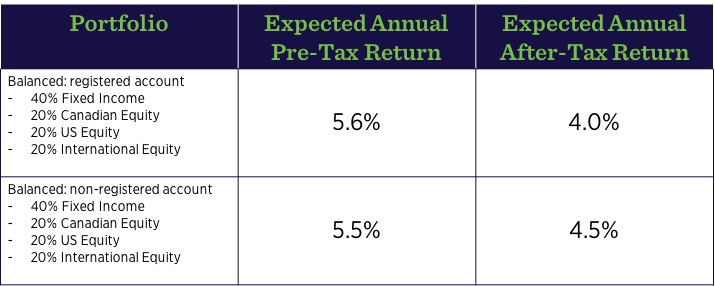
Consider an investor in the top marginal tax bracket who is considered to have an “average” risk tolerance and is invested in a Balanced portfolio of 40% bonds, 20% Canadian equity, 20% U.S. equity and 20% international equity. A reasonable long-term expected annual rate of return on this portfolio, on a pre-tax basis, is 5.6%. Applying tax rates to the interest, dividends (Canadian and foreign) and a conservative estimate for capital gains, the after-tax return on the portfolio is reduced to 4.0%.

By making some minor changes to the portfolio’s asset allocation, such as emphasizing asset classes that receive more favourable tax treatment and finding investment vehicles (ETFs in our case) that are innovatively structured to receive more favourable tax treatment, we can create a new portfolio that is very similar from a high-level asset allocation and risk perspective. The expected pre-tax return on this new, tax-efficient portfolio is slightly lower at 5.5%, but after taxes are applied, the return is a more favourable 4.5%.


The difference of 0.50% in after-tax returns should be considered the MINIMUM cost of tax inefficiency, since we have not yet addressed any other tax-inefficient practices. Extending the analysis across our entire range of investor risk tolerances (from Conservative to Aggressive) shows that the cost of tax inefficiency can vary from a low of 0.40% up to 1.00%. In most cases, the cost exceeds our 0.50% management fee, meaning that you would be better off paying our fee rather than having your assets managed for FREE at any another institution that does not use tax-efficient portfolios!

Continue reading

Are you concerned about Retirement?

“Retirement: World’s longest coffee break.”
—Author Unknown

Families are becoming increasingly concerned about achieving and maintaining their long term retirement goals. Some retirements will be in doubt. Others will fall short of the objectives. Having sufficient, reliable sources of funds is at the top of the worry list. Deploying a secure retirement plan spanning 20 to 30 years, often longer, is a demanding journey for many.

Planning for retirement remains a balancing exercise between providing for today and salting away a big enough portion for the later years. Sadly, not everyone gets it right. Hopefully, you will never have to face that dreaded realization. That is, you don’t have enough money to retire, or continue retirement, as planned.

“Most retirement concerns or mishaps typically surface after age 60.”

Someone who is broadly qualified should be in charge of stickhandling this exercise. Perhaps, someone who can take on duties of a “wealth pilot.” Extensive experience is desirable in navigating the nest egg through the myriad of temptations for making sudden moves. Logical decisions that place the family’s best interests first are a must. It also manages overreactions to daily headlines.

Canadian families rely on a combination of financial sources to fund retirement: personal savings such as cash, RRSP, RRIF and TFSA accounts. A variety of real estate properties contribute. Employer pension plan benefits are important to many. Government benefits typically include Old Age Security payments net of clawbacks and the Canada Pension Plan. The last two offer some flexibility as to when they commence. American families have their own assortment of registered accounts, such as 401(k) and IRAs, along with entitlements to Social Security.

Most retirement concerns or mishaps typically surface after age 60. This situation may pose a variety of difficulties to recover from. Some investing landscapes have been getting a little tattered of late. Continued low-return environments contribute to the dilemma.

What causes shortfalls

All retirements need to deal with several moving parts at once that develop along the roadway. I summarize some of the more critical reasons that affect retirement funding shortfalls:

  • Not saving enough to fully fund the family retirement.
  • Being in denial that the nest egg is not sufficient.
  • Spending more than can be safely drawn from the nest egg on hand.
  • Incurring large investment losses or borrowing more than safe limits.
  • Sustaining a breakup of the marriage or relationship.
  • Employer developments forced you to early retire sooner than planned.
  • Enduring a business failure or financial setback.
  • Involuntary payment reductions from an employer pension.
  • Incurring significant health costs or financial emergency.
  • Investment game plan is too conservative or concentrated.
  • Underestimating costs incurred, such as a retirement home facility.
  • Ignoring the adverse impact of inflation over the long run.

Investors are wise to delve into the pressures of delivering long-term portfolio results. Most nest eggs receive little or no saving capacity after retirement begins. Think of this as having to rely only on investment returns, say for 30 years. That is both hard to imagine and accomplish.

In addition, emotional attachments to investments owned typically prevent portfolios from taking corrective actions in a timely manner. For example, investors hold onto loss positions far longer than necessary.

Any one reason, or combination, can abruptly slam the brakes on family retirement goals. You typically need to act quickly to rectify the setback in the making.

I suggest starting with a deep breath. Then proceed to methodically analyze and estimate the size of your retirement shortfall. Sketching a few “what if” scenarios should help your family identify and select the best ways to move forward.

Assess your options

Continue Reading…