General

Why starting your own business is better than getting a job

By Savannah Wardle

Special to the Financial Independence Hub

Instead of getting a job, make a job. You can take a large vacant place where a business should have been and fill it with everything you’ve ever dreamed of. If you’re on the verge of a major career change, you have the unique ability to customize that change to your needs. It might be time for you to branch out on your own and do things for yourself: you can wind up better off for having done it.

It’s easier than it used to be

The internet revolutionized the way that people run businesses. It used to be that people were confined to working for someone else because they didn’t have the resources they needed to become fully independent. Now, almost everything you can’t do yourself can easily be outsourced to software, apps, or freelancers who know how to get things done the right way. It doesn’t matter if you need to hire a Twitter expert, have a catering website built, or find specialty garage door software. The internet has it, and you can use it to build your own empire.

You’re free to explore Innovation and Creativity

Think about all the aspects of your old job that were holding you back. Did you have bold new ideas that you were dissuaded from pursuing because they didn’t adhere to the company’s “play it safe” motto? You don’t have to worry about that anymore. You’re the one calling the shots, and if you know you have the potential to shake up your industry, no one is stopping you. You can try and try and try, even if you fail, and you don’t need to worry about the powers that be restricting you from exploration.

You can live the way you want  

If you used to work long hours and weekends, you probably felt like you were missing out on life. If you run your own business, you can be open from 9 to 5 on weekdays. Close up shop for dinner and the weekends and live your life. A lot of people cite work/life balance as being one of the reasons they opt for a career change, and if you’re one of those people, you can easily find the exact balance you want by becoming an entrepreneur or an independent contractor.

You get to build your dream team Continue Reading…

What the first week of Retirement is really like

By Fritz Gilbert, RetirementManifesto.com

Special to the Financial Independence Hub

I have no idea why I’m fascinated by the “First Week Of Retirement,” and I’m curious if others also wonder about it? I suspect many do and dedicate this post to those of you who wonder what the first week of retirement is really like.

Now that I’m living the first week of retirement, how would I describe it? Is it what I thought it’d be, or is it different? Is it a big deal, or just another week? Is it weird, or normal? Is it scary, or exciting?

Yes to all of that. And no to all of that.

What does Retirement taste like?

Have you ever tried to explain what something tastes like? Let’s go with chocolate, as an example. How would you describe it? What words would you use? Describing the first week of retirement is like describing the taste of chocolate. It’s really good, but it’s hard to describe.

Yeah, the first week of retirement is alot like that.

It’s good, but I can’t think of the right words to describe it. Regardless, today we’re going to try.

What the first week of Retirement is really like

Is It Like Taking A Vacation?

A Vacation In Norway. Is it like that?

As I write these words, I’m 5 days into my retirement (a true rookie). Is the first week of retirement like being on vacation? On one hand, kinda sorta, but that falls far short of describing the reality. It’s similar in that you’re off work for a few days, but it’s very, very different in the knowledge that You’re Never Going Back To Work.is


A Vacation that never ends will always feel different than a two-week vacation. Full Stop. So, imagine the first half of your vacation, where you’re all pumped up and excited. But you know it lasts for the rest of your life. Yeah, it’s more like that.

Only different.

I love swimming in my local mountain lake.

Is it like Saturday every day?

With less than a week of retirement under my belt, the “Saturday” analogy seems to be a better description of what the first week of retirement is really like. Like the Saturday’s you’ve experienced for decades, you’re free to do what you want to do. You’re ok letting your email go unchecked for a day or two. You can stay up later, you can sleep in.

You’ve got time to head up to the lake for that swim.

But it’s different because you know that there’s no Monday looming on the horizon.

What’s chocolate taste like?

Yeah, it’s hard to describe.

Is it scary, or exciting?

I had a friend ask me if I was “scared.” I answered that I was 98% excited and 2% scared. Sure, there’s some apprehension, but it’s a really small piece of my mindset in Week 1. At this stage of the game, I’m just learning my way around this thing called retirement, and enjoying the sensation of the very first Tastes Of Freedom I’ve worked so hard to earn. It’s only scary if you make it scary.

I know we’ll travel through many phases during our retirement journey, and I’m sure some will be more “scary” than others. We’re planning to take it all in stride. One day at a time, with some thoughts on where we want this thing to lead while leaving some freedom to enjoy the Serendipity of the thing.
You can choose what you want your retirement to be. Don’t choose scary. Life’s too short.

Choose the attitude with which you’ll live your life.

I’m choosing excited (and yeah, just a wee bit scared). Continue Reading…

How do Canadians feel about the new Real Estate regulations?

By Penelope Graham, Zoocasa

Special to the Financial Independence Hub

The anniversary of the implementation of the Ontario Fair Housing Plan has come and gone, and the playing field is just starting to even in the province’s housing market. Designed to cool demand and price growth in the Greater Golden Horseshoe, the 16-part package of housing regulations has effectively done just that, with sales down double-digit percentages throughout the region, and prices softening for the most expensive housing types.

Housing analysts argue that this result is mainly due to psychological factors, rather than the new regulations – which include a foreign buyer’s tax, and overarching rent controls – themselves.

But what do Ontarians really think about the new regulations? To find out, Zoocasa conducted a survey of 1,400 respondents on their sentiments around the highlights of the plan, and whether they support the government’s intervention in the free housing market.

Following BC’s footsteps

If Ontario’s attempt to tax foreign purchasers of real estate seems familiar, that’s because it closely resembles what occurred in British Columbia; the province initially implemented a 15-per-cent levy on foreign buyers within the Metro Vancouver area in August 2016, before upping the tax to a full 20 per cent, and extending the affected geographical area, in February of this year.

While Ontario’s version, called the Non-Resident Speculation Tax (NRST) still taxes just 15 per cent of a home’s purchase price, it will apply to anyone buying a home within the GGH – including homes for sale in Hamilton, or condos for sale in Mississauga, who is not a Canadian citizen or permanent resident (those who obtain such status, or who are enrolled in a minimum two-year full-time post-secondary program within a year of their home purchase are eligible for a full rebate on the NRST).

At the time of its implementation, former Ontario premier Kathleen Wynne was adamant that the tax was not intended to discourage newcomers to Canada from settling in Ontario.

“The Non-Resident Speculation Tax has nothing to do with new Canadians or people who want to make Ontario their home,” she stated to a media scrum on April 20, 2017. “This is targeting people who are not looking to raise a family, who are just looking for quick profit or a place to park their money.”

The measure appears to have resonated well with all Canadians; according to survey results, 69 per cent of respondents from all provinces indicated they support the tax, while 61 per cent felt foreign ownership directly impacts prices in the local housing market.

Perhaps not surprisingly, respondents from provinces with the most competitive real estate marketplaces were most likely to support the tax: 77 per cent of British Columbians and 70 per cent of Ontarians indicated they were pro-tax.

Support extends beyond affected Housing markets

However, even respondents from provinces where foreign investment and homeownership is not considered a stressor on the market, indicated support for the tax; 65 per cent of Albertans indicated support, even though only 40 per cent feel out-of-country buyers impact housing prices in their region. Continue Reading…

Investing for people over or under 45

By Tea Nicola

(Sponsor Content)

Your ideal investing strategy when you’re 25 just is not the same as when you’re 52.

That’s because what you earn is partly a function of what you’ve already managed to acquire. In Canada, about 85% of all financial assets are in the hands of people over age 45. Pension assets are held in the same proportions. On the real estate front, just 32% of all real estate value is in the hands of those under age 45. Meanwhile, fewer companies today offer a pension plan of any kind. The defined benefit pension plan is on its way to extinction.

What’s a young person to do? And for older investors who are going to retire earlier, how should their investment strategy change? What are the lessons that need to sink in when it comes to investing for people over or under 45?

What’s the investment strategy for Canadians under 45? Lower your fees!

You’re finished with school (at least for now). You’ve entered the job market and you’re starting to build up some savings. You’re diligently putting between 10 and 20 per cent of your salary into an RRSP. The younger you start to contribute to an RRSP, for instance, the sooner you can take advantage of compound interest.

Regardless, you want a good return on your investment and maybe you’ll get lucky and enjoy a bull market.

You can’t actually control that return, even if you’re investing in your own company … but if you’re using an investment platform like WealthBar or a traditional firm, you definitely can control how much you pay in fees.

For instance, with a WealthBar account, an investor might pay about 0.6% in management fees to WealthBar, versus 2.2% for a mutual fund at a bank. Put another way, an investor might pay $10 a month for WealthBar to manage $25,000, versus nearly $46 per month with a typical bank mutual fund.

Fees add up! While it may seem like the older generation controls the vast majority of assets (OK, they do), young people can at least control how much they pay a firm to manage their account. The right choice can literally save hundreds of thousands of dollars in value that would otherwise pad a financial adviser’s pocketbook.

But, should you race to the bottom? Perhaps not. Ensure that your strategy is still sound and diversified in order to achieve your goals in time. So, do not invest all your money into that 0.05% US Equity ETF. Some fees are ok, if they provide value such as diversification, cash flow, currency alignment and liquidity.

What’s the investment strategy for Canadians over 45? Reduce your risk!

Perhaps you’re one of the lucky Canadian investors over 45 who has had a good run. A pride-inducing chunk of that 85% chunk of financial assets are in your account. Continue Reading…

Retired Money: How to be financially, physically and emotionally fit for Retirement

My latest MoneySense Retired Money column, which has just been published, looks at a self-published book by the semi-retired (at age 64) Howard Pell. His book is titled Retire Fit, Fit & Fit. Click on the highlighted headline to retrieve the full MoneySense column: Retirement fitness involves mind and body, as well as money.

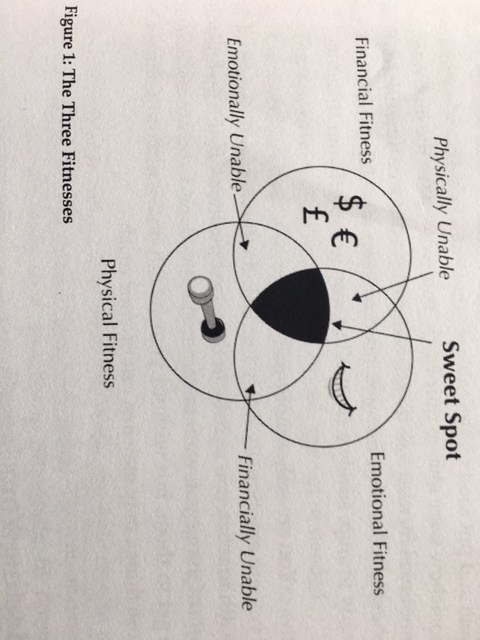
So what does the Fit, Fit & Fit mean? It’s in the headline of this blog as well as the adjacent photo taken from the book cover, which is the book’s subtitle. So it’s referring to being all three of financially fit, physically fit and emotionally fit for Retirement.

There are plenty of books about financial fitness so Pell pays only lip service to that aspect: what he brings to the table is insights on how to integrate finances with physical and emotional fitness. (To some extent, so does the book I co-authored with Mike Drak: Victory Lap Retirement)

Pell, who is based in Waterloo, Ont., does add a few newish terms to the semi-retirement lexicon.  He dubs the lifestyle “voluntary unemployment” but like many at this stage, finds the word “retired” inadequate. He tosses out several alternatives but the best one is his suggestion to simply adopt the Spanish word for “retired,” which is Jubilado (for males) or Jubilada (for females.”) He would use the term to signify anyone who is financially, physically and emotionally fit.

I can certainly relate to his observation of the semi-retired life that  “The big difference is that now all my deadlines and commitments are self-imposed.” Of course, as the old quip goes about driven self-employed business people: “My boss is a slavedriver.”

Pell also went personally through the “glide path” to semi-retirement described in other Retired Money columns and here at the Hub, via working a three-day week for his then employer during the last two years of his time there. This is a good way to test out your financial fitness while also clearing time for more physical fitness and — perhaps the toughest challenge — preparing for emotional fitness for retirement (I’m speaking for myself here.)

Finding the sweet spot

A Venn diagram on page 7 of Pell’s book (shown adjacent) illustrates that the sweet spot is the intersection where financial, emotional and physical fitness all converge.

If they don’t, and you became financially fit by selling out either your physical and/or your emotional health, the retirement your finances make possible may be a very limited and unsatisfying one.

It’s also possible to be only physically fit or only emotionally fit but lack the financial resources for retirement. The need to keep working to pay the bills will be frustrating, especially if all your peers have retired.

Continue Reading…