
Victory Lap

Once you achieve Financial Independence, you may choose to leave salaried employment but with decades of vibrant life ahead, it’s too soon to do nothing. The new stage of life between traditional employment and Full Retirement we call Victory Lap, or Victory Lap Retirement (also the title of a new book to be published in August 2016. You can pre-order now at VictoryLapRetirement.com). You may choose to start a business, go back to school or launch an Encore Act or Legacy Career. Perhaps you become a free agent, consultant, freelance writer or to change careers and re-enter the corporate world or government.

How to find your Encore Career

By Sheryl Smolkin, Retirement Redux

Special to the Financial Independence Hub

cf-old-and-new--timelines_500pxI recently interviewed Lisa Taylor,  president of Challenge Factory, for savewithspp.com. Challenge Factory helps individuals make career transitions and employers dealing with an aging workforce.

Her organization draws on the talents of a wide variety of professionals as required by individual clients. But what’s really interesting is that they have a roster of over 160 people who are experts in their own jobs, who have agreed to take on Challenge Factory clients for one-day test drives.

“If you’re in one occupation, and you’re thinking that you might want to go and do something totally different, the best way to make a decision is to do a dry run,” Taylor says. “This gives our clients an opportunity to spend a day with an expert in that particular field to find out if their assumptions are really true and whether the job is really as great as they thought it would be.”

A life stage that can last 20 or 25 years

I asked Taylor what the terms second act, encore or legacy careers really mean to her. Continue Reading…
Global study finds 15% of Canadians plan never to fully retire but many will embrace semi-retirement

By Jonathan Chevreau

Financial Independence Hub

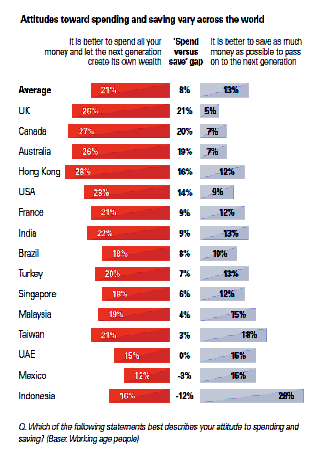
nonameA global study on retirement finds 15% of Canadian workers don’t expect to ever fully retire, but many plan to downshift gradually into semi-retirement.

Compared to 14 other countries surveyed, Canadians do well in reaching their later-in-life goals, even if they have to spend all their wealth and leave less to their children.

HSBC’s latest global report — The Future of Retirement, Choices for later life – surveyed 16,000 working-age and retired people, including 1,000 Canadians.

When asked about their attitude towards spending and saving, 27% of working-age Canadians say “spend all your money and let your children create their own wealth.”

The study also found Canadian retirees are much more likely to reach their later-in-life goals than some of their counterparts in other countries. 44% of Canadian retirees have reached “at least one of their retirement hopes and aspirations,” well above the global average of 24).

Mixed sentiments on semi-retirement Continue Reading…

Budget 2015: The Findependence Trifecta comes home!

Horse racingHere’s my latest MoneySense blog, covering Tuesday’s federal budget: Seniors Hit Jackpot with Budget 2015.

As you will note from the adjacent illustration of a horse race, we have focused on the big three measures we called earlier today the Findependence Trifecta.

As we noted on the Hub shortly after 4 pm, all three measures came through as telegraphed in the major media in recent days, including MoneySense. That is, almost-doubled TFSA annual contribution amounts ($10,000), reduced RRIF withdrawal rates and reduced tax on small businesses.

Now what’s all this about trifectas? Back in February, we ran a blog both at the Hub and at MoneySense about my reflections on harness racing in Florida, and its (somewhat remote) application to asset allocation. For those not familiar with the term trifecta, here is Wikipedia’s definition.

In a nutshell, horse-racing enthusiasts (“gambling” is such a harsh term!) make a bet on three specific horses placing one-two-three in a particular race. As you can imagine, this is not too likely: it’s a lot easier to bet on a single horse to “show” by coming in either first, second or third. But to  correctly identify the first-, second- and third-place winners in exact order involves considerably longer odds. So it’s a big deal if you actually get it right and win a massive bet called the trifecta.

Of course, when it comes to financial independence, the analogy breaks down a little. But as I note in the MoneySense piece linked above, I think we should all be happy with the budget. Enjoy your potential future winnings from the Findependence Trifecta! 

For convenience and archival purposes, we’ve also republished a version of the blog below: Continue Reading…

Budget 2015: Savers, retirees hope for more TFSA room, lower RRIF minimum withdrawals

17036735929_81f61edc6e_n
Finance Minister Joe Oliver (Department of Finance/Flickr)

By Jonathan Chevreau

Journalists and financial experts will be entering a “Lock-up” this morning in Ottawa, getting roughly a six-hour head start on the rest of us on the contents of the 2015 federal budget.

Even so, a combination of leaks and informed speculation give us a pretty good idea about the contents, which will gush forth within seconds of 4 pm, when the embargo is lifted.

Here at the Financial Independence Hub, we will be focusing on three main measures that if announced will do much to speed or improve our collective “Findependence.” Our hoped-for “trifecta” from Finance Minister Joe Oliver (pictured above) includes the much-delayed promise of a doubling of annual TFSA limits, a lowering of minimum withdrawal limits for RRIFs, and lower tax rates  for small business. Continue Reading…

How to Choose a Retirement Location

By Billy and Akaisha Kaderli,

Special to the Financial Independence Hub

Chiang Mai, Thailand

So you and your spouse have decided to retire. At some point in your retirement planning you must ask yourself where you would like to spend your Golden Years. The following questions and insight should place you on the right path for finding just the location that suits your needs.

First things first

The first question you must ask yourselves is whether you want to stay in the home in which you are currently living or would like to move elsewhere. Retirement is a big step.  Sometimes people feel more secure staying in familiar surroundings because it makes the transition to your new lifestyle smoother. Others, for financial reasons, a change of pace, health reasons, or for better weather, want to relocate. In this case, the next decision you must make is whether you want to stay in your home country or move overseas.

If you want to stay in your home country you must decide what sort of climate is most attractive to you. Do you want to experience the four seasons or have a more moderate, year-round climate? Do you like mountains or beaches? What size of city or town do you most enjoy? These questions are important because they automatically exclude places you won’t need to research. Knowing what you prefer in climate, city size and geographical configuration carries a lot of weight in terms of your happiness quotient.

Another thing to consider is that if you choose a town or small city, are there adequate medical facilities nearby? Larger cities tend to have a full range of medical care. Smaller towns generally have clinics and a variety of doctor’s offices, but perhaps not the equipment needed for complex medical situations.

Narrowing your search

Continue Reading…