Hub Blogs

Hub Blogs contains fresh contributions written by Financial Independence Hub staff or contributors that have not appeared elsewhere first, or have been modified or customized for the Hub by the original blogger. In contrast, Top Blogs shows links to the best external financial blogs around the world.

Retireby40’s take on Semi-retirement and Victory Lap Retirement

joeudo
Joe Udo of Retireby40.org

By Joe Udo, Retireby40.org

Special to the Financial Independence Hub

It might be surprising to new readers of Retire by 40 that I don’t believe in the traditional definition of retirement.

Yes, the site is titled Retire by 40, but I really meant Semi-Retire by 40. The idea is to leave the stressful corporate job life and continue to work part-time on something I enjoy. I don’t want to spend every day lounging by the pool or golfing at the country club. That sounds nice, but I’d be bored out of my mind in about three days! Full retirement can wait until I’m 70.

The problem is Semi-retire by 40 just doesn’t have the same impact as Retire by 40. There wasn’t a good word to describe what I was aiming for … until now. Mike Drak and Jonathan Chevreau’s new book Victory Lap Retirement describes exactly the lifestyle I wanted when I started blogging.

What is a Victory Lap?

The following paragraph from the book explains it perfectly: Continue Reading…

How Collecting can keep you young

Old postage stamps from various countries on wooden tableBy Cher Zevala 

Special to the Financial Independence Hub

For your entire adult life, you saved diligently for retirement, but if you want to make the most of your savings, you need to remain healthy for as long as possible. Being physically active will keep your body in good shape, but your mind also needs exercise as you age — which is why you should consider starting a collection.

Humans have a drive to collect things; it’s what helps our species survive and thrive in an unpredictable environment. However, now that you have the time, you can begin collecting items of interest that you can show off to friends and fellow collectors. Here are a few benefits to starting a collection so you can be happy and healthy for decades after you retire:

Reduce Stress

Stress is terrible for the mind and soul, but it does dreadful things to the body, too. Research shows that excess stress ages your body’s cells prematurely, causing all sorts of age-related diseases, such as Alzheimer’s and hearing and vision loss, before you might naturally develop them. Unquestionably, the less stress you have in your life, the better.

Research also shows that having hobbies can reduce stress as well as exercise, which is to say: quite a lot. Unless you feel like going for a run ― and few retirees can truthfully say they do ― you might start finding something to collect to cut down your stress.

Appreciate Beauty

There is beauty in the world, and with the right collections, you can prove it. Artwork, jewelry, books, and even droll items like stamps and coins can be evidence of the sublime. It doesn’t hurt to have pretty things around you, but you do have to locate and gather the things you find most precious and appealing.

Continue Learning

Continue Reading…

Book Review: The Devil’s Financial Dictionary

41ixw3fyeLL._SX354_BO1,204,203,200_Like most closed shops, the financial industry features its own specialized vocabulary. As an investor, the key to understanding the financial industry is to understand the buzzwords and special terminology that are as often used to obfuscate concepts as to illuminate investors.

All of which makes Jason Zweig’s The Devil’s Financial Dictionary an invaluable tool for serious investors. Zweig is of course the Wall Street Journal’s eminent personal finance columnist. The book, published late in 2015, was inspired by Ambrose Bierce’s classic book, The Devil’s Dictionary.

As Zweig writes in his book’s introduction, “If investors are to be partners instead of pigeons, they must master the many ways in which Wall Street uses language to conceal rather than reveal information. Every profession is a conspiracy against the laity, and every profession’s jargon is meant to confuse and exclude those who aren’t part of the guild.”

If you learn nothing else, consider the following pithy observation by Zweig:

The denser the jargon, and the more polysyllabic the terminology, the more likely someone is hiding something from you.

Arranged alphabetically, as one would expect of a dictionary, this is a book you can peruse randomly; in fact, I’d suggest that approach. Without further ado, here are some sample definitions that got my attention and/or made me chuckle: as you’ll see, many of the definitions are simultaneously amusing and yet useful in penetrating the true meaning of many financial terms. They’re also quite cynical, which is half the fun: I’m sure Zweig had a blast writing them up in the first place.

ANALYST, n. A purported expert on a company who in theory estimates its value by breaking it down into its constituent parts but in practice functions as a salesperson and cheerleader.

CREDIT CARD, n. A thin slab of plastic that enables a person to feel pleasure today by incurring pain tomorrow. Continue Reading…

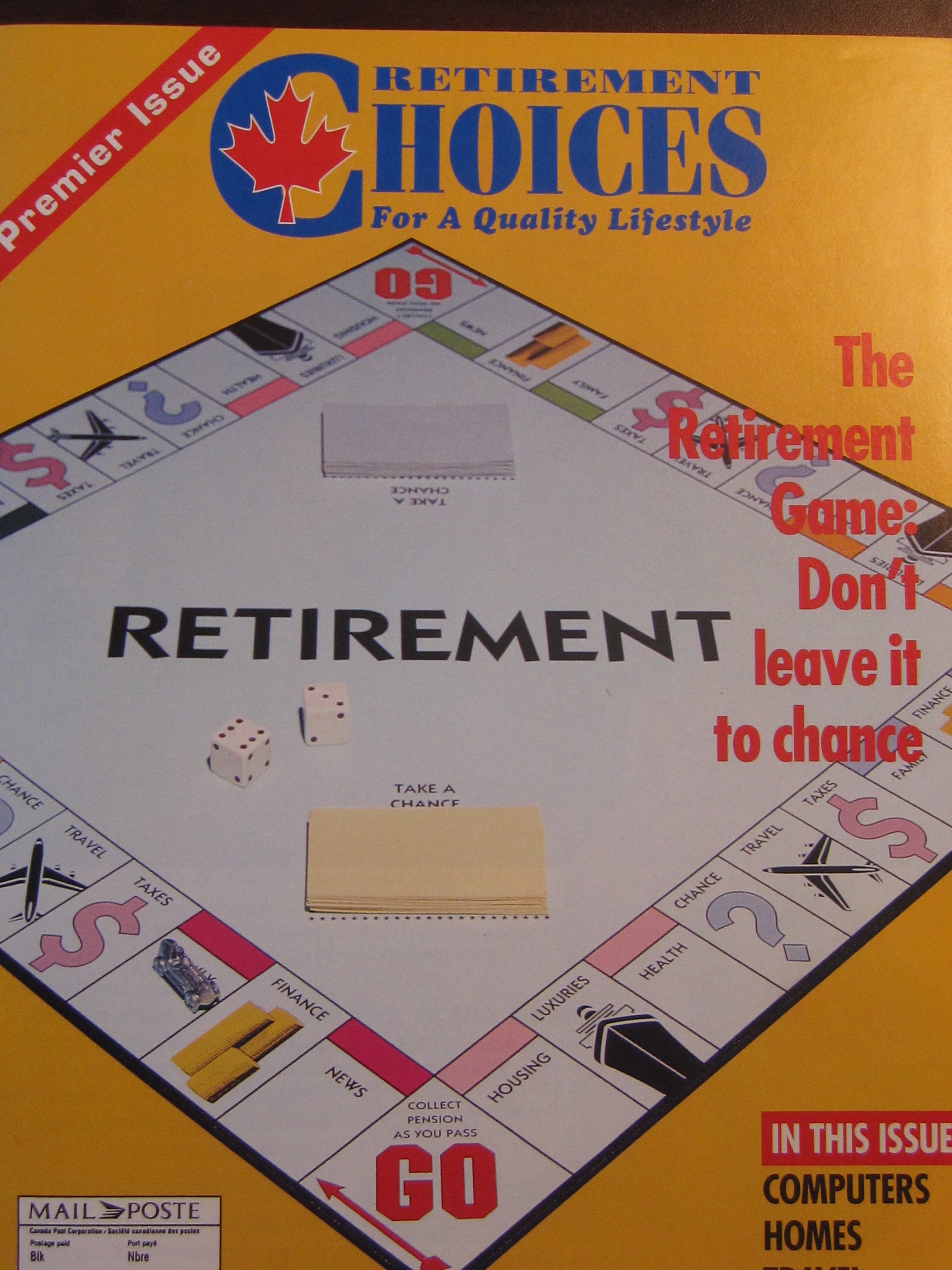
Retirement as a Board Game

img_8015by Mark Venning, ChangeRangers.com

Special to the Financial Independence Hub

At the risk of being too serious over a Labour Day long weekend, I decided to lay out some ideas for future blog posts. In the process, I found my way back to my newly refiled library of articles and reports related to a multitude of topics under the theme of aging and longevity.

This is one of my instinctive ways to begin thinking of the future: appreciate the threads of history and see how far we have come along on a particular subject.

Well, as it happens, when it comes to the subject of “Retirement,” maybe not that far. In some ways, the vocabulary associated with this concept still rests in the same dictionary from thirty years ago in the mid-1980’s to early 90’s. During that period in my retail career, I was setting up exhibits at Seniors consumer shows in Toronto, featuring travel-related products to a 55-plus market (which seemed to be the entry level, as I recall).

If you made the circuit up and down the aisles, you could satisfy all your “lifestyle” needs, from the Craftmatic bed (still going strong), to golf-oriented retirement resorts and back support systems. Twice in the day, you could sit in on a retirement planning seminar, featuring the top ten tips to finding financial security, before you returned to see the rest of the show, from RV sales to cremation services and vacation cruises.

Targeting the Seniors market

Fast forward to 1994, I found myself interviewing for, among other things, marketing positions that targeted this same Seniors market. None of that materialized, but I do recall one interview with the Canadian Snowbird Association in Toronto, where I was given a research project and as part of the process, make a business case to prove I really wanted to work with them. Everybody should be so lucky to be asked to do this. Excellent experience as it turns out.

One of the items the director tossed at me as I was leaving that first meeting was a twenty-page set of US and Canadian articles on the organization. Two main shout-out advocacy points for traveling seniors (notably the “over 65 age group”) were their “threatened” out of country medical coverage, and government clawbacks in health spending. Reading this now, by most press accounts this sounded militant back in 1993.

Thorny after all these years?

Continue Reading…

Never mind a few years more Longevity, what about Immortality?

longforthisworldbookWe’ve reviewed several books about Longevity over the nearly two years the Hub has been running, the most recent one being Mark Venning’s review of The 100-Year Life. (See Superlongevity: The 100-Year Life in a Blue Zone).

I mentioned this book in my talk Thursday to T.E. Wealth, in the context of the prospect of an 80-year investment time horizon for Millennials. (Implication of that: 100% stocks!)

But until now, for obvious reasons, we have held off on the “farther out” topic of immortality.

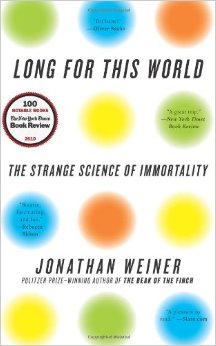
Even so, there is a growing literature on the topic of what I might term “ultra-longevity.” One in this camp is Long for This World: The Strange Science of Immortality.

Published in 2010 by science writing teacher Jonathan Weiner, the book focuses on a real believer in the possibility of human immortality: one Aubrey David Nicholas Jasper de Grey, who he quotes thus: “When you start talking’ about five-hundred year humans, or one-thousan’-year humans, most members of the general public get a li’l bit nervous.”

Indeed, and Weiner himself seems skeptical, despite providing such a platform to Aubrey de Grey. As the back-cover blurb states, “Could we live forever? And if we could — would we want to?”

Continue Reading…