Hub Blogs

Hub Blogs contains fresh contributions written by Financial Independence Hub staff or contributors that have not appeared elsewhere first, or have been modified or customized for the Hub by the original blogger. In contrast, Top Blogs shows links to the best external financial blogs around the world.

Is a fixed-rate or variable-rate mortgage right for you?


By Alyssa Furtado, RateHub.ca

Special to the Financial Independence Hub

Interest rates in Canada have rarely seen such lows, which makes borrowing money to buy a home pretty attractive. But when you start looking around for the best mortgage rates, homebuyers face a choice of going with a variable-rate or a fixed-rate mortgage.

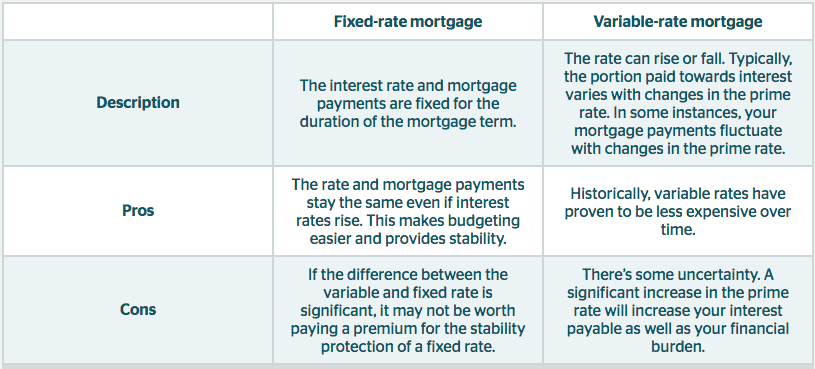
So what’s the difference? A variable-rate mortgage follows interest rates as they move up and down. And a fixed-rate mortgage is locked in for a certain term. Sounds simple, but deciding which option works for you can depend on a number of factors. Here are some essential pros and cons:

Fixed-rate mortgages

Pro: Added security

You don’t have to worry about whether your payments will change because of economic factors you can’t control during the mortgage term. This makes long-term financial planning much easier.

Say you get a five-year fixed-rate mortgage, with a 2.5% interest rate. Regardless of whether interest rates go up or down elsewhere, the rate will stay at 2.5% for the entire five-year period. This allows you to set it and forget it until it comes time to renew your mortgage, at which point you’ll need to renegotiate your rate. At this point your rate could be higher or lower.

Con: Added expense

The luxury of knowing your rate will remain the same will likely cost you, as fixed rates tend to be higher overall.

Variable-rate mortgages

Pro: You can save a bundle

Although by no means guaranteed, historically borrowers save more money over time with this method. Your rate is correlated to the prime lending rate, which can fluctuate. Your rate is quoted as the prime rate plus or minus a certain percentage, such as prime minus 0.4%. In this instance, if the prime rate is 2.7%, your mortgage rate will be 2.3%. Such a small percentage might not look like it will affect your payments, but the savings will add up significantly over time.

Con: Rates can always go up

The variable-rate option comes with a certain risk. If your bank’s prime lending rate changes, the interest moves up or down in conjunction with it. The amount you actually pay your lender on a regular basis (biweekly, monthly, etc.) won’t necessarily change. If the interest rate goes down, more money from your payment will go toward paying down the principal. If the rate goes up, more of the payment will be eaten up by interest, and sometimes your regular payment can also rise. Continue Reading…

The 10 most common Millionaire Habits

By Jessica Kane

Special to the Financial Independence Hub

The ambition and ability that it takes to achieve wealth comes from all kinds of people, but not all from the same locale, upbringing or backgrounds. This begs the question, do rich people have anything particular in common? Well in a sense, yes they do.

Most of the people who have achieved the status of millionaires engage in daily rituals that help them meet their goals. These are primarily activities that engage them in a personal and private way, but many other millionaires share these daily rituals in common with other wealthy individuals.

So for readers who would like to become richer and realize their potential to become millionaires themselves, here are the ten things to consider incorporating into your own daily routine. These 10 daily rituals may be the boost you are looking for to become the next millionaire, or at least a person of better financial means.

1.) Be the Early Bird

Everyone has heard this one expressed by mentors in life, but not everyone takes it to heart like they probably should. Starting early is a common theme when discussing daily rituals with most modern day millionaires. Getting a jump on the rest of the day begins by being awake earlier than the other birds out there. Also, being up early allows more time in the day and more hours to engage in personal activities. This seems to be the most common daily ritual that most millionaires practice.

2.) Maintain a healthy diet

Staying healthy is important, but a lot of people don’t make it a priority. Not the average millionaire: these people understand that a sick day means a non-working day. The more involved in wealth building a person becomes, the more value they place on their personal health and well being. Because if you are not able to get out of bed, you surely cannot make decisions and be there when needed in the business world. So eating right is a first step to being more successful.

3.) Keep fit and exercise

Continue Reading…

Self-employed? 5 tips on meeting the June 15th tax-filing deadline

By Lisa Gittens, Tax Expert at H&R Block

Special to the Financial Independence Hub

With more than half a million Canadians entering the ranks of self-employment each year according to Statistics Canada, the self employed are truly a (work) force to be reckoned with. As such, they should also be reminded their tax return deadline is just around the corner, on June 15th.

If you carried on a business in 2016 [sole proprietorship with a December 31st year-end: see Editor’s Note at the end of this blog], you should file by that date to avoid a late-filing penalty. And although penalties can be avoided if you file on time, it’s important to note that interest will still be charged on any balance due from May 1st 2017.

If you’ve recently joined the ranks of self-employment or have been self-employed for many years, here are a few pointers that can help you file this tax season:

Are you self-employed?

Although most people know if they are self-employed, generally speaking, you fall under this category if you retain control of how and when you do the work, supply your own tools to get the work done and run a financial risk if the venture is unsuccessful. Examples of the self-employed include Uber drivers, freelancers and small-business owners.

Some employers, however, treat their employees as self-employed when they should not be classified as such in order to avoid payroll taxes. If you are unsure of your status, be sure to request a ruling from the Canada Revenue Agency.

When to claim GST/HST

Continue Reading…

Turning 65 soon? Service Canada wants to give you OAS benefits!

Turning 65 in the next year? These things do eventually happen, God Willing!

The bad news is you are now considered by the Government to have reached Old Age; the good news is that also means Ottawa wants you to consider starting receiving Old Age Security (OAS) benefits the month after you officially turn 65.

My latest MoneySense column provides all the details, starting with a letter Service Canada should be sending you automatically shortly after you reach 64. Click on the highlighted text for the full column about how to get ready to receive Old Age Security benefits and possibly the Guaranteed Income Supplement (GIS) to OAS: What to expect when receiving OAS at 65.

As you’ll see, no action at all is required if they did send you this initial package and you’re happy to receive gross (pre-tax) cheques mailed to the address they have on file. If you want the funds deposited electronically to your bank and/or have tax deducted at source (as I did), then you either have to go to the web site provided or call them on the phone.

I have to say my initial attempt to do this on the Internet was a frustrating one. It turned out to be far easier to call them on the telephone on the English-language helpline listed in the letter: 1-800-777-9914. Due to “high call volume” I was put on hold for 15 minutes, during which time the automated voice advised listeners to apply for OAS at least six months before their 65th birthday and no more than a year in advance. It also said the maximum monthly OAS benefit is currently $578.53.

I chose to have 25% tax withdrawn at source so with no further action on my part, I can expect my first OAS deposit of $433.90 (net of tax) to arrive magically in my bank on or about May 29, 2018, and every month after that for as long as I live, like any other pension. By then it may be slightly more, as it may be indexed to the cost of living.

Take OAS early, CPP late if you can possibly swing it

Keep in mind that, like the Canada Pension Plan (CPP), you can opt to defer receipt of OAS benefits to as late as age 70, thereby raising the payout. I revealed my reasons for taking OAS as soon as it’s on offer in an earlier MoneySense column last summer: Why I’m taking OAS right at 65. Continue Reading…

U.S. Corporate Bonds: Taking all the credit

Investment-Grade Spread (RS) vs. High-Yield Spread (LS)

By Kevin Flanagan, WisdomTree Investments

Special to the Financial Independence Hub

Without a doubt, one of the better-performing sectors in the fixed-income arena over the last year or so has been the U.S. corporate bond market. Indeed, both the high-yield (HY) and investment-grade (IG) asset classes have enjoyed visibly positive returns both in 2016 and thus far in 2017, with HY registering specifically robust readings. Against this backdrop, questions have surfaced as to whether these types of performance can be sustained for the remainder of 2017.

And here we are, roughly five months into the calendar, and the question remains: Can the U.S. corporate bond market continue to produce positive outcomes? Oftentimes, market participants tend to focus on more recent trends, and in the process apply their findings to determine whether an asset could be overbought or oversold. In order to put recent developments in U.S. corporates into some perspective, we thought it would be a useful exercise to take a look at how HY and IG spreads have fared over a longer period (See chart at the top of this blog.)

So, where exactly are U.S. corporate bond spreads? According to the Bloomberg Barclays U.S. Aggregate Corporate Index, IG spreads have narrowed by 10 basis points (bps) since the end of the year, and stood at 113 bps as of this writing. This is the lowest level since the latter half of 2014. On the HY front, the Bloomberg Barclays U.S. Corporate High Yield Index shows the spread at 376 bps, a decline of 33 bps from the year-end 2016 tally, and also resides at levels last seen almost three years ago.

A slightly more dramatic way of looking at the current readings is to focus on how much these spreads have come in since the recent high watermarks were posted in February of last year. From this key risk-off period, IG spreads have declined by more than 100 bps, and an eye-popping 463 bps for HY. It is this combination of recent spread-narrowing and current levels that has prompted the aforementioned questions.

Some historical perspective

This is where some historical perspective is in order, specifically: Have we entered uncharted territory? Continue Reading…