Hub Blogs

Hub Blogs contains fresh contributions written by Financial Independence Hub staff or contributors that have not appeared elsewhere first, or have been modified or customized for the Hub by the original blogger. In contrast, Top Blogs shows links to the best external financial blogs around the world.

Why we are taking Social Security at age 62

By Billy and Akaisha Kaderli

Special to the Financial Independence Hub

We decided to take Social Security at age 62. We know there are as many ways to consider this decision as there are days in a year. And many experts advise against taking social security “early” so that you get a bigger check at full retirement age.

It is hard to argue against that.

We have always lived an unconventional lifestyle and the fact that so many experts agree on waiting for payment gives us pause for thought. Here is our logic.

First, the S&P 500 index has averaged over 8% per year, plus dividends, since we retired in 1991. If we take social security early and invest it, we won’t be losing the 8% per year the experts claim is the annual increase of waiting – although one is guaranteed and the other is not. Maybe the markets will trend sideways or go down or even up, no one knows.

For the last 27 years we have lived off of our investments through up and down markets, so investing the monthly check is definitely an option. More likely, we will just not spend our stash and look for opportunities in the markets as our cash positions grow. Plus we have control of the money at this point, adding to our net worth.

Next let’s look at some numbers.

11 years to break even

For easy math, say at 62 you are going to receive $1000.00 per month in benefits, but if you wait until you are 66, your payment will be $1360 ($1000 x 8% for the four years you have waited). Sounds great, right?

However, you would have missed receiving $48,000 dollars in payments from the previous 48 months. How long is it before you make that money back? Using this example it would take 133 months or a little over 11 years ($48,000 divided by $360) and that would put us at 77 years of age, just to break even. In that time frame, the Social Security we are receiving plus our investments should grow far outpacing the extra money received by waiting.

For some people deferring until their full retirement age could make sense, especially if they do not have the assets to support themselves, are poor at handling money or if they are still working. However, this is not our situation and therefore we decided to take the money and run.

It’s really a question of who you think can handle your money better; You or Uncle Sam?

Update: The illustration above shows the return of the S&P 500 Index since we took Social Security at 62.

Billy and Akaisha Kaderli are recognized retirement experts and internationally published authors on topics of finance, medical tourism and world travel. With the wealth of information they share on their award winning website RetireEarlyLifestyle.com, they have been helping people achieve their own retirement dreams since 1991. They wrote the popular books, The Adventurer’s Guide to Early Retirement and Your Retirement Dream IS Possible available on their website bookstore or on Amazon.com.
.

Retired Money: Should you worry a large TFSA will trigger a CRA audit?

MoneySense/Shutterstock

Should you worry that a large TFSA will trigger a CRA audit? My latest MoneySense Retired Money column looks at a legal debate between the Canada Revenue Agency and taxpayers who have succeeded too well in growing their Tax-free Savings Accounts (TFSAs) with shrewd investing. You can access the full story by clicking on the highlighted headline: Why the CRA is targeting some TFSAs in court. 

If you’ve contributed regularly to the TFSA since it began in January 2009 you now have $57,500 of cumulative contribution room. With decent growth, it’s easily possible to have accumulated $100,000 in a TFSA by now: in fact, the CRA told me for the article that of the 13.5 million TFSA accounts that existed by 2016, 18,000 have balances of at least $100,000 (a number that includes myself and my own Millennial daughter, thanks to a few good FANG stock picks).

A Globe & Mail article last week profiled several ordinary Canadian investors and financial bloggers who have TFSAs of at least $100,000. See How to Grow your TFSA: Tips from Financial Bloggers to Fatten Your Account.

My MoneySense article quotes an unnamed investor who is being audited because his TFSA has grown to $500,000, owing to  timely growth of some private technology companies. He doesn’t think $100,000 is enough to trigger an audit but suggests $250,000 may be. In other words, the CRA may be fine with TFSA doubles but five-baggers will invite scrutiny and ten-baggers most certainly so.

But the real controversy involves TFSAs that are run as de facto securities trading businesses. The Globe highlighted this latest crackdown in an earlier article in July but was merely the latest of a series of TFSA audit scares that have been surfacing virtually since after the first year the program existed.

Shrewd stock-picking is not “aggressive tax planning” 

Some of those earlier audits involved TFSAs that soared because they held private companies but my guess is that, as in my own case or that of my daughter, the vast majority of TFSA holders are neither day traders nor experts in investing in private companies. We only buy exchange-traded funds or blue-chip North American stocks, including the FANG tech giants (Facebook, Amazon, Netflix and Google). Continue Reading…

Want an affordable neighbourhood with top Schools? Head for the ‘Burbs

By Penelope Graham, Zoocasa

Special to the Financial Independence Hub

The mantra for real estate shoppers is typically “location, location, location” – but for those with kids in tow, it might as well be “schools, schools, schools.”

For parents, whether or not a home is close to a highly-ranked educational institution is a top consideration, alongside affordability, number of bedrooms, and parking.

In fact, living within a certain school catchment can significantly impact one’s home value: even homes located across the street from one another that are in different school zones may see that difference reflected on their home listing prices.

EQAO school ranking and home price are especially correlated in high-demand urban centres, such as the City of Toronto, where home buyers pay a premium of hundreds of thousands of dollars to live within their coveted catchment.

For example, in Etobicoke, where the top EQAO-ranked school of Lambton Kingsway Junior Middle School boasts a score of 3.2 (out of 4), home buyers would pay a premium of $821,580 to dwell nearby. In York, that premium is $689,178 to live near Humbercrest Public School (3.1), and $444,183 to be close to CD Farquharson Junior Public School in Scarborough (3.3).

Exploring affordability in the Greater Golden Horseshoe

However, those who wish to live close to a top-ranked school at a more affordable price are wise to head to the suburbs: according to recent data compiled by Zoocasa, the correlation between school ranking and average home price isn’t as strong in surrounding Greater Golden Horseshoe markets.

Consider the city of Hamilton, located just west of Toronto along the shores of Lake Ontario. Also known as “Steeltown” or the “Hammer” for its roots as a steel manufacturing centre, it’s now highly sought for its growing “eds and meds” industry; and the fact that detached Hamilton houses with large lots are relatively inexpensive.

Those looking to live close to the best schools have many options in Hamilton; for example, one of the top-ranked schools, Sacred Heart Separate School (2.9) is located in East Hamilton, where the average home price clocks in at $396,964. In upscale Ancaster, where the average home sells for $838,337, is the similarly-ranked Immaculate Conception Elementary School, illustrating similar education standards are available for buyers regardless of home budget.

Mississauga schools among the best

The City of Mississauga is also a great example of a municipality where good schools and real estate affordability go hand in hand. Continue Reading…

Retiring at home — and how to get the funds to do it

By Darlene Vilas

Special to the Financial Independence Hub

I’ve spent many years helping a lot of retirees to stay in their home. So, I wasn’t surprised when a survey by HomeEquity Bank and IPSOS revealed that 93% of Canadians aged 65+ are determined to retire at home.

For people with a healthy pension and retirement savings, staying in their home is rarely a problem. However, many Canadians have inadequate retirement savings. According to a report by CIBC, 30% of people have no retirement savings at all, while another 19% have saved less than $50,000. I help people with lower retirement income to understand the financial options available to them, so they can retire comfortably in their home.

Why staying put is so important

According to HomeEquity’s research, maintaining independence is a key reason for retirees wanting to stay in their home, followed by staying close to family, friends and their community.

Many of my older clients find just the idea of moving to be very stressful. They don’t like the thought of downsizing, which means leaving behind loved ones and places they’re familiar with.

I can understand that, so I try to help people stay in their home, whatever their financial situation. Thankfully, for homeowners, there are several options available.

The financial tools that can help you stay at home

Taking out a mortgage or a line of credit can allow you to cash in on some of your home’s equity. However, the mortgage option is becoming increasingly difficult for retirees. With the new mortgage stress test, you have to qualify at a much higher rate than before, which means you can now borrow much less. Plus, taking on mortgage payments for up to 20 years can put a strain on your retirement income. If you miss some payments, you could lose your home.

A home equity line of credit can be a good option if your income qualifies.  They are fully open and can be repaid at any time without penalty. This is a very helpful option for homeowners who would like to access cash easily if they experience unforeseen home expenses such as emergency repairs to the home. Payments are typically interest only, which keeps your monthly obligation at a minimum.   The downside of a home equity line of credit is they are callable at the discretion of the bank.  This means you could be forced to sell your home to repay the line of credit.

With a reverse mortgage, you can borrow up to 55% of your home’s value. You never have to make a mortgage payment and you’ll never be forced to move out. Many of my clients use a reverse mortgage as an efficient way of cashing in some of their home’s equity. Because there are no regular mortgage payments, it can help them to greatly improve their financial situation, boost their disposable income and live the kind of retirement they’d hoped for.

Those people concerned about maintaining their home’s equity can make monthly interest payments, but the nice thing is, they don’t have to. Continue Reading…

New mandatory risk rating is misleading Canadian investors

By Nick Barisheff (Sponsor Content)

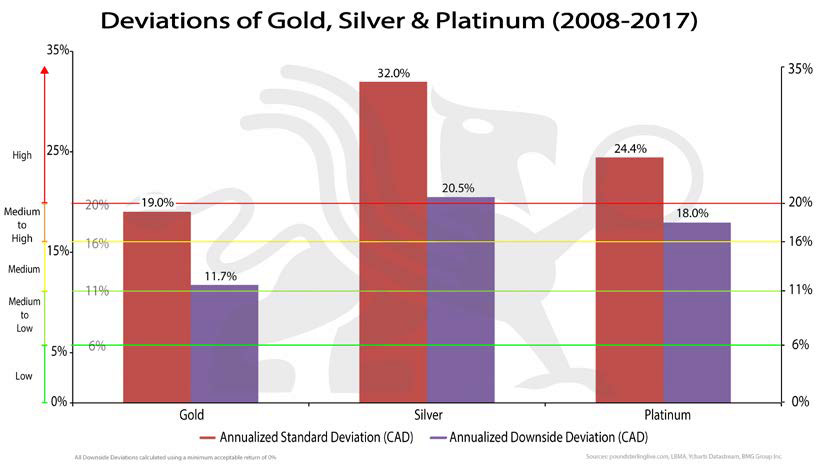
Canadian securities regulators may be putting investors at risk. They implemented a new mandatory risk weighting system in September 2017 based on 10-year Standard Deviation. Every Canadian mutual fund and exchange-traded fund (ETF) must now include a risk rating based on the following:

Before implementing this policy, the Ontario Securities Commission (OSC) asked for submissions from the industry. These can be viewed here.

Over 50 submissions were received (mine included.) and out of those, three warned about the deficiency that Standard Deviation does not differentiate between upside and downside volatility.

Scott C. Mackenzie of Morningstar made a particularly succinct comment:

“A conservative investor’s portfolio that is missing a key sector or asset class, essential for prudent diversification (and risk reduction), may demand the inclusion of a small amount of a concentrated sector mutual fund or ETF. A single measure risk score for such a vehicle may be higher than recommended for the investor and they are consequently dissuaded from incorporating it. The irony and potential downside is that the risk of the conservative portfolio may actually be higher than otherwise would have been had the investor included the diversifying investment. “Diversification as a risk-reduction activity is a sensible approach, practiced by many, and supported by decades of investment research.” http://www.osc.gov.on.ca/documents/en/Securities-Category8-

Comments/com_20140312_81-324_mackenzies.pdf

There are two major flaws with the methodology:

  1. It does not differentiate between Standard Deviation and Downside Deviation; and
  2. It measures individual portfolio components rather than the overall Standard Deviation of the entire portfolio.

This policy will not protect investors from experiencing losses, but may prevent investors from structuring portfolios for reduced volatility, optimal performance and effective diversification. The resulting reduction in investment demand in sector funds will result in a negative impact for many Canadian public companies.

The overall weakness of this approach is best exemplified by the fact that Bernie Madoff’s fund had the lowest Standard Deviation in the industry for over 30 years – yet investors lost most of their money.

David Ranson of H.C. Wainwright & Co. published a report entitled “Why Standard Deviation Won’t Serve to Classify the Risk of a Portfolio.” This report details why Standard Deviation is a poor and overly simplistic approach to measuring the risk of a portfolio.

“The riskiness of an investment product cannot be represented by the Standard Deviation (volatility) of its historical returns, or by any other single statistic … On a real risk scale, cash could be assessed as risky and gold as safe.” 

http://bmg-group.com/wp-content/uploads/2017/12/why-standard-

deviation-wont-serve-to-classify-the-risk-of-a-portfolio.pdf

As an example of how flawed this policy is, Morningstar Canada lists 9,412 equity classes of mutual funds. Of these,1,932* have 10-year performance histories. The best-performing fund is the TD Science and Technology Fund, which achieved an 18.00% 10-year annualized return net of MER. A $10,000 investment in 2007 would now be worth $66,554*.

On the other side of the performance scale is the Brompton Resource Fund. It ranks as 1,932*(last) in performance and has experienced a-21.8% annual decline over the same 10-year period. A $10,000 investment ten years ago would now be worth only $643*.

*As of July 18, 2018

The 10-year (2008-2017) Standard Deviation for the TD Science and Technology Fund is 17.7% (MEDIUM to HIGH RISK) and for the Brompton Resources Fund it is 29.57(HIGH RISK)However, the Downside Deviation is 10.6% (LOW to MEDIUM RISK) for the TD Fund and 25.7% (HIGH RISK) for Brompton Fund.

It should be obvious, even to the unsophisticated investor, that the risk of these funds that are at opposite ends of the performance spectrum is not similar.

This flawed methodology is more pronounced when it comes to physical bullion funds such as the BMG Funds. According to this methodology, the Standard Deviation for gold results in a MEDIUM to HIGH risk rating. Silver and platinum would be rated HIGH RISK.

This new risk rating methodology is in direct contradiction to the suggested risk rating for gold established by the Basel Committee on Banking Supervision (BCBS). BCBS brings together regulators from 28 countries, and establishes rules governing the appropriate level of capital for banks. The current version of these rules, known as Basel III, is a key element of the international regulatory reform agenda put in motion following the global financial crisis of 2008. During the 2008 financial crisis, gold was used in international settlements as a zero-risk asset after many decades of being sidelined in the monetary system. Gold’s old emergency usefulness resurfaced, albeit behind closed doors, at the Bank of International Settlements (BIS) in Basel,Switzerland. Continue Reading…