Hub Blogs

Hub Blogs contains fresh contributions written by Financial Independence Hub staff or contributors that have not appeared elsewhere first, or have been modified or customized for the Hub by the original blogger. In contrast, Top Blogs shows links to the best external financial blogs around the world.

Buying a condo in the GTA on one income? Here’s where It’s possible

By Penelope Graham, Zoocasa

Special to the Financial Independence Hub

Looking to purchase a home in the Greater Toronto Area on your own? According to new data, the real estate reality for solo buyers is pretty heartbreaking, with most options out of financial reach for those earning the median single-household income in the region.

In fact, owning a condo within a GTA municipality will set a single homeowner back more than double the recommended shelter cost, even in the most affordable markets. With two incomes getting far more home for their buck than one, it’s no wonder buyers are increasingly partnering with family, friends, or even strangers to improve their real estate affordability.

Tough affordability throughout GTA

Check out this infographic to see how affordable condos are for both single and multi-income buyers throughout the GTA.

To find out the extent of housing affordability for single buyers, Zoocasa calculated what’s called the home-price-to-income ratio in 17 of the markets tracked by the Toronto Real Estate Board. Crunching the average January 2018 condo price and median income earned in each municipality determines how many years of total income (as in, one’s entire annual salary) it would take to pay off a condo in that region. The higher the ratio, the tougher the home will be to carry financially.

The ratio recommended by most financial experts for shelter costs is three, but that’s well below what’s possible in the GTA market, the numbers reveal. The data finds that the minimum ratio for a single condo buyer is seven, available in only two markets: Milton and Clarington.

That’s not to say dual-income households have it much easier; coupled-up buyers have only three regions that satisfy the recommended affordability ratio (Milton, Clarington, and Whitby), while another 10 regions hover just above the four-point mark.

City Centre most challenging for all buyers

The toughest place to purchase for all Toronto condo buyers is Toronto central, which sets single buyers back a whopping 16 times their income, and seven times for multi-income buyers. And, while affordability varies throughout the region, it’s steep across the GTA; Mississauga condos command 10 times a single buyers’ income, while Vaughn costs 11 times the median household income.

Penelope Graham is the Managing Editor of Zoocasa.com, a leading real estate resource that uses full brokerage service and online tools to empower Canadians to buy or sell their home faster, easier, and more successfully.


9 ways to survive when money’s tight on Maternity Leave (or Pat Leave)

By Maria Weyman

Special to the Financial Independence Hub

Being on maternity ‒ or paternity leave ‒ usually means you’re taking a pay cut, and that can leave you feeling perpetually broke.

Not only are you bringing in a smaller income each month, but you’re also shelling out for baby items you never had to buy before. Despite the crunch, many parents also struggle with the temptation to shop more than usual since they have extra time to spend wandering around the malls or browsing online.

However with some effort, it’s possible to get through maternity leave with your finances ‒ and your sanity! ‒ intact.

Challenge yourself

Saving money can be kind of fun if you make a game out of seeing how much you can save ‒ and then trying to beat your own record.

1.) Get your thrift on

Babies outgrow their clothes very quickly, and secondhand items are usually in nearly-new condition because they’re hardly worn.

So why not plan an outing at the thrift store, meet up with a friend (who’s also on mat leave) and dig through the bins and racks together.

2.) Try couponing

Even if you’ve never clipped a coupon in your life, there’s no better time to learn.

You can save on groceries once you learn how to find grocery coupons online, how to stack coupons, and earn money with cash-back couponing apps.

Pssst. Babies also come with some handy freebies if you know where to look.

3.)  Trim the budget

Sit down and look at where your spending could be tightened, and decide on a goal that’s going to help you spend less each month.

If you’re overspending on groceries ‒ after all, you are home all of the time now ‒ maybe you can set a strict budget and really stick to it.

If you’re visiting the coffee shop a little too often, make the effort to bring a hot drink in a travel mug when you head out the door.

Look for free fun

It might feel like every activity costs money, but there are so many ways to get out that are absolutely free.

4.) Take a walk

Walking is a great way to explore new neighbourhoods, get some exercise, and lower your stress levels by breathing in the fresh air.

Babies also enjoy going for walks, and usually the movement lulls them to sleep. If it’s too cold or rainy to walk outside, look for an indoor track. Often it’s free for people from the community to use, and you can bring the baby in their stroller.

5.) Try something new

Most gyms and fitness centres offer a trial membership, whether it’s a day pass or even a full week. By expressing interest in maybe joining their facility, you can get the chance to try out their equipment, sweat through a cardio class, and take a shower in peace.

Bonus points if you find a place that offers free daycare for your little one!

6.) Join a group Continue Reading…

Even more rookie mistakes that seasoned investors make

By Neville Joanes

(Sponsor Content)

Even though we all “knew it was coming” the precise timing of the market correction this month caught quite a few seasoned investors by surprise. Hey, it happens. No one can predict where the stocks go all the time. But how did you respond? Did you sell along with the herd — and lock in your losses? Or did you see this as a buying opportunity? How were you prepared for it in the first place?

Even the most experienced investors can get caught short in times like these. Recognize your investing biases that can lead to bad decision-making — and learn from them. Here are a few more that we didn’t cover last time. (See 3 rookie mistakes that seasoned investors still make.)

Confusing the familiar with the safe

Disney, Coca Cola and Starbucks are big brands. But are they safe, or even good investments — by virtue of their size?

Just a few years ago, you might have gotten the same feeling of rock-solid reliability about Nortel, Blockbuster or Kodak. Or Sears. Pan Am airlines. Netscape. Pets.com Or hundreds of other companies with billions in their war chests …  that aren’t even around today. By last year, just 60 companies remained from the original Fortune 500 list.

Investors have inherited the illusion of stability and power from size, possibly from our origins in hunting wooly mammoths with wooden spears. The big guys are hard to take down (we think). So even experienced investors will throw their money at blue-chip stocks and other institutional-style investments. It’s a half-baked hedging strategy.

When you have this bias, you don’t do the proper due diligence you would with other investments. Why look too closely, when the trading megafauna like Amazon or Apple just keep bounding onward and upward? Because the bigger they are, the harder they fall.

A big-name brand is not necessarily a bad bet. This is where a strategy of diversification comes in. By planting seeds in a range of investments instead of a single big-name brand, you’re in safer territory. Continue Reading…

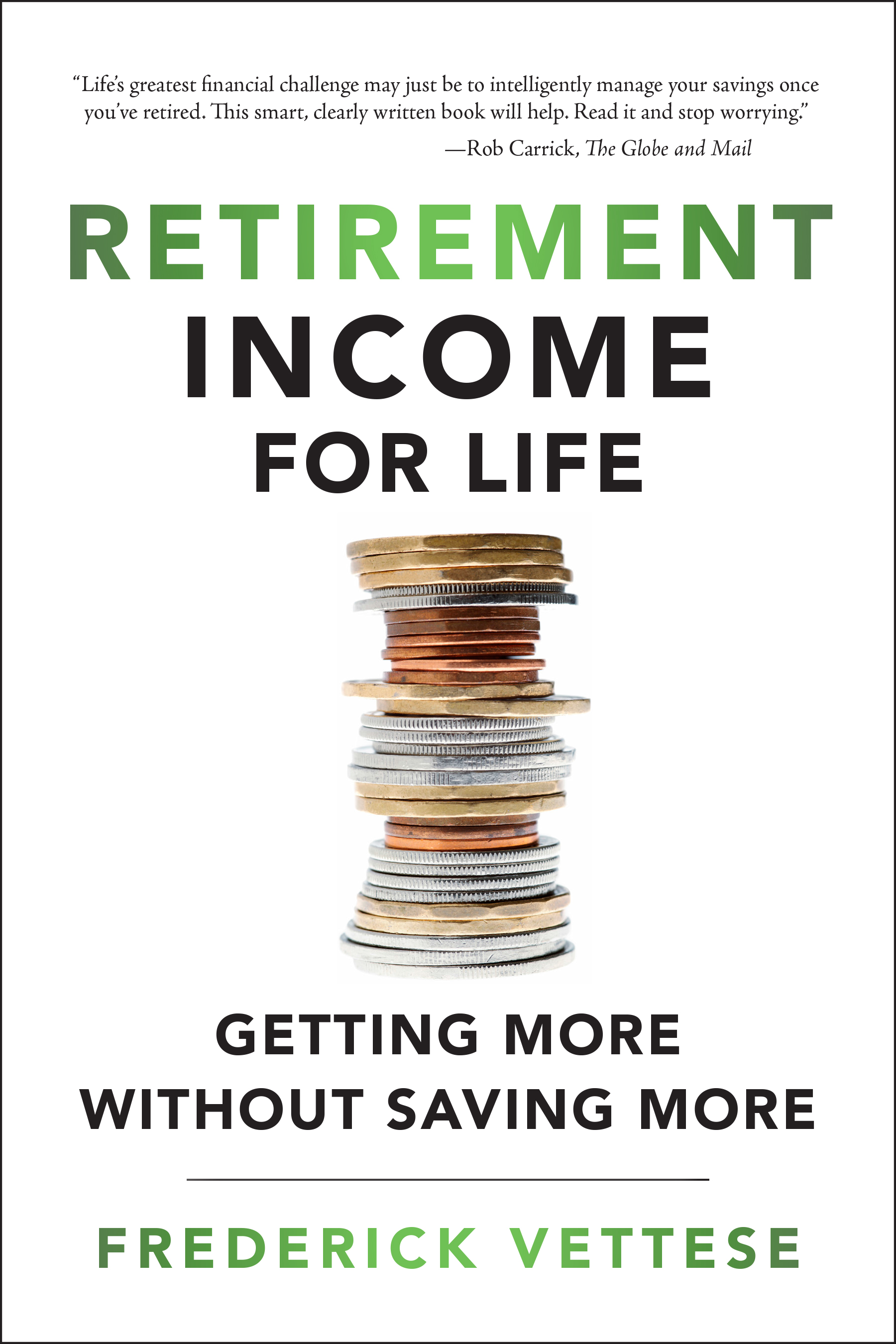
Retired Money: How to boost Retirement Income with Fred Vettese’s 5 enhancements

 Once they move from the wealth accumulation phase to “decumulation” retirees and near-retirees start to focus on how to boost Retirement Income.

The latest instalment of my MoneySense Retired Money column looks at five “enhancements” to do this, all contained in Fred Vettese’s about-to-be-published book, Retirement Income for Life, subtitled Getting More Without Saving More. You can find the full column by clicking on this highlighted headline: A Guide to Having Retirement Income for Life.

You’ll be seeing various reviews of this book as it becomes available online late in February and likely in bookstores by early March. I predict it will be a bestseller since it taps the huge market of baby boomers turning 65 (1,100 every day!): including author Fred Vettese and even Yours Truly in a few months time.

That’s because a lot of people need help in generating a pension-like income from savings, typically RRSPs, group RRSPs and Defined Contribution plans, TFSAs, non-registered investments and the like. In other words, anybody who doesn’t enjoy a guaranteed-for-life Defined Benefit pension plan, of the type that are still common in the public sector but becoming rare in the private sector.

The core of the book are the five “enhancements” Vettese has identified that help to ensure that those seeking to pensionize their nest eggs (to paraphrase the title of Moshe Milevsky’s book that covers some of this ground) don’t outlive their money. Vettese says many of these concepts are current in the academic literature but have been slow to migrate to the mainstream, in part because few of these “enhancements” will be welcomed by the typical commission-compensated financial advisor. That in itself will make this book controversial.

Each of these “enhancements” get a whole chapter but in a nutshell they are:

1.) Enhancement 1: Reducing Fees

By moving from high-fee mutual funds or similar vehicles to low-cost ETFs (exchange-traded funds), Vettese explains how investment fees can be cut from 1.5 to 3% to as little as 0.5% a year, all of which goes directly to boosting retirement income flows. One of his takeaways is that “Tangible evidence of added value from active management is hard to find.”

2.)  Enhancement 2: Deferring CPP Pension

We’ve covered the topic of deferring CPP to age 70 frequently in various articles, some of which can be found here on the Hub’s search engine. Even so, very few Canadians opt to wait till age 70 to collect the Canada Pension Plan. Because CPP is a valuable inflation-indexed guaranteed for life instrument — in effect, an annuity that you can never outlive — Vettese argues for deferral, although he (like me) is fine with taking Old Age Security as soon as it’s available at age 65. He argues that for someone who contributed to CPP until age 65, they can boost their CPP income by almost 50% by waiting till 70 to collect.  “You are essentially transferring some of your investment risk and longevity risk back to the government, and you are doing so at zero cost.” Continue Reading…

How to enjoy a healthy retirement (literally!)

By Rachel Jackson

Special to the Financial Independence Hub

Whether it’s junk  food, drugs, alcohol, cigarettes or simply laziness there are many things that can lead to an unhealthy life. Not being health conscious can have dire consequences and you can easily walk yourself into an early grave if you don’t take care of your body. But it doesn’t have to be that way. With these tips to live by, you can stay healthy well into your retirement years.

1.) Keep fit

No matter what your age, you should be exercising regularly and doing your best to stay fit. While you don’t need to become a marathon runner or boxing expert, try to exercise for at least 30 minutes every day to maintain a healthy body and mind. Don’t believe that you have to tone it down when you reach a certain age either: your body will keep up with what you offer it. If you don’t start running until the age of 50 then you might have some problems but someone who regularly runs well into their fifties will be able to keep it up. Exercise helps to strengthen your heart, keep your body working and mobile and release endorphins to ease stress and improve mood.

2.) Eat healthily

There’s nothing wrong with a treat now and then but you need to stick to well-balanced meals and healthy snacks for the most part if you want to live for a long time. Eating the wrong diet, can result in  obesity, diabetes, digestive problems, heart problems and high cholesterol. And that’s only the start. Eat well: remember that when you put good stuff in, you will get bad stuff out.

3.) Laugh often

One of the best ways to extend your life is to enjoy it. Failing to spend time with friends and family, to entertain yourself, to have fun and laugh daily can be almost as harmful to your health as smoking or drinking. If you enjoy yourself, you exercise your heart muscles, ease stress and tension and keep a positive mind. If you don’t, you increase your risk of depression, illness, and complications associated with stress such as heart attacks.  Continue Reading…