Overspending is a common problem for many people; it creates debt, anxiety and relationship problems, even among high income earners. All too often, people’s spending habits seem to rise to meet – and exceed – their incomes.
So why does this happen? What compels people to overspend when they already have the items they truly need? The answer lies deep within each person’s spending personality. Recently, I read Dr. April Benson’s book I Shop Therefore I Am, and was fascinated by what the contributing authors uncover about the emotional and psychological factors influencing our buying habits.
I thought it would interesting, and beneficial, to touch on the six key spending personalities they explore: image spenders, bargain hunters, collectors, compulsive shoppers, co-dependent spenders (a.k.a. gift-givers) and bulimic spenders. Continue Reading…
I’ve dubbed those on the vanguard of this phenomenon (as of today) “retirement refugees,” because as you’ll see from the Times’ piece, these people may have given traditional retirement a shot, only to suffer from boredom within a few months of experiencing the supposedly blissful leisure pursuits of golf, bridge, daytime TV and reading whatever you want for hours on end. And yes, one person quoted by the Times even found Travel boring: see our Friday piece on this trend: Is Travel Overrated?
Just in the last week here at the Hub we’ve had several pieces touching on this theme. Friday before last, for instance, we ran the blog on the “Boomertirement Salon,” in which baby boomers who had long been salaried employees were looking to start all over as “Boomerpreneurs” in their early 60s (including Yours Truly.)
Also here at the Hub a few weeks earlier, we ran Sheryl Smolkin’s blog on her early retirement at 54, since followed up with another decade of writing, blogging and lately the launch of her Retirement Redux site.
In categorizing this blog, I found it difficult to narrow it down to one of the categories we’ve selected for the Hub. I’ve included it in Longevity & Aging because the two concepts go hand in hand: if you’re going to live longer and more healthily than generations did in the past, it stands to reason that you’ll want to keep your mind active and your social skills honed. Both can be accomplished by staying in the working world at least on a part-time basis, perhaps supplemented by charitable or philanthropic work or volunteering of one’s time or expertise.
I’ve also categorized this under Business Ownership rather than Decumulation, although in the transition from employee to business owner, you may need to draw down on your financial resources to make up any income shortfall: you can’t always invoice your sweat equity.
Driven achievers “fail” at traditional full-stop retirement
The NYT piece begins by focusing on Suzy Boerhoom, a registered nurse who retired “for the first time” after 35 years in health care, during which she owned some Curves exercise locations. Upon retirement, she spent five years helping her three daughters raise their own children. She’s now 66 but after getting bored being a full-time grandma in 2009 started Welcyon, Fitness After 50. She is quoted as saying she had “failed” at retirement, being one of those “driven achievers” who work because they love it, not necessarily because they need the money. (another major theme of this website).
Those inclined may want to download two short studies mentioned in the Times article: the AARP Work and Career Study and another study by Age Wave and Merrill Lynch on Work in Retirement.
If you do and feel moved to write a blog of your own on these themes, we would be delighted to run it here at the Hub. Let me know by emailing me at Jonathan@FindependenceDay.com.
Making smarter investment choices is one of the key elements in building up adequate retirement savings. [1] People are constantly inundated with sales pitches for investment opportunities from banks, insurance companies, and their friends and relatives. For those with limited investment knowledge, this can be intimidating. The natural inclination is to seek advice from a professional investment advisor; however, many investment advisors may be motivated to recommend the investment vehicles that pay them the highest commission. In this environment, it’s wise for individual investors to have a basic knowledge of investments. This paper aims to provide seven fundamental principles that should lead to smarter investment decisions.
1. Ignore ‘hot’ investment tips
Investments are inherently risky; some have lower risk, others have higher risk. It is socially common for co-workers, friends, or relatives to announce that they have the inside scoop on an investment opportunity that is going to have a high return, if it is acted on immediately. To compound this, people tend to discuss their winning stock picks publicly, but do not readily disclose their losers. The media often provides flashy investment advice that may not be right for a vast majority of investors, while sensationalizing world events in the context of stock markets. There are constant psychological triggers to buy and sell securities without adequate knowledge built into everyday life, and acting on these triggers can be the single biggest threat to the long-term financial health of an investor.
Conclusion: Acting immediately on information from friends, family, and the media may lead to a bad investment experience.
2. Have a basic knowledge of investment vehicles
There are many ways for individuals to invest their savings in financial markets. The most common ways to invest include stocks and bonds, mutual funds, and exchange traded funds (ETFs).
Individual stocks and bonds are inherently risky investments requiring in-depth knowledge of the underlying company being considered. It is highly unlikely that individual investors will have the time, background, or resources to conduct the necessary analysis on enough companies to build a portfolio that is positioned to outperform a passive investment in a benchmark index – even professional money managers have trouble achieving this consistently[2]. An alternative is to invest in a basket of stocks and bonds in such a way that diversifies away the risk associated with any individual company. The exact number of securities that it takes to build an optimally well-diversified portfolio is up for debate, but it is safe to say that buying a handful of stocks and hoping for the best is not ideal.
Mutual funds are vehicles that allow investors to obtain a well-diversified portfolio through a pre-packaged product. For this service, investors pay a fee to the mutual fund company, referred to as management expense ratio (MER). The MER pays for the fund’s manager and other expenses. Many mutual fund companies claim that their managers have special predictive insights and the ability to find stocks that are poised to increase in price more than their peers. These actively managed funds have significantly higher fees than a mutual fund that simply buys all of the stocks in an index, called an index mutual fund, or index fund. The high fees paid to actively managed mutual funds could be warranted if they produced superior performance, but an overwhelming amount of evidence shows that superior long-term performance is not likely[3]. Currently, 98.5% of the assets invested in Canadian domiciled mutual funds are invested in actively managed mutual funds[4].
ETFs, like index mutual funds, invest passively in an index. ETFs tend to have much lower fees than mutual funds due to their underlying structure, while still allowing investors to invest in a well-diversified basket of securities.
Conclusion: It is not practical for the average investor to build a well-diversified portfolio using individual stocks and bonds. There is sufficient empirical evidence to show that actively managed mutual funds, on average, do not show any superior performance over index mutual funds. Investors are likely better off investing in index ETFs or low cost index mutual funds.
3. Understand the risk-return trade-off
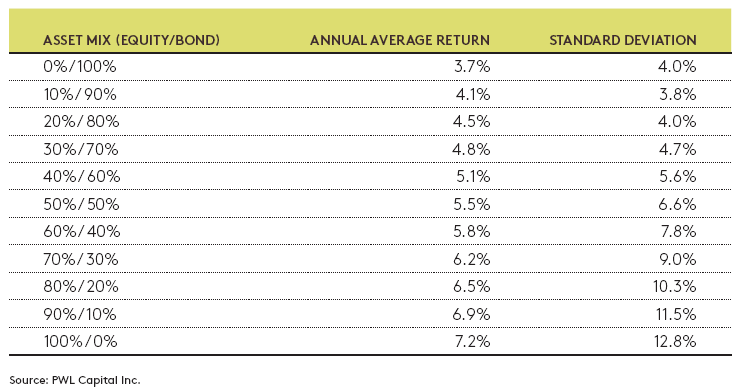
Most investors build their portfolio using some mix of stocks and bonds; this is known as their asset mix. Stocks tend to be riskier than bonds, as measured by the standard deviation of their returns. Riskier investments must have higher expected returns to attract investors, and it follows that stocks must have higher expected returns than bonds.
In a recent white paper, PWL’s Raymond Kerzerho and Dan Bortolotti used historical data and current market expectations to demonstrate the expected returns for portfolios with various mixes of stocks and bonds. The results demonstrate the relationship between risk and return – portfolios with higher expected returns also have a higher expected standard deviation. Statistically, it can be expected that in 65% of trials, the returns of a portfolio will fall within one standard deviation of the average return; in 95% of trials, the portfolio returns will fall within two standard deviations of the average return.
To ensure a desirable risk-return expectation, investors must decide how much volatility they are willing to bear, while understanding that less volatility means lower long-term expected returns. Selecting the right asset mix is one of the keys to sticking with an investment plan.
Conclusion: Higher returns are associated with higher risk, as measured by standard deviation. Investors need to understand, and be comfortable with, the risk and return expectations of their portfolio.
4. Know your time horizon
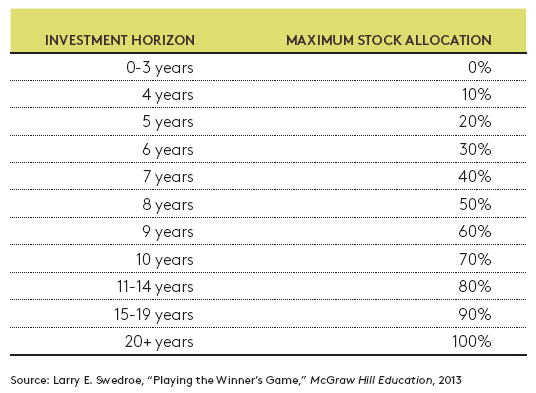
In a given year, the return on a portfolio has a 95% chance of being within two standard deviations of the expected average return. As an example, the one year return on a 60% equity, 40% fixed income portfolio could be expected to fall between -9.8% and 21.4%. If an investor has a one year time horizon, this wide range of returns is not likely to be suitable. As the investor’s time horizon gets longer, it becomes more likely that the realized average return on the portfolio will be close to the expected average return. Investors can have different time horizons for various investment goals, but the funds associated with each goal must be invested appropriately to achieve a successful investment experience. In his book, Playing the Winner’s Game, Larry Swedroe outlines some suggested asset mixes based on investment time horizon.
Conclusion: A long time horizon gives investors the ability to withstand the short-term volatility that accompanies the higher expected returns of stocks. A short time horizon means that less risky investments must be chosen to avoid realizing losses.
5. Focus on time in the market, not timing the market
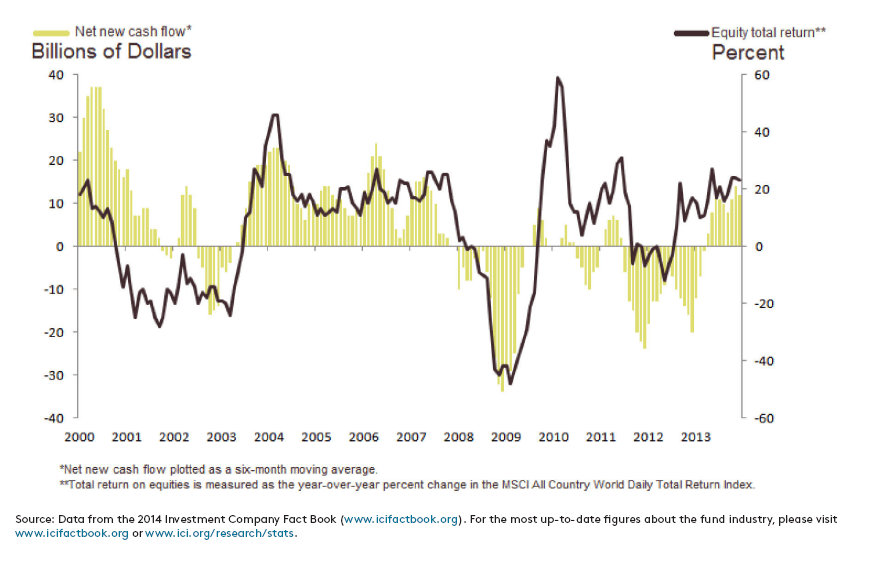
Timing the market is the action of timing buy and sell decisions in an attempt to gain additional profits by buying low and selling high. Data for US mutual fund cash flows and global equity returns from the Investment Company Institute shows how investors tend to fare at market timing; when markets were doing well, investors were pouring money into equity mutual funds, and when markets were doing poorly they were selling. This buying high and selling low behaviour is driven by the fear and greed that underlie investor psychology. These actions have extremely negative effects on the performance of a portfolio.
A simple solution to avoid market timing impulses is dollar-cost averaging, systematically investing the same amount each month. This method of entering the market alleviates the stress associated with market timing, and suits investors with a fixed amount available to invest each month.
Some investors may have a large lump sum to invest from a settlement, prize, or inheritance. Research from the Vanguard Group has shown that approximately two-thirds of the time, lump sum investing has resulted in superior risk-adjusted performance as compared to dollar-cost averaging[5]. Based on this research, if an investor is comfortable with their asset mix and its risk and return characteristics, it is statistically prudent to invest the full lump sum immediately. If the investor is more concerned about protecting against short-term losses and feelings of regret, then dollar-cost averaging is appropriate.
Conclusion: The simplest solution for investors to avoid market timing is to invest the same amount every week, month, or quarter without worrying about the short term movement of the market. When lump sum investing is deemed appropriate, the investor must be comfortable with the risk/return characteristics of their portfolio.
6. Costs impact wealth accumulation
If an investor decides to invest in an actively managed mutual fund, they are subject to management fees, which are especially high in Canada[6]. The fees, typically in the range of 1.5 to 2.5% of the account value on an annual basis, have a significant impact on wealth accumulation[7]. This can be best illustrated with an example. Assume that both an active mutual fund (2% annual fee) and a passive ETF (0.5% annual fee) generate the same long-term investment return, less their fees. If the market produces an assumed rate of return of 5% over 25 years, and an investor invests $10,000 each year in an RRSP, the value of the savings invested in the active mutual fund would be $364,593, whereas the value of the passive ETF investment would be $445,652. This is a difference of $81,059, or 18%, in favor of the low cost passive investment.
Conclusion: Costs can have a dramatic effect on wealth accumulation. Ask for all possible fees to be disclosed when working with a professional, and look for investments with low upfront and ongoing costs.
7. Utilize tax advantaged accounts
In Canada, we have a handful of tax advantaged accounts that can be used to hold qualified investments. The various accounts have different purposes, but both large and small investors can benefit from using them. For a long-term investor planning for retirement, two of the most useful account types are the Registered Retirement Savings Plan (RRSP), and the Tax Free Savings Account (TFSA).
Contributions to the RRSP are deducted from taxable income in the year they are made, in most cases result ing in a tax refund. Investment growth and income build inside the RRSP tax free, and any withdrawals are taxed as income in the year they are withdrawn. The idea is that investors will contribute when they are in a high tax bracket, and withdraw when they are in a lower tax bracket. RRSP room builds based on 18% of the previous year’s earned income and can be carried forward indefinitely.
For the TFSA, there is no deduction from taxable income when money is added to it, and there is no tax payable on withdrawals. Like the RRSP, investment income and growth build tax free. Every Canadian resident starts building TFSA room when they turn 18, and currently all eligible people build $5,500 of new room each year.
Until both these accounts have been maximized, there are very few logical reasons to start investing in taxable accounts.
Conclusion: Before investing in taxable accounts, maximize the user of registered, tax-advantaged savings plans.
Becoming a smart investor
Acting on these principles is likely to be beneficial, but they all need to be tied together with a clear investment strategy. One method for sticking to an investment strategy is the creation of an Investment Policy Statement (IPS), which becomes a guideline for future investment decisions.
The IPS is created based on risk-return requirements, time horizon, and investment preferences; it sets rules for how much of each type of security should be held. An example of an IPS could be 20% Canadian stocks, 20% US stocks, 20% International stocks, and 40% bonds. When designed thoughtfully, an IPS allows the investor to separate their emotions from buy and sell decisions, instead basing decisions on the predetermined rules. When the portfolio strays from its targets due to market movement, it must be rebalanced to match the allocations set out in the IPS.
With a strategy in place, a smart investor will revisit their personal situation periodically (annually at least) to see if they should be modifying their IPS or their holdings. It is possible that new investment vehicles with lower costs or increased tax efficiency have been introduced, or that the investor’s time horizon or risk tolerance has changed due to a life event. Managing the optimal use of tax advantaged accounts must also be revisited periodically.
Tying these seven principles together and sticking to a consistent and methodical strategy can result in a pleasant, stress free investment experience, and long term wealth creation.
[1] Vijay Jog, “Investment Performance and Costs of Pension and other retirement Savings Funds in Canada: Implications on Wealth Accumulation and Retirement,” Department of Finance Canada, 2009
[2] Mark Carhart, “On Persistence in Mutual-fund Performance,” Journal of Finance, March 1997
[3]Aye M. Soe, “The Persistence Scorecard,” S&P Dow Jones Indices, June 2014
The other day I ordered online a library book published in 2013, which I thought was entitled 65 Things to do When You Retire. But once it arrived and I started to leaf through the pages, I realized with some disappointment that this particular edition of what was evidently a series was dedicated solely to travel, as you can see in the prominently featured word in red on the cover image to the right.
Now I know travel is regarded as one of the bedrock activities of retirement, if not the holy grail itself — provided you’re physically and mentally healthy, financially equipped to bear the costs, and young enough to enjoy it.
A curmudgeon’s view: Travel is expensive and over-rated
Based on a survey released this year by the TransAmerica Center for Retirement Studies, it appears that the majority of Millennials and Gen Xers believe Social Security will no longer exist by the time they are ready to retire. It’s time to set the record straight about what Americans can realistically expect from Social Security in the coming decades and what they can do to secure their own financial future.
The Truth about Social Security
The truth is Social Security is in need of a fix. Social Security trustees believe the program will still be financially solvent through to 2019. However, if no changes are introduced by 2033, the trust fund will be exhausted. Based on the latest Social Security Trustees’ report, money generated from current payroll taxes at that point are estimated to be enough to support only 77% of promised benefits until the year 2088.
Changes to the Social Security program are required at a congressional level and with the current stalemate in Congress over other political agendas, Social Security has apparently taken a backseat. Congress hasn’t passed any significant ratification to the program since the last reform of 1983.
A public opinion poll sponsored by Voice of the People in February 2014 suggests Americans are willing to make some tough concessions. A representative majority of the public supports measures such as raising the payroll tax rate and the annual cap on income, reducing benefits for top income earners and increasing the full retirement age to 68 or more.
Count Social Security as a Bonus
It’s important to note Social Security was never intended to serve as a full pension but rather as a supplemental retirement and disability insurance program. The reality is that many Americans rely solely on Social Security payments during the course of their retirement years. Suffice it to say, extreme financial hardships along with poor financial planning are often cited as reasons why some retirees end up with little to no personal savings and investments.
Even though many Americans overwhelmingly disapprove of any potential cuts to Social Security, according to recent Gallop polls, over 69% of those surveyed don’t expect to rely heavily or at all on Social Security payments. These findings mirror my own view in that my plans and calculations for achieving financial independence do not consider Social Security payouts as part of the equation.
As taxpayers, Americans have the right to expect their fair share from Social Security during their golden years but considering that the average Social Security monthly payment is $1,192.21, this amount is likely far from being enough for the vast majority.
Achieve Financial Independence without Social Security
Whether the intent is to leave the workforce earlier than 55 or continue to work well into your golden years for the sheer joy of it, focusing on achieving financial independence is truly a wise option. By saving and investing as much as possible, ideally well above the suggested rate of 10% to 15% of earned income, keeping consumer debt out of the picture while paying off any mortgage debt, spending consciously and living frugally, financial independence is well within reach.
In striving for financial freedom, your future and financial security will never be limited by how much Social Security can afford to pay you. In the event Social Security reforms are enacted and in place by the time you’re eligible to file, you could easily decide to defer filing your claim until 70 years of age, in order to reap even higher benefits.
As the saying goes “Never keep all your [financial] eggs in one basket.”
Kassandra Dasent is a freelance writer, business consultant, wife and step-mom. She is the founder of More Than Just Money, where she discusses a variety of topics and personal experiences that intersect with money. Her articles have been featured on several sites, including US News & World Report, The Globe & Mail and Brighter Life.

 Posted By
 the contributing authors uncover about the emotional and psychological factors influencing our buying habits.