All posts by Adrian Mastracci

How to prepare for market corrections and advances

“Motivation is what gets you started. Habit is what keeps you going.” —Jim Ryun, Olympic runner

We’re working our way through the fourth quarter 2017. Many stock indices have been hovering near their tops and often keep making new highs. Daily headlines are typically a mixed bag of fears and optimism. They are often interpreted as indications of possible changes in market direction.

Some themes really stand out. For example, NAFTA talks are topics du jour in the US, Mexico and Canada. The United Kingdom is wrestling with Brexit implications. German politics are entertaining altering the seating arrangements.

Many stock indices hover near their tops and keep making new highs.

China faces pressures from increasing debt levels. US tax cut battles keep marching along. Several faces will soon change at the US Federal Reserve. Rising interest rate discussions send chills down the spines of borrowers. These few points alone are forceful enough to create trepidation in investor minds. You will have no difficulty finding headlines for every investment neighbourhood.

As a result, investors develop itchy fingers that want to migrate to the safety of the sidelines, whether it’s beneficial or not. Of course, these investors that have the need for action will make the crucial timing calls on what to buy or sell. Everyone should know by now that timing the markets is a low percentage approach, fraught with many dangers.
My Observation

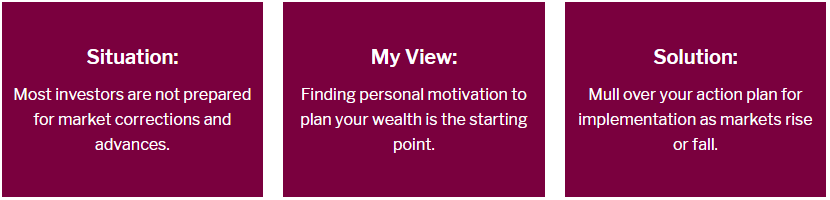
This brings me to one important observation. Wise investors are in the habit of investigating what it takes to be well prepared for both market corrections and advances. They have at least sketched out a rough game plan for each case on the back of the napkin. Something to get started, aiming for the right path. I encourage you to become conversant with what you would likely do with stocks and bonds during bullish and bearish markets.

Most investors that think in this fashion prefer to have some framework of how to approach the uncertainties that come their way. Just some simple ideas are required to get started. The best news is that today’s planning is being conducted while stock prices are high.

Finding the motivation to be informed is a welcome initial step. Perhaps, discussions with your investment professional will shine more light on what actions are in your best interests. Reconfirming your family risk profile is also time well spent. Hopefully, these efforts lead to more disciplined planning for the precious nest egg. The main mission is to reach and deliver your retirement objectives.

Seasoned investors are well aware that diversification and rebalancing strategies are part and parcel of this logical planning approach. I cannot emphasize that enough as nobody knows where the markets are headed or when a directional turn comes around the curve. Bells do not ring when the time is ripe to make portfolio changes. Neither at the top, nor at the bottom.

My Recommendation

I suggest mulling over these situations in preparation for your exercise: Continue Reading…

Two notable investment books to build your long-term Wealth

“Books are the bees which carry the quickening pollen from one to another mind.” — James Russell Lowell, poet and author

Last week I highlighted two books that help manage your family’s retirement aspirations. This week I turn my sights onto two books that shape investment success over the long run: all about taking charge of investing in your self-education through quality reading.

I’ve selected two books that provide great insights into stewarding your long-term wealth. The authors are well known in the wealth management profession.

The books emphasise simple, yet fundamental recipes of investing: something for everyone’s investment toolbox when the bulls and bears make their presence known.

The Elements of Investing

Burton G. Malkeil and Charles D. Ellis


My initial pick is a gem written by two leading, seasoned authors of many books. Both have contributed heavily to the profession of managing wealth. The investing process is condensed into five short chapters, all in layman’s language.

The authors make the point that everything starts with savings. It is their position that each of us can make sound investing decisions. The process does not have to be complicated.

Rather, it is a highly disciplined approach to investing. All the rules you need to know and implement are explained. I visualise the book as a clear, concise and practical guide for the long road ahead.

The easygoing writing style emphasises keeping the approach to investing as simple as possible. My perspective concurs with the view that the book is a prudent, logical road map.

Continue Reading…

My RRIF playbook: what you need to know in 2017

“Retirement at sixty-five is ridiculous. When I was sixty-five I still had pimples.” — George Burns (1896–1996) Comedian, actor, singer and writer

There are three retirement accounts everyone ought to understand. They are the RRSP, the TFSA and the RRIF (Registered Retirement Income Fund).  I submit that the early part of each year is preferred to review the RRSP and TFSA. That leaves the RRIF to be dealt with well before year-end.

Start paying special attention to planning the RRIF, even if you don’t yet need one.

Be very mindful of the RRIF. Recognise its purpose and how it complements the other two accounts. Review it periodically to ensure it stays on track.

The RRIF is firmly entrenched as a prominent retirement planning vehicle, serving as an essential foundation of retirement nest eggs. For example, starting a RRIF at 71 implies long planning, often to age 90 or more: especially if there is a younger spouse or common-law partner.

Three conversion choices for RRSPs

RRIFs typically result from the aftermath of mandatory RRSP conversions. Three conversion choices include cashing the RRSP, purchasing a variety of annuities and using the RRIF account. The RRIF is most popular because it provides considerable flexibility. Avoid cashing RRSPs.

Continue Reading…

Two notable books to guide your ‘Retirement’ journey

“Books are the bees which carry the quickening pollen from one to another mind.” — James Russell Lowell, poet and author

This week I highlight one of my best recommendations for Retirement. Invest in self-education with some quality reading. The critical factor is how to select just a couple of books.

Investors have a thirst for knowledge about their precious retirement journey. They seek detailed information to assist in navigating the capital accumulation process to achieve retirement. Then comes the desire of making that capital outlast the spending phase.

Walk into any well-stocked bookstore and the retirement section will seem like a maze. There are plenty of titles competing to become permanent occupants of your precious bookshelf space.

My two book selections provide insight and understanding into the design and management of the retirement nest egg. The authors are well known. The books complement one another.

The emphasis is understanding long-term principles, policies and best practices that steer the family’s retirement goals from dreams to realities. Getting fully acquainted with these two books helps craft better decisions about retirement. Something for everyone’s retirement toolbox.

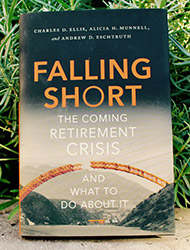
Photo: Kia Meiklejohn

Falling Short: The Coming Retirement Crisis and What To Do About It, by Charles D. Ellis, Alicia H. Munnel, and Andrew D. Eschtruth

This century has clearly shown that we are living longer, health costs are rising and employer pensions are diminishing. That is the big picture applicable to retirees in the USA. However, similar arguments also exist for the Canadian retirement landscape.

The good news is that what is seemingly a dire retirement situation can be easily rectified by implementing a few coordinated steps. This book makes you appreciate the scope of that big picture. Working a little longer, saving a bit more, judicious use of government benefits and being smart about portfolio draws are some of the key answers that deliver.

The message for every retiree is that a successful retirement is about being empowered to look after the personal situation. At age 60, it is not unusual for retirement to last into the 90’s for at least one spouse.

Yes, long term retirement that spans decades is expensive. Sensible and methodical decision making is sound advice for all ages. It renders the scope of the big picture into realistic solutions.

Retirement projections have the answers

Much has been written about the level of retirement readiness and capital needs required to fund that long-term family objective. I submit that the retirement projections have the answers.

I am, however, puzzled by this key observation: “None of the potential clients I’ve met for the first time in the past five years had a recent retirement projection.”

There is much talk and little walk of the talk around this subject. Even though retirement is a top priority for investors and their families.

You are wise to start crafting your personal retirement projection. The sooner the better, then revisiting it every three to five years.

This is something I encourage everyone to mull over. “How do you assess whether your retirement prospects are on target if you have no personal retirement target in mind?”

I summarise three more observations from meetings with potential retirees:

  • Most have not come to grips with the possibility of retirement lasting 25 to 30 years, maybe longer.
  • Most have not thought about the implications of their portfolios receiving little or no saving capacity after retirement.
  • Most are not prepared for escalating costs of health care, say a retirement home facility, even if for only one spouse.

Planning three decades of dependable retirement income is the new money management challenge. Especially, during times of continued low returns.

Very few investors now retired, or nearly retired, have a “retirement projection.” I liken it to building a home without the blueprint.

I don’t know of anyone who builds homes this way. However, there is no shortage of investors who continually try to assemble and guide their retirement nest egg without a personal plan of action. They just buy stuff for the investment shelves.

Retirement surveys keep popping up frequently with similar messages. Typically about how investors are not fully prepared for the long retirement journey.

Some may have accumulated too much debt or too few assets. Others may have incurred too much risk. Perhaps, many may not be saving enough.

Reasons aside, it is rare to meet someone who has a grasp of the capital ballpark required to fund retirement. The main ingredient is the “retirement projection,” also known as the “capital needs” analysis.

The basic step of preparing a retirement projection is a very informative process. I favour constructing one for every client well before retirement and updating it periodically.

The retirement projection is the starting point for everyone considering retirement or actually now retired. It is a ballpark indication of what the family capital needs look like for the long run.

My projection covers several key retirement aspects, such as:

  • Providing long-term retirement income goals, possible health costs and inflation factors.
  • Reviewing the family’s total expenses and cash requirements for projects and purchases.
  • Inclusion of income sources, like employment, pension benefits, real estate, CPP and OAS.
  • Assumptions for possible home downsizing, longevity, special needs and pension funding.

The analysis brings to light these important facts:

  • Capital estimate of funds required to achieve your retirement goals and desires.
  • Periodic saving capacity required by your investment plan.
  • Annual return estimates to reach and maintain your desired retirement lifestyle.
  • Whether your retirement goals are achievable or in need of periodic adjustments.

A retirement projection allows the design of a customised investing road map tailored to each client. It also ensures that what the client seeks is reasonable and suitable vis-à-vis family goals.

Most investors do not feel comfortable navigating their retirement math. A solution is to engage a professional who is well versed with retirement projections.

You are wise to start crafting your personal retirement projection. The sooner the better, then revisiting it every three to five years.

Clearly, up-to-date retirement projections have the answers. It’s time for action if yours is missing in action.

 Adrian Mastracci, Discretionary Portfolio Manager, B.E.E., MBA  started in the investment and financial advisory profession in 1972. He graduated with the Bachelor of Electrical Engineering from General Motors Institute in 1971,  then attended the University of British Columbia, graduating with the MBA in 1972. This blog is republished here with permission from Adrian’s new website, where it originally appeared on May 23rd
Powered by the Financial Independence Hub.
© 2013-2026 All Rights Reserved.
Financial Independence Hub Logo

Sign up for our Daily Digest E-Mail!

Get daily updates from the FindependenceHub.com straight to your inbox.