For the first 30 or so years of working, saving and investing, you’ll be first in the mode of getting out of the hole (paying down debt), and then building your net worth (that’s wealth accumulation.). But don’t forget, wealth accumulation isn’t the ultimate goal. Decumulation is! (a separate category here at the Hub).
Toronto’s big banks: CBC puts focus on misleading job titles
“Integrity has no need of rules.” – Albert Camus
“If it is not right, do not do it. If it is not true, do not say it .” – Marcus Aurelius
Words to live by, no? Unfortunately, the financial services industry in Canada doesn’t tend to screen for existentialists and stoics. I’d take Marcus Aurelius or Seneca as my financial advisor any day, even if they weren’t one of the rare advisors in Canada who are required by law to act in their clients’ best interest.
The headlines have been ablaze in the last few weeks with furor over alleged mis-selling at Canada’s banks. Most recently, CBC’s Go Public investigators published a piece about misleading job titles: a grand conspiracy perpetrated by the Canadian financial services industry in which the English language is manipulated to dupe unknowing consumers. (See: ‘I feel duped’: Why bank employees with impressive but misleading titles could cost you big time)
“What’s in a vowel?”
Specifically, the authors suggest that by calling their employees “advisors” with an “o” instead of “advisers” with an “e”, banks are intentionally granting staff license to engage in all sorts of nefarious product mis-selling and conflicted behaviour. Continue Reading…
I wrote a piece last September titled ‘Why Our Economic Liberty Depends on the Blockchain’, providing an analysis on why I am certain distributed ledger technology is important to securing our rights under the law in the digital age.
In an ever-increasing realm of technology that is meant to improve (in positive ways) facets of our lives, the imperfection of humanity still exists while greed heavily plagues the banking world. As a firm advocate for the rule of law, I find recent revelations by CBC’s Go Public , that highlighted rampant fraudulent activity occurring amongst Canada’s largest financial institutions (TD, BMO, RBC, CIBC, and Scotiabank) disturbing to say the least.
‘This is why the only solution really is to have government step in and look after the Canadian people.’ says lobbyist Stan Buell as quoted in the CBC article.
Ultimately directives from above led to not only immoral, but also illegal tactics that chased their bottoms lines. Adding more bureaucracy at a government level will only exacerbate the climate.
Blockchain is the answer, not government
In my previous article I had given several broad examples of current institutions that could improve themselves, one being quasi-relevant to the financial fraud currently being exposed in Canada.
What is financial independence? How do you get there?
Financial independence means work is optional. You have enough money to live the way you want without having to earn money.
When you get there, life changes. You have freedom. You can do only what you enjoy or find meaningful.
If you don’t like your job or your boss, just quit. Your life is full of options. You can make the most of your own life.
When you get there, you can have a quiet confidence. You are financially secure.
Your plan should start with understanding your inner motivation and defining specifically the lifestyle you want to have once you are financially independent. It is your opportunity to determine your future.
Becoming financially independent requires planning and effort, but it is worthwhile to live a more fulfilling life. “It’s not about the money. It’s about your life.”
“Real freedom is financial freedom.” When is your Findependence Day?
Achieving financial independence is a very broad topic. Writing nearly 1,000 comprehensive, professional financial plans specifically for real Canadians has given me a deep insight into what really works.
Alongside the rapid growth of the online wealth management space is the speed with which firms are evolving to investors’ demands.
Some of the first online investment managers in Canada have evolved their initial investing models to include services like financial planning, advisory firm partnerships, and now, a platform offering portfolios from multiple management firms.
One of the challenges in evaluating cost, performance, and reputation across multiple “robo-advice” platforms is looking at their similarities and differences to get a real sense of how each portfolio compares. In addition, many firms are relatively new and, while investors like the experience of working with an online advisor, they’re restricted to portfolios designed solely by the same firm they feel provides that great experience.
A simple way of choosing the right portfolio
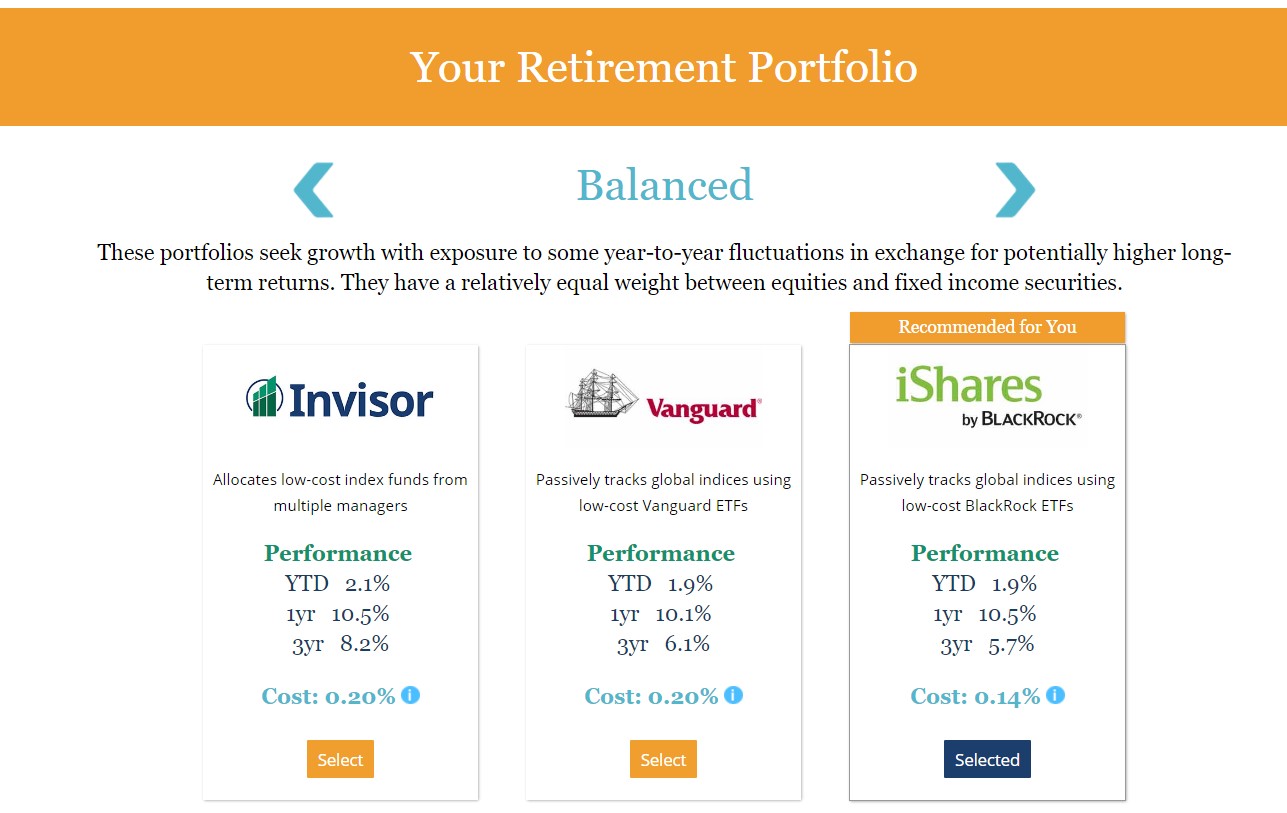
In response to the demand for greater choice, we’ve created a platform that offers clients multiple portfolio options created by two of the largest and most reputable institutional money managers in the industry; BlackRock and Vanguard. In working with these two firms, we are not only leveraging the quality of their investment products, but also their expertise in providing great portfolio solutions.
This addition will allow potential clients to compare and select portfolios based on our recommendations for them, as well as the elements of a portfolio they value most, like performance, asset allocation, and cost.
As social media becomes ever prevalent in our lives, we have become increasingly accustomed to sharing personal details with friends, family and coworkers. While there’s certainly no harm in sharing vacation details or family photos with your network, this culture of sharing can lead to troubling consequences when it extends to personal financial information.
In the spirit of Fraud Prevention Month – an educational campaign each March that encourages Canadians to recognize and reject fraud – I’d like to offer a few tips to help empower Canadians to be their own first line of defense.
Protect your personal details
Our recent fraud prevention study found 47% of Canadians have shared their credit card number over the phone, via email or through the mail. One in five Canadians (22%) also admit to sharing their banking information via email, where the risk of phishing is high.
When it comes to sharing your personal information, always be cautious. Whether it’s over the phone, in person, through the mail or on the Internet, always know who you are sharing your personal or financial information with and why. If a call or email seems questionable, end the communication and visit the company’s secure website to contact them directly.
Select a strong PIN and protect it
While it may seem harmless to share your PIN with family members (in fact, 40% of Canadians admit to doing it), a PIN should never be shared with anyone. Select a secure and difficult-to-guess PIN that isn’t based on personal information like a birthday, address, SIN number or telephone number. Make sure you choose a unique PIN for each card. And, when accessing an ATM or paying with your card, be aware of who is around you and cover the keypad when you enter your PIN. Finally, if you’re going to store your PIN somewhere, make sure you choose a secure location and never write it on or store it near your card.
Take advantage of any features your card issuer offers

 Posted By
 Posted By