General

Shopping for a Mortgage: 4 factors to consider apart from the Rate

By Sean Cooper

Special to the Financial Independence Hub

Shopping for a mortgage in the near future? The mortgage rate matters, but it shouldn’t be the only factor you consider. There are so many factors to consider, yet homeowners often get fixated on this one factor.

When you’re shopping for bread at the supermarket, you most likely don’t just shop for the bread at the lowest price. You consider other factors, such as calories, sugar and nutritional value. So why do so many people do the same thing with their mortgage?

Mortgage rates should be one in a long list of factors. Your likelihood of breaking your mortgage is a lot higher than you think. Even if you get the lowest mortgage rate, if it comes with a hefty mortgage penalty, it’s probably not worth it. Let’s look at four factors to consider besides just the rate.

1. ) Penalties

It’s not a coincidence that mortgage penalties are number one. Mortgage penalties are such an important factor (perhaps more important than your mortgage rate), yet they’re one of the most overlooked factors. Here’s a stat that may change your mind: 6 out of 10 Canadians with a fixed rate mortgage break their mortgage at an average of 38 months in. Why do they break it? For many reasons:  job loss, illness, job relocation and divorce, to name a few.

If you have a variable rate mortgage, the penalties are pretty straightforward: 3 months of mortgage interest. However, if you have a fixed rate mortgage, that’s where things get a little more tricky; and costly. You’ll pay the greater of 3 months of interest or the interest rate differential (IRD). The IRD looks at the mortgage rate your lender is charging today on a similar term mortgage. If mortgage rates are a lot lower today, then that’s when you can be hit with a hefty IRD penalty by your lender.

To avoid a hefty IRD, ask your lender whether the IRD is being calculated using the posted or discounted rate. If it’s using the posted rate, be careful. If you break your mortgage and have a big balance owing, your mortgage penalty could amount to thousands or tens of thousands.

2.)  Portability

To avoid a hefty mortgage, it helps if your mortgage is portable. When your mortgage is portable, you can take it with you. For example, let’s say you’re living in Ontario and you get a job offer in B.C. If you sell your home in Ontario and buy a home in B.C, you can “port” or take your mortgage with you and avoid the hefty mortgage penalty. If the property that you’re buying in B.C. is more expensive, lenders often let you “blend-and-extend” your mortgage, which means you take your current mortgage and blend it with a new mortgage for the additional amount of financing you need.

A word of caution: all portable mortgages aren’t created equal. There are specific conditions that must be met in order for a mortgage to be ported. Sometimes the time window is tight, so ask your mortgage broker for all the details. Likewise, if you think there’s a possibility that you could transfer outside your province, avoid portable mortgages with credit unions. Credit union mortgages can never be ported outside the province you took them out, leaving you stuck paying the hefty mortgage penalty.

3.) Prepayment Privileges

Is your goal to be mortgage-free? Continue Reading…

Help your company thrive by tracking Key Performance Indicators (KPIs)

By Gary Bordeaux

Special to the Financial Independence Hub

One of the defining characteristics that distinguishes successful companies from their less successful counterparts is the ability to learn from their mistakes. When developing the world’s first bagless vacuum cleaner, for example, James Dyson created 5,127 prototypes. Rather than giving up after each unsuccessful attempt, he analyzed the failed prototypes and used that information to develop a better product. By taking a similar approach and tracking key performance indicators (KPIs), you can identify problematic areas in your company and sow the seeds for long-term success.

What are KPIs?

A KPI is any measurable metric of a business’s success in its respective industry or field or work. They can be expressed as static figures, percentages, ratios or other values. A common KPI used by retail companies is sales. Expressed as a static figure, the number of sales a company generates in a defined period directly reflects its level of success. If a company experienced low sales in a period, it can change its operations to improve this KPI.

Another common KPI used in the retail industry is shrink rate. This metric reveals the percentage of a company’s products that are lost due to shoplifting, fraud, employee theft, damage and employee error. According to The Balance, the average shrink rate among retailers is 2 per cent, meaning roughly one out of every 50 products retail companies purchase cannot be sold.

Advanced KPIs

There are also more advanced KPIs that companies can track to measure their success. When selling products online, for instance, companies can track their shopping cart abandonment rate. Defined as the percentage of a website’s shoppers who add a product to their cart but do not complete their purchase, it helps e-commerce companies identify problems with their site.

According to a study conducted by Baymard Institute, the average shopping cart abandonment rate in the e-commerce industry is 69.23 per cent. E-commerce companies can lower this rate by connecting with shoppers who abandon their cart and encouraging them to return. Some of the most common reasons cited for abandoned shopping carts include high shipping costs, forced account registration and a long checkout process.

Why you should track KPIs

So, why should you spend your time and resources tracking KPIs? Continue Reading…

U.S. Fixed Income: Looking at U.S. High Yield, by Default


Kevin Flanagan, WisdomTree Investments

Special to the Financial Independence Hub

Has the fixed income arena entered a new phase? While the lion’s share of attention has been given to interest rate developments for quite some time now, another topic for discussion has been where we are in terms of the U.S. credit cycle. Specifically, the debate has centered on whether the corporate bond market has entered the bottom of the ninth inning of the current cycle or whether the time frame is more akin to being in the sixth or seventh inning. Interestingly, in sticking with this baseball analogy, there does seem to be agreement that credit is not in the first few innings.

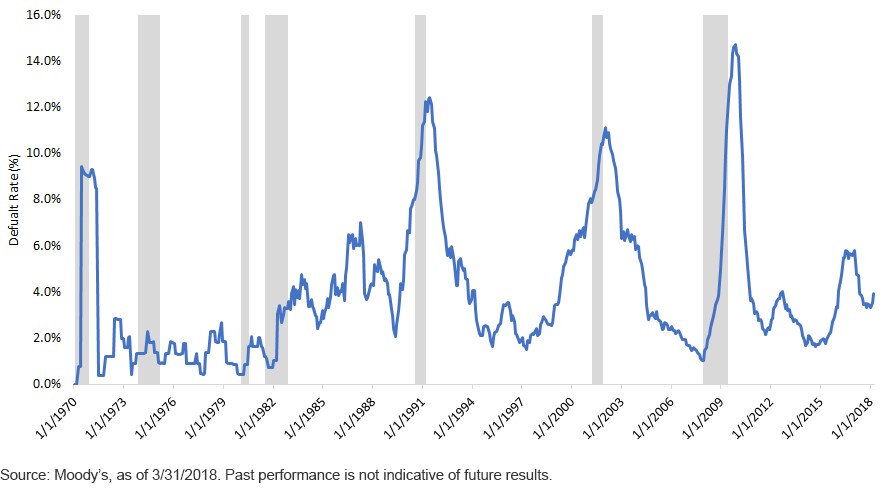
For this blog post, the focus will be on U.S. high yield (HY), particularly because if one was to see the first signs of stress, the argument could be made that this is the sector where investors should turn their attention. Over the last six months, investors have witnessed two episodes where HY spreads have visibly widened. The first of these episodes occurred during late October to mid-November of last year, when spreads rose 53 basis points (bps).1 The second occurrence was more recent, as HY differentials moved from more than a decade low of 311 bps on January 26 up to 369 bps two weeks later, representing a widening of 58 bps.2

U.S. Speculative-Grade Issuer Default Rate vs. Recessions

It is interesting to note that in both cases the widening trends were rather brief (two to three weeks) and of similar magnitudes. In addition, both times the sell-off was short-lived, as buyers re-emerged and compressed spreads back down.

Continue Reading…

Retirement Is not Rocket Science

By Billy and Akaisha Kaderli

Special to the Financial Independence Hub

Getting your house in order for retirement or financial independence is not that difficult. Many investment professionals, journalists, and commentators seem to complicate the issue to the point that even we can’t understand it. Safe withdrawal rates, stocks, bonds, balanced funds, commodities, options, laddered portfolios, annuities, offshore accounts, hedge funds … are you kidding? No wonder some people are confused and scared!

What’s a person to do?

First, you need to recognize your needs. Let’s be realistic here. How much are you spending now? Not how much do you make a year, but how much are you paying out? With today’s computer tools, this is a very easy task to compute. Or you can do what we did: Create a chart on a piece of paper and add to it daily.

Date Cumulative spending Day# Cost/p/day Times 365
1/1/2018 $24.00 1 $24.00 $8760
1/2/2018 $99.00 2 $49.50 $18,068
1/3/2018 $144.00 3 $48.00 $17,520
1/4/2018 $244.00 4 $61.00 $22,265
1/5/2018 $314.00 5 $62.80 $22,922

(These figures are for illustrative purposes only.)

The longer you keep track of current consumption, the more confident you’ll become of your future spending habits.

Once you know your expenditures per year, take a look at where that money is going. If it’s to pay credit card bills or other consumer debt, you need to pay that off first. It’s fine to use credit cards as long as you completely pay off your balance monthly. And stay out of debt. I know this is not easy, but it’s your future, and the money you were paying in interest can now be invested.

With your debts paid off, you can commit to financial independence. Analysts say a guideline of 25 times your annual capital outlay should be enough to sustain your current lifestyle. With the data you’ve collected in your chart, you can easily calculate a target amount. It’s really that simple.

How do you get there?

Continue Reading…

Thinking responsibly about socially responsible investing

By Tea Nicola

(Sponsor Content)

“Do the right thing.” That’s the new corporate motto for Alphabet, Google’s parent company, putting a more proactive spin on Google’s “Don’t be evil.” (Interestingly, as of this month, Google has eliminated the phrase from its corporate code of conduct).

On the one hand, Google’s change in mantra from “don’t be evil” to “do the right thing” is a perfect example showing we do not want to just avoid the worst, but elevate and encourage the best.

But what does the new motto mean, exactly? That motto, and that overly simplistic approach, is also what’s tripping up investors when it comes to Socially Responsible Investing (SRI).

SRI can be a great thing for investors. According to a Deutsche Bank study of more than a decade’s worth of data, ethical funds perform very well, indeed. That performance-plus-values formula explains why assets in Canada managed using one or more responsible investing strategies adds up to $1.5 trillion.

While the Responsible Investment Association noted individual investors’ responsible investment assets were up 91% in two years, a large chunk of that $1.5 trillion comes from institutional investors. That’s a good sign that the smart money is definitely aligned with fighting climate change, promoting human rights and admirable causes.

That enthusiasm is only likely to grow, assuming the younger generation keeps up their habits. Millennials are twice as likely as baby boomers to pick investments if they help solve social or environmental problems, according to a recent Ipsos survey cited in Business in Vancouver. The same report noted “about 38% of the US$5 trillion global public equity market is subject to some level of investment “screening.”

Demand is there. But for SRI, the devil is in the details.

Green oil companies, dark tech firms and shades of grey in SRI

What does SRI boil down to for a lot of investors and portfolio managers? Guns and tobacco, bad. Organic food retailers, good. Dirty, fossil-fuel-extracting drillers, bad. Silicon Valley tech companies, good. And on and on it goes.

There’s nothing wrong with trying to create simple investment categories. That’s particularly true for retail investors. Realistically, they might want to devote the bare minimum of time examining the holdings of various portfolios.

Nothing wrong with the intent, anyway. But execution is tricky.

Clean, green oil?

For instance, those giant fossil fuelled energy dinosaurs like Exxon and Shell? This sector has spent billions on cleantech. It’s in their interest to go lean and green, making their operations ever-more-efficient. Certainly, US and Canadian energy companies have stakeholders demanding higher standards, compared with Mideast producers. When Big Oil is also Clean(er) Oil isn’t it a bit perverse for ethical investors to stay away?

And of course, if the whole purpose of investing is to get a good return, that decision to turn away from this sector would seem downright irresponsible when oil is on a tear. Yes, green energy is the future … but investors want returns now, not just 10 or 20 years from now.

Socially responsible investors often risk unintended consequences. Another kind of oil (not the kind you put in your car), palm oil, went big a few years back. It was seen as a kind of superfood and made its way into a bevy of edible and beauty products. It was a clean, organic product … and then people realized that its cultivation was actually harmful to rainforests that got cleared for palm oil production.

Don’t be evil (or just kind-of-evil) … wink, wink, Facebook, Apple, etc.

The much-celebrated FAANG stocks represent the profitable innovation of Silicon Valley (Facebook, Amazon, Apple, Netflix, Google). Their leaders are seen as visionaries. The legions of smart people who work for these firms have created products that add immeasurably to the convenience and comfort of modern living. Their gleaming campus-sized, solar-powered, people-friendly office spaces are surely the opposite of the “satanic mills” of the coal-powered, mutilating sweatshops of the industrial era. Until quite recently (and coming soon once more), they were the stars of investor portfolios. Continue Reading…