Hub Blogs

Hub Blogs contains fresh contributions written by Financial Independence Hub staff or contributors that have not appeared elsewhere first, or have been modified or customized for the Hub by the original blogger. In contrast, Top Blogs shows links to the best external financial blogs around the world.

Borrowing to invest? Beware of rising interest rates.

Del Chatterson

By Del Chatterson

Special to the Financial Independence Hub

Your financial advisor is probably not recommending it and you may be naturally averse to more borrowing, but it is hard to ignore the basic principles of financial leverage from Finance 101. (The principles have not changed, since I first taught the course in 1972!)

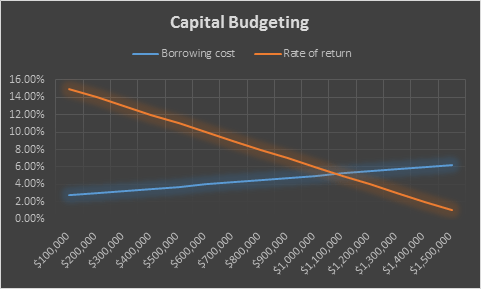
As explained in a chapter on Capital Budgeting, companies and investors should continue to invest in projects until the marginal cost of capital equals the marginal rate of return: assuming you select projects in order from the highest return to the lowest return and that the cost of borrowing increases with the total amount of loans outstanding.

So in the example chart shown to the right, you would borrow and invest up to $1.0 million, which is the point where the expected rate of return declines to meet increasing cost of borrowing at about 5%.

You may have confirmed the theory from your own experience. Your current portfolio has a few investments that are achieving better than 10% or 12% returns, most congregate around the long-term average of 7% to 8% and a few continuing disappointments are returning below 5%, or worse.  Your lowest cost of borrowing is probably the mortgage you signed in 2015 at 2.5% or a car loan at 1.9%, but your subsequent borrowing for a personal line of credit is at 3.25%.

Continue Reading…

Liberal tax changes would spark exodus of Canadian entrepreneurs

By David J Rotfleisch, CA, CPA, JD

Special to the Financial Independence Hub

The proposed changes to the Income Tax Act that the Minister of Finance, the Honourable Bill Morneau, has released have real-world implications. The consultation period ends October 2, 2017, so now is the time to make your voice heard. Call or email your member of Parliament, or Minister Morneau directly.

I recently had a meeting with a high-tech entrepreneur in an internet-based business. He is very conservative and has not carried out any tax planning. His wife helps him but he does not do any income splitting with her. He has about $1 million in his corporate bank account for possible business use, but has not invested it and just earns minimal bank interest. The hype about the proposals has caused him to take notice of his tax affairs and meet with me.

I told him that under the new proposals income splitting with his wife, other than a fair salary for services performed, will be prohibited. His wife will probably not be able to participate in the lifetime capital gains exemption. If he decides to invest his retained earnings, there may be an additional tax on his income. He is now thinking about lifestyle and whether he wants to leave the country. I fully expect to prepare a memo for him about becoming non-resident.

Minister Morneau’s proposed tax changes will have the effect of causing an exodus of Canadian entrepreneurs for more business-friendly jurisdictions.

I had lunch with accountants a few days ago and they reported the same types of conversations with high-tech clients. They are considering leaving the country. Now, some won’t because of the education of their children, to be close to aging parents, adult children,or because they like their Canadian lifestyle. Others will decide it’s more important to maximize after-tax income and that it makes sense to move offshore.

70% of Canadians work for firms with 100 or fewer employees

Remember,  statistics show that the vast majority of Canadians — 70 per cent — who are the economic engine of this country, work for companies with between 1 and 100 employees: the very targets of these new measures, and who are able in many cases to pack up and leave.

This is not just the view of tax professionals. Ryan Holmes, the CEO of social media internet company Hootsuite, was reported as saying on Sept 14, 2017 that the proposals are causing a lot of concern to business owners and that “I think you need to be very favourable at the small end of the market.”

I was recently contacted by a Liberal MP who is very opposed to what his government is doing. He has an entrepreneurial background and he realizes the impact of these proposals.

Continue Reading…

Women have distinct financial planning needs

Marie Philips

By Marie Philips

Special to the Financial Independence Hub

The financial assets controlled by Canadian women as well the income earned by women is projected to grow significantly over the next decade.

This increase in wealth will result from a greater overall participation in the work force, higher level professions, an increase in female entrepreneurship and being the beneficiaries of a large share of the $1 trillion wealth transfer that is underway in Canada.

By 2026, women in Canada will control close to half of all accumulated financial wealth, roughly $900 billion in financial and real estate assets. That’s a significant increase compared to a decade earlier, when the share was closer to one third.

Yet according to a recent white paper published by IPC Private Wealth in collaboration with Strategic Insight, almost two  thirds of financial advisors (85% of whom are men) do not believe a female client should be viewed in any different light than a male client.

If we look at some of the concerns women have, we can see that there are distinct financial planning needs for women compared to men. Life expectancy at birth now means mortality in 2015 is 84 (80 for men).  Women live longer and are likely to have interrupted careers as a result of family responsibilities (children and caring for elderly parents) which all lead to potential lower available savings for retirement income.

Caregiver women more likely to end up in poverty

Research shows that women caregivers are likely to spend an average of 12 years out of the workforce raising children and caring for an older relative or friend.  Continue Reading…

Right side of the tracks: most affordable commuter Neighbourhoods

By Penelope Graham, Zoocasa

Special to the Financial Independence Hub

It’s a given that home buyers will pay a premium to live within big city limits: close proximity to work, lifestyle benefits and a comparatively healthy job market mean homes within a municipality’s core are in high demand.

While the concept of moving to further-away communities with lower real estate prices isn’t new, the suburbs near Canada’s largest cities are becoming a buying destination for home seekers at a faster pace. For example, homes within the Greater Toronto Area’s 905 region have appreciated 56.96 per cent over the past years, fueled by demand from spillover buyers from the 416.

This trend is mirrored on the west coast, where popular commuter cities Maple Ridge, Pitt Meadows and New Westminster have appreciated 6.5, 72.8 and 73.4 per cent, respectively.

Car commute costs add up

However, a long-standing argument against “driving until you qualify” is the opportunity cost of longer commutes. Those who choose to drive to an office in the downtown core need to factor in the cost of purchasing and maintaining one or more vehicles, as well as insurance, gas and parking. For this reason, neighbourhoods closest to well-serviced transit lines, such as rail, light rail or bus lines, tend to appreciate in value faster than their car-accessible-only counterparts.

“The cost of owning and operating one or more personal vehicles greatly outweighs the cost of taking transit,” states the Metro Vancouver-commissioned “Housing and Transportation Cost Burden Study”. It found the average auto-related commuter costs range from $13,500 to $17,700 annually, a “significantly higher amount than the average annual transit costs.”

That makes a pretty strong argument for suburban buyers to stick close to local transit stations when buying. But what regions provide the greatest value vs commute cost? To find out, Zoocasa crunched average home prices and transit pass prices in Canada’s two largest housing markets: Toronto and Vancouver. (Please refer to the infographic at the top of this blog.)

Toronto commuters could save $395,667

That’s the difference between purchasing the average home in the 416 compared to one in Malton, the most affordable neighbourhood located along the GO Transit Line, which services the majority of the Greater Toronto Area with commuter trips to downtown Union Station. Continue Reading…

Average Canadians stranded in storm of Liberal tax changes

By Dave Faulkner, CLU, CFP

Special to the Financial Independence Hub

On July 18, 2017, the Liberal Government announced a significant set of tax proposals designed to close certain tax loopholes that can result in high-income individuals gaining tax advantages that are not available to most Canadians, these include:

  • The elimination of “income sprinkling” by paying dividends to family members that own shares in a business or holding company.
  • The curbing of “passive investment income,” by imposing additional taxes on money sitting in a corporate investment account.
  • The conversion of a corporation’s regular income into capital gains using legal tax strategies that have been around for decades.

In recent interviews, Finance Minister Bill Morneau said that average Canadian business owners need not worry about his proposals, because if you make less than $150,000 per year you will see no increase in taxes paid. He continues to state that he is going after only the wealthiest Canadians that use corporate tax loopholes to gain advantages over the hard-working middle class. It is important to note however, that what Bill Morneau refers to as tax loopholes are in fact legitimate tax planning strategies that have been available to all Canadians for many years.

To help sell these proposals proponents of the new tax have released simple spreadsheets illustrating the impact to an individual in Ontario earning $1.00 of business income who earns over $200,000 and pays tax at the top marginal rate of 53.53%. In other words, the wealthy 1%.

As a financial planner, I know first hand that most small business owners are not wealthy. They are hard working average Canadians who are struggling to build their business, often at the cost of not being able to make regular contributions to retirement plans. As a software designer, I know first hand that simple spreadsheets do not provide enough analysis to come to any meaningful conclusions, due to the complexity of our tax system. All they do is support the opinions of the author.

So, to help bring some meaningful analysis to the position that these proposed changes will not burden middle class business owners, Razor Logic Systems has deployed a temporary version of our financial planning software RazorPlan that addresses one aspect of these proposals, passive investment income. As the largest provider of financial planning software to independent Canadian financial advisors, upon request we will temporarily make this version available to any financial writers, bloggers, the media, and Minister Morneau.

Passive Investment Income

Currently, to eliminate double taxation, a portion of the income tax a CCPC pays on investment income is refundable. In Ontario, the combined Federal and Provincial tax rate is 50.17% made up of 19.5% non-refundable and 30.67% refundable only once the income is paid to the shareholder in the form of a dividend. This effectively ensures that the tax paid on $1.00 is the same regardless of where it originated. The tax proposal aims to eliminate the 30.67% refundable portion, claiming the low tax rate on active business income in a CCPC creates an advantage for individuals with a corporation compared to individuals who earn income personally. Continue Reading…