Hub Blogs

Hub Blogs contains fresh contributions written by Financial Independence Hub staff or contributors that have not appeared elsewhere first, or have been modified or customized for the Hub by the original blogger. In contrast, Top Blogs shows links to the best external financial blogs around the world.

Doing it: 50% more income in Retirement

By Mark Yamada and Ioulia Tretiakova

Special to the Financial Independence Hub

Nobel laureate William Sharpe described managing retirement assets as the “nastiest hardest problem in finance.” Living longer on a fixed pool of capital is only the start of a problem complicated by the myriad of possible personal and family needs and obligations that develop over a lifetime.

The need

Demographics are driving big change in the retirement market. Not only will Gen Y workers have fewer opportunities to save for retirement because of high predicted job turnover and reduced access to workplace pensions, but retiring baby boomers are being abandoned by the very industries created to serve them.

The pension, mutual fund and wealth management industries are direct responses to boomers joining the work force, but fewer retiring boomers meet the criteria for investment advisors who are compensated for growing assets. Retiree portfolios don’t get contributions and many are too small to qualify as brokerage minimums rise. Most mutual fund fees are too high for this cohort for whom costs are more important than ever before. The number of advisors is also shrinking, not only because of compensation and compliance pressures but also because advisors too are retiring.

Saving more, starting earlier and taking more risk are the accepted ways to improve retirement outcomes. Two or more of these options may no longer be available for retirees. A growing crisis in retirement savings is stretching an already extended social welfare system and new thinking is needed if disaster is to be averted.

Solutions not products

Our research motivation (Journal of Retirement and two Rotman International Journal of Pension Management papers) is a belief that investing can be improved to solve problems. The pension problem, for example, is best resolved by focusing on what workers really want, reliable replacement income in retirement rather than trying to pick the best performer every period. Consumers today want solutions. The investment industry is still about products.

Just as someone who only owns a hammer sees every problem as a nail, the industry has a singular focus on “maximizing returns.” This sounds good, but anyone using Google maps knows the fastest route to a destination is not necessarily the shortest. UPS routes deliveries to avoid turns against oncoming traffic to reduce accidents and delays waiting for gaps. Their drivers make 90% right hand turns and experience shorter delivery times, lower fuel consumption and operate smaller fleets. What if investment portfolios could similarly be routed more efficiently to correct destinations?

Autonomous portfolios

The self-driving automobile that protects passengers from immediate risks and routes itself to a predetermined destination provides a template for an autonomous portfolio.

Getting to a destination is a different strategy than going as fast as possible all the time. For starters, brakes and steering are needed not just an accelerator pedal. Maximizing returns, the investment industry’s primary approach, is about going fast. If your strategic asset mix is 65% stocks and 35% bonds, your advisor will periodically rebalance to this mix. If stocks go down, she will buy more stocks. This sounds like the right thing to do, and it is, if your investing time horizon is long enough to make back accelerating loses over the next market cycle; your portfolio is throwing money at a falling market after all. For an aging population in general and retiring baby boomers in particular, this is an increasingly risky and unpalatable proposition.

How we can do it

To protect portfolios we keep risks as constant as possible. When volatility rises, some risky assets, like stocks, are sold and less risky ones, like bonds, are added. When volatility falls, we add riskier assets. The critical effect is avoiding big losses. Statistically this is like card counting in the casino game of blackjack. When volatility is higher than average, the deck is stacked against the player. This means we expose portfolios primarily to markets that are favorable. It’s an unfair advantage but it’s legal! Continue Reading…

How the CRA and IRS cooperate in taxing dual citizens

By Peter Muto

Special to the Financial Independence Hub

Canada and the United States have very different tax regimes, and if you live and work in Canada but happen to be an American citizen, you better pay attention. It is estimated that up to two million Americans currently reside in Canada either as full-time or part-time residents. Full-timers who hold jobs in this country, effectively U.S. citizens and green card holders, sometimes start thinking of themselves as being Canadian. But as far as the IRS is concerned, that is a big mistake.

Unbeknownst to many, the IRS in the U.S. and the Canada Revenue Agency (CRA) in Canada can assist each other in collecting taxes from their respective citizens, and this also goes for those with dual citizenship. The fact is tax debts can be enforceable in a foreign jurisdiction. Canada currently has collection-assistance provisions in treaties with such countries as Germany, the Netherlands, Norway, New Zealand, the United Kingdom and Spain. And the United States.

A recent case concerning an American who was ordered to pay a big penalty in U.S. district court demonstrates this all too well.

How one Canadian resident fell afoul of the IRS

The man, Donald Dewees, teaches at the University of Toronto. He lives and works in Canada, and dutifully pays his Canadian income tax. But, as mentioned at the outset, Canada and the U.S. have very different tax regimes. The biggest difference is that in this country the federal government taxes people based on residency, but the U.S. imposes tax obligations on all its citizens regardless where they live, even if they have no U.S. income.

According to the rules, Dewees is supposed to file with the IRS a document called an FBAR: the Report of Foreign Bank and Financial Accounts, which is known as Form FinCEN 114. He has to do that annually. What is this for? One situation it applies in is when an American citizen or green card holder has financial interest in, or signature authority over, one or more foreign accounts as long as the aggregate value is more than US$10,000 at any time during the reporting period. So, even though the person may not hold an American bank account and may not even earn American source income, they still have to file this report with the IRS every year.

Voluntary Disclosure Programs

In this case, back in 2009 Dewees entered what is known as the Offshore Voluntary Disclosure Program (OVDP). He did that so he would be compliant with his U.S. tax obligations. So far, so good. This program is similar to Canada’s Voluntary Disclosure Program, which allows a taxpayer to pay fixed penalties. In this way you know right away how much you owe. Also, when you are in the U.S. OVDP, criminal charges will never be laid against you.

However, here is where DeWees veered off course. After entering the OVDP program, he wanted to know how much he owed in penalties and the amount was about US$185,000. So he withdrew from the OVDP program.

After that the IRS got involved. The IRS assessed a penalty for failing to file form 5471, which is required when you own a controlling interest in a foreign company; in this case a non-U.S. company. The minimum penalty is US$10,000 and that is for every year of non-compliance. For Dewees, that meant 12 years and 12 X $10,000 is US$120,000. That is the total for which he was assessed.

Continue Reading…

Integrate eldercare into financial planning or pay the price

By Susan Hyatt

Special to the Financial Independence Hub

People plan for retirement to live how they want in their ‘silver years.’ But have you thought about including eldercare in those plans? Most have not and when reality sets in people are shocked at the cost.

Several years ago I was on a consulting assignment in the United Kingdom when both my elderly parents went into crisis at the same time. To make matters worse, they were divorced and lived in separate towns. Still, I figured I could work it out. I had consulted for governments and global technology companies all over the world with expertise in healthcare. In Canada I helped government bring the healthcare system into the electronic age. I figured I knew the system.

I returned to Canada only to find that, despite all my experience and contacts, it was a challenge to navigate my parents through the healthcare system into new living quarters, due to their dementia and inability to live on their own. I had 40 years of professional experience in the healthcare industry, and discovered that in all this time little had changed. The hospital system is well funded, but after discharge from hospital you are on your own and pay for out-of-pocket costs.

After six months wandering through the maze of eldercare options, I put my retirement plans on hold and started a professional services company that delivers crisis management and planning services for the elderly. We offer seniors and their families advice in estate planning and life planning.

Boomers slow to formalize eldercare plans

We always see people, including those of high net worth, who don’t include eldercare costs in their financial and estate planning. Too many Baby Boomers have not formalized plans for growing old or designated who should care for them. Indeed, people refuse to plan ahead or even talk about aging. Adult children don’t want to question their parents about plans involving money management, never mind health issues that may already be developing.

Today many seniors – especially those with health or mobility issues – talk about whether or not to stay at home. The ‘gold standard’ used to be that you stayed at home as long as possible. But for how long and at what cost?

Before, family members might have taken care of you. But now families are dispersed and most of your neighbours work. So you must pay for help yourself.

Bill Gates’ dementia campaign

Bill Gates just announced he is donating $50 million to Alzheimer’s research and discovery. He realizes there is a dementia epidemic and Alzheimer’s is a leading cause. As he says in his blog, almost 50% of people who live into their 80s will get Alzheimer’s. But health care costs are prohibitive. Current estimates in the U.S. indicate that health care costs and eldercare costs for those suffering from Alzheimers will be five times the costs for normal aging.

Seniors and their adult children must start thinking about a lot of factors if a parent becomes ill. What exactly is Dad’s prognosis? How long will he be able to walk? How long will it be before he’s in a wheelchair? If he stays in the house, what modifications are needed and how much will they cost? What about home care? All, this takes time and expertise, and people need a plan to cost out the options.

Where to start? It’s a good idea to create a family playbook with clear plans and expectations to help reduce the emotional and financial strain that may be ahead. At Silver Sherpa, we use a holistic assessment approach. We assign a Client Director to work with the senior and their family to navigate through key quality-of-life factors such as health issues, legal and financial preparedness, family dynamics, and the needs and wants for living accommodation. This is a proactive approach. It lets our clients recognize the warning signs of an impending crisis and respond in advance rather than slip into chaos.

Canadians are beginning to understand that they must pay for out-of-pocket costs associated with aging, and as care needs increase, those costs could skyrocket. Earlier this year CIBC released a study called ‘Who Cares: The Economics of Caring For Aging Parents,’ and it’s an eye-opener. According to the study, in 2007 about 14% of Canadians were aged 65 and older, but now it’s 17%, and in ten years it will be 22%. Today, 30% of working Canadians with parents over the age of 65 have to take time off from work for eldercare duties.

40% are uncomfortable talking about eldercare/illness

The study also found that 40% of respondents were uncomfortable talking about eldercare and illness because they figured their parents would think they were after their money, and that only 23% of Canadians with a parent 65 or over have a financial plan for their senior years. What’s more, Continue Reading…

October home sales stronger as buyers beat Mortgage deadline: CREA

By Penelope Graham, Zoocasa

Special to the Financial Independence Hub

October ushered in slightly stronger home sales across the nation leading to tighter buyer conditions, but losses in Canada’s largest markets continue to “overwhelmingly” drag the average well below last year’s activity levels, reports the Canadian Real Estate Association (CREA).

Sales remain weak Year over Year

According to CREA’s October report, overall sales rose 0.9 per cent month over month, but remain 4.3 per cent under 2016’s number. Compared to peak activity experienced in March, sales are down an even steeper 11 per cent. It was the seventh month in a row that sales have underperformed on an annual basis. And, with the majority of the downturn experienced in the Greater Toronto Area and surrounding Golden Horseshoe markets, it’s clear detached houses, townhomes, and condos in Hamilton and Toronto are proving less of a draw.

However, fewer homes listed for sale in October made the market more seller-friendly, down 0.8 per cent over the month. This could indicate the flood of Toronto real estate listings that followed the Ontario Fair Housing Plan may be subsiding, as well as typical seasonal factors: fewer people want to deal with selling their home as the holiday season approaches.

Buyers rush to beat Mortgage Rule deadline

The slight improvement could also be due to new mortgage qualification rules, which will make it tougher for all borrowers of new mortgages — regardless of their down payment size — to qualify, and will reduce the amount of home they can afford. CREA President Andrew Peck says that as the changes will take effect in January, buyers now are rushing to get into the market in order to avoid the new requirements.

“Newly introduced mortgage regulations mean that starting January 1st, all home buyers applying for a new mortgage will need to pass a stress test to qualify for mortgage financing,” he stated. “This will likely influence some home buyers to purchase before the stress test comes into effect, especially in Canada’s pricier housing markets.”

CREA’s Chief Economist Gregory Klump agrees, saying short-term improvement may be temporary.

“National sales momentum is positive heading toward year-end. It remains to be seen whether than momentum can continue once the recently announced stress test takes effect beginning on New Year’s Day,” he stated. “The stress test is designed to curtain growth in mortgage debt. If it works as intended, Canadian economic growth may slow by more than currently expected.”

Home prices continue to rise across Canada

Real estate continues to get more expensive throughout Canada, with the national average price rising 5 per cent to $506,000, and the national MLS Home Price Index benchmark up 9.7 per cent year over year. However, the pace of price growth appears to be slowing: that’s the smallest increase seen since March 2016. Not factoring in Toronto and Vancouver, the average price would be $383,000 – $120,000 lower.

Toronto: following Vancouver’s footsteps?

Continue Reading…

Don’t shun Bonds merely because of fear of rising Rates

Sources: Bloomberg and FactSet

By James Redpath and Curtis Elkington

Special to the Financial Independence Hub

Conversations about increasing interest rates and their impact on bond investments have recently spiked in Canada. Since bonds are traditionally viewed as an investment that provides a steady stream of income while acting as a safety net within an overall balanced portfolio, an environment of rising interest rates understandably causes unease: it can decrease the price of bonds and therefore can negatively impact performance.

While we share the same concern, we also think some of the prevailing discussions oversimplify the relationship between interest rates and bonds and require a bit more context. We may want to think twice about knee-jerk shunning of the asset class.

Right off the bat, what should be kept in mind is that the interest rate most commonly referred to in media articles is the overnight interest rate, which we will refer to here as simply ‘interest rate’. For anything longer than the overnight rate, we will use ‘yield’ and/or ‘yield curve’.

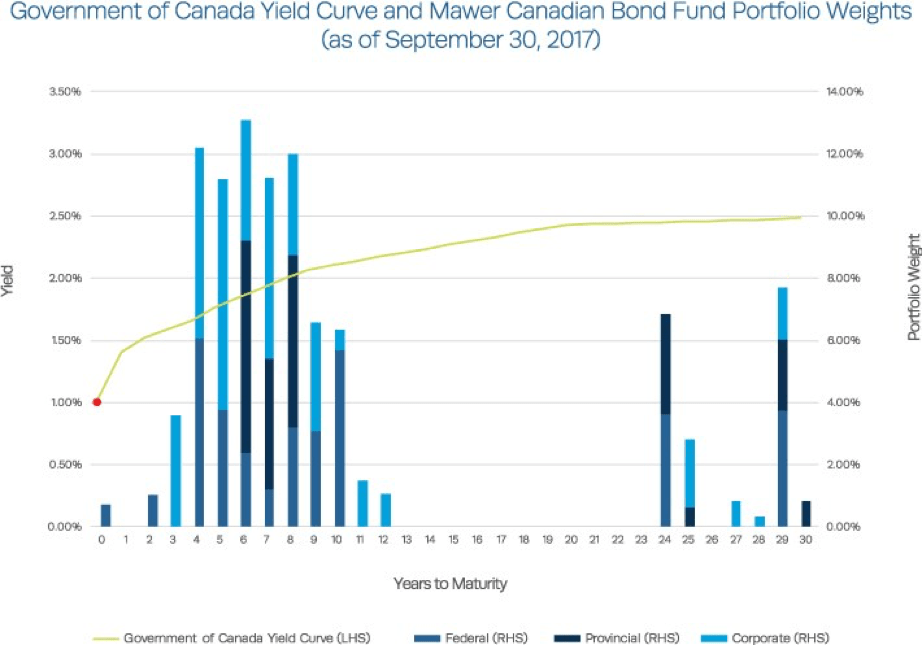
While the Bank of Canada controls the overnight interest rate (represented by the red dot in the graph above) and has some influence on the short end of the yield curve, medium to long-term yields are a different story. Medium and long-term yields tend to be driven by long-term factors outside the Bank of Canada’s direct control, such as potential economic growth and inflation dynamics, supply and demand, and global influences.

Thus, pinning too much importance and conversation onto that red dot doesn’t provide a holistic picture since the Fund has a diverse maturity structure and exposure to multiple sectors: all of which can have different influences on performance. While shifts higher in the yield curve over the short-run will likely negatively impact a bond portfolio, over a longer time horizon, the effects might be surprisingly positive.

In long run, rising yields are a positive

Why? Although it may seem counter-intuitive, if you have a long-term time horizon, an increase in bond yields is usually more beneficial than if yields remained lower as the performance of a bond fund is influenced by the level and slope of the yield curve over time. Another important factor is the pace yields rise relative to the time it takes to recover lost performance. While there could be short-term pain, maintaining a long-term horizon allows an investor to reinvest at a higher yield, which over time typically outweighs the negative short-term impact. Simply put, the higher yields are, the higher the income an investor receives when cash flows are re-invested.

Continue Reading…