
Hub Blogs

Hub Blogs contains fresh contributions written by Financial Independence Hub staff or contributors that have not appeared elsewhere first, or have been modified or customized for the Hub by the original blogger. In contrast, Top Blogs shows links to the best external financial blogs around the world.

What’s your real Risk Tolerance? Chinese Face Reading tells us Listen to your Ears

By Jane Hawley Edward

Special to the Financial Independence Hub

My Google search for “choosing a financial advisor” yielded more than 30 million hits. It appears to be a popular topic. The recommendations over the first 20 pages were variations on:

Education and Experience

Compensation and potential conflicts of interest

Investment suitability to the client

Yet I propose another characteristic for consideration; one that can quickly help assess one’s risk tolerance and show whether a client and advisor are compatible.

It comes from the ancient Chinese science of Face Reading, where ears are the physical feature that shows how much innate courage and risk-taking ability a person has. The larger the ear, the more comfortable they are gambling physically, in their choice of work or taking risks with money.

To understand the kind of risk-taking you can naturally handle, all you have to do is measure the size of your ear.  Measure it by holding your thumb and index finger in a “C” up to your ear. If it matches in size, you have a small ear.  A large ear is the size of your thumb and middle finger formed into a “C”. A medium ear is between those two sizes.

The broader your ear is across the top, the more comfortable you are with financial and emotional risk.  Chances are that you would be the type who would be more willing to try aggressive growth stocks or volatile markets for potentially larger gains.

In contrast, if your ear is narrow across the top, you’d tend to be a conservative and cautious investor. Your preference would be to invest in safer low-risk vehicles because your main goal is to preserve savings because you feel the pain of losses more intensely than the comfort of gains.

Matching to your financial advisor’s

That’s where matchmaking our ears to our financial advisor’s gets interesting.  A client with cautious, narrow ears may be most comfortable with a similarly narrow-eared, like-minded advisor.  But there’s merit in matching opposite traits; a wide-eared advisor could construct a portfolio that offers protection plus opportunity for moderate growth.  Or a narrow-eared advisor could help curb a high-risk tolerant client from gambling on a poorly diversified portfolio or too speculative an investment.  In either case, together they could temper each other’s risk taking appetite.   The main point is to know what each brings to the equation. Continue Reading…

How Finance Apps & Online Tools will revolutionize Millennial Financial Planning

By Drew Hayles 

Special to the Financial Independendence Hub

When you’re young, you feel like nothing can stop you. You’re in charge of your own destiny.

Things might look different in hindsight, but don’t worry about that now. The most important thing you can do right now is set in motion a plan to achieve financial independence as soon as possible. With the means to do what you want, when you want, you’ll open doors you never even knew existed.

Before you begin in earnest, make sure you have the right digital tools and apps in your corner. These user-friendly resources all have their place in a coherent, comprehensive financial independence plan, provided you use them properly and consistently.

Perhaps you’re using a few already.

 Digital Budgeting Tools: All Your Money in One Place

 This list of the “best simple and free budgeting tools” doesn’t get to actual digital solutions until the third entry, when it calls out the trusty old Excel spreadsheet.

If you’re in the market for something a bit more robust and hands-off than a wall of spreadsheet cells, consider later entries like Mint or PearBudget (which, to be fair, began life as an Excel tool).

These aren’t professional-grade tools by any means, but they’re nevertheless robust enough to accommodate basic household budgeting and ensure that you spend well less than you earn. Remember to download mobile versions and link your bank accounts for automated cash flow tracking.

 Automated Savings Apps: Ditch the Reminders

 Tired of remembering (or forgetting) to make regular savings deposits? Take the uncertainty out of the process with automated savings apps that quietly transfer small sums to your savings accounts without any input on your end.

Tools like Digit exist wholly for this purpose. More robust online banking solutions like Chime Bank typically have built-in automated savings features that round up every debit transaction to the nearest dollar and sock away the difference

 Educational Videos: DIY, But for Money

 Are you a DIYer at heart? You can learn a lot from high-quality investing and financial education videos. After all, there’s no need to pay for entry-level information and strategic advice when you’ve got a YouTube account to your name. If you need help or want to learn more about specific topics, you can always go straight to the source with questions.

Lightweight Accounting Platforms for Entrepreneurs   Continue Reading…

Toronto Housing: Implications for Canadian Banks

By Jeff Weniger, CFA, WisdomTree Investments 

Special to the Financial Independence Hub

Is the footing getting shaky in Ontario housing? The Teranet–National Bank National Composite House Price Index for Toronto rose 272.8% from its inception in July 1998 to the peak last summer. Everyone knows nothing of the sort happened to wages. The average Canadian earned $579 a week back then and $988 today, a 69% change.1 Something is amiss, and maybe the bell was rung in July 2017.

The Toronto housing market appears to have turned on a dime, and the home price index is off 7.3% through 2/28/2018 (figure 1). Aside from the index’s 10.9% fall during the global financial crisis, this is the sharpest decline in Toronto residential real estate since the index’s inception in 1998.

Figure 1: Teranet–National Bank National Composite House Price Index, Toronto

When home prices quadruple in the span of one generation, with much of the appreciation in recent years taking on a “just buy before getting priced out forever” mentality, the natural concern is that  the 7% drawdown might be just a taste of what is yet to come.

This is where we are reminded that MSCI Canada has 43% of its weight in financials,2 and almost all of that is in the big banks. Canada is unique in that its banking system, for better or worse, is concentrated in the five national champions.3 The U.S. has 4,888 commercial banks,4 so major indexes like the S&P 500 do not have the same domination of Bank of America or Wells Fargo as the big players do on the TSX. In fact, in the developed world, Canada’s degree of sector concentration is akin to only Hong Kong, with hardly any other industrialized economies as reliant on so few key sectors. Continue Reading…

6 tips for managing your Kids’ bank accounts

By Emily Roberts

(Sponsored Content)

It’s 2018 and the days of buying your kids a piggy bank are long gone. It makes much more sense to let your kids have a bank account that will not only help them keep their money safe but also teach them how to grow and save it. Unfortunately, it seems as if most modern banks offer little to no incentive for kids to save their money and many focus on charging them as much as possible.

Transaction fees and unexplained charges can easily chew up what little money you deposit. Many banks will continue to charge exuberant monthly fees on small balances to the point where everything that was deposited is gone within a few months. This is why it’s important for you as a parent to find the right bank account for your kids that will help them get the most out of their money and hopefully grow it at the same time.

1.) Check those transaction fees

Most bank accounts come with a PDF or pamphlet (depending on how you apply) that stipulate the charges for every type of transaction. Sometimes these numbers are changed without notice, so be sure to check the fees for each type of deposit, withdrawal, and transaction. Advise your kids to deposit their money through your account or an ATM at the very least, as doing it over the counter is expensive.

2.) Teach your kids about saving

Educating your children about properly managing their money should be done long before they leave for college. Teach them how interest works, how saving their money is the right thing to do, and how to budget correctly. This way, they’ll know how to manage their funds better when they become independent.

3.) Link their bank to your phone number

Doing this means you can see every transaction that goes through. All of these usually come from a single number, so it won’t fill up your inbox. Not only can you see where their money goes, but if its stolen or their bank accounts are hacked, you’ll know first. Continue Reading…

By James Gauthier, CIO, Justwealth

Special to the Financial Independence Hub

When investors run out of contribution room in their tax-sheltered investment accounts such as RRSPs and TFSAs, they often continue investing in a non-registered account that does not have the same automatic benefit of avoiding or deferring taxes. Managing investments in a taxable portfolio then becomes a much more complicated exercise: one that attempts to maximize wealth on an after-tax basis instead of a pre-tax basis, which is how investments would be structured in a registered account.

Any investment income that is earned in a non-registered account is subject to taxation annually and can therefore be thought of as a “fee,” similar to the annual fees charged by your financial institution or advisor. As a robo-advisor that provides low-cost investment options for investors, we devote much time and resources to educating investors about the negative impact that investment management fees can have on their overall wealth. But unlike management fees, which are generally easy to identify and compare amongst different investment options, it is virtually impossible to find after-tax rates of returns for making apples-to-apples comparisons between various products and providers.

Most investment providers, including robo-advisors, use the exact same portfolio recommendations for their clients’ non-registered accounts as they do for their registered accounts, as long as the “risk” level is deemed to be the same. To illustrate the true cost of tax inefficiency, we can show how altering a portfolio recommendation, without materially altering the risk level or other characteristics of the portfolio, can improve the after-tax return of the portfolio.

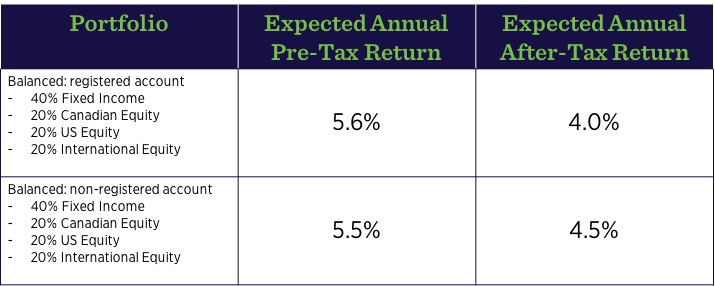
Consider an investor in the top marginal tax bracket who is considered to have an “average” risk tolerance and is invested in a Balanced portfolio of 40% bonds, 20% Canadian equity, 20% U.S. equity and 20% international equity. A reasonable long-term expected annual rate of return on this portfolio, on a pre-tax basis, is 5.6%. Applying tax rates to the interest, dividends (Canadian and foreign) and a conservative estimate for capital gains, the after-tax return on the portfolio is reduced to 4.0%.

By making some minor changes to the portfolio’s asset allocation, such as emphasizing asset classes that receive more favourable tax treatment and finding investment vehicles (ETFs in our case) that are innovatively structured to receive more favourable tax treatment, we can create a new portfolio that is very similar from a high-level asset allocation and risk perspective. The expected pre-tax return on this new, tax-efficient portfolio is slightly lower at 5.5%, but after taxes are applied, the return is a more favourable 4.5%.


The difference of 0.50% in after-tax returns should be considered the MINIMUM cost of tax inefficiency, since we have not yet addressed any other tax-inefficient practices. Extending the analysis across our entire range of investor risk tolerances (from Conservative to Aggressive) shows that the cost of tax inefficiency can vary from a low of 0.40% up to 1.00%. In most cases, the cost exceeds our 0.50% management fee, meaning that you would be better off paying our fee rather than having your assets managed for FREE at any another institution that does not use tax-efficient portfolios!

Continue reading