I didn’t attend this year but Morningstar’s big annual gala that mostly pays homage to actively managed investment funds was held Wednesday night. As Morningstar reports here on its site, Morningstar analysts chose Calgary-based Mawer as fund company of the year for the second year running. It also won several individual awards.
Edgepoint’s Tye Bousada and Geoff MacDonald won foreign equity fund of the year.
Advisors voted (for the fourth year in a row) for Fidelity Canada as the Advisor’s Choice Fund Company of the Year.
Sun Life Financial won the IFIC Invesor Education Award.
In a posthumous award, Raymond Chang of C.I. won the Career Achievement award.
ETF skunks at the party?
Despite all the attention lavished on actively managed mutual funds and pooled funds, ETFs do get a cameo role. Vanguard Canada was awarded ETF Provider of the Year, while BlackRock Canada’s iShares won Best ETF Initiative for its iShares core series of ETFs.
Online discount brokerages are an important element of what I have called the “Findependence Day” strategy, coupled with ETFs and fee-for-service financial planners. The rise of robo-advisers provides a slight variant but picking a good discount brokerage is still a solid way to control investment costs and have control over implementing your strategy.
During my full-time stint at MoneySense, we launched an annual review of discount brokerages running in the summer and ETFs early each year, both spearheaded by Dan Bortolotti, as well as an online directory of fee-only planners, to which we link in the “Getting Help” section.
After two years in the top spot for Virtual Brokers, Qtrade is again number 1, with Virtual narrowly falling to number 2. Questrade is 4th.
BMO in third, leading bank discount brokerages
At MoneySense, where the rankings were picked by a group that included Morningstar Canada, Surviscor and Bortolotti, there was a feeling that convenience was important, typically meaning having all your banking and investing functions under one roof; as a result, since most Canadians tend to do their daily banking with one of the big six banks, bank brokerages often ended up rated higher than some of the independents, however much the latter may have had a technical or pricing edge.
Even so, the banks don’t do badly in the Globe roundup. This year BMO InvestorLine was third , RBC Direct #5, Scotia iTrade and TD Direct Investing tied for #6, National Bank 7th (I’d say 8th given the tie in front) and CIBC Investor’s Edge 8th (really 9th, IMO).
BMO wins Morningstar’s award
Note that BMO was voted the best online brokerage at Wednesday evening’s Morningstar Canadian Investment Awards. Our comment on the event and a link to a piece summarizing the winners can be found here.
P.S. Check out this decision-tree graphic (from Rob Carrick) to help choose an online broker. We’ll put up a separate new post on this later today.
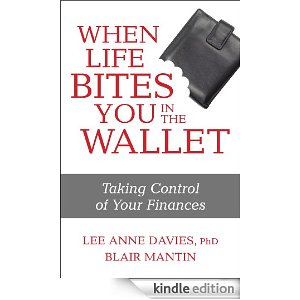
When Life Bites You in the Wallet, published earlier this year, is an excellent personal finance primer on banking, credit, debt and insolvency, written by a former banker and a bankruptcy trustee.
The bankruptcy trustee, based in British Columbia, is Blair Mantin. The other coauthor is Lee Anne Davies, who I got to know a bit when she worked in Toronto at the senior levels of a major Canadian bank. Lee Anne now lives in British Columbia.
However, in her new career as a health, aging and financial guru, Lee Anne pulls no punches about the wily ways of the industry that once employed her. Continue Reading…
Here’s my latest MoneySense blog, based on a Fidelity media briefing on Monday. Click on the red type to go directly to the piece at MoneySense.
For one-stop shopping and archival purposes, here it is again below, with different photos and subheads.
Peter Drake, Fidelity Canada
By Jonathan Chevreau
You’re probably going to live longer than you think but it if you’re worried about outliving your money, planning to work in retirement is not a panacea, warns Toronto-based Fidelity Investments Canada ULC.
At a media briefing on Monday, Fidelity Canada’s Peter Drake, vice president, Retirement & Economics Research urged those still saving for retirement that they have to take more individual responsibility for their future after work. “You’re going to live longer than you think,” he said, citing steadily rising Life Expectancy statistics going back to 1921. Someone born in 1921 would have a Life Expectancy of about 58, a figure that passed 70 for someone born in the mid 1950s and which passed 80 shortly after the new millennium.
Can an “Encore Career” bridge the gap?
Certainly, the latest data from the 2014 Fidelity Retirement Survey released at the event suggests those falling short of their retirement savings goals are counting on some kind of paying “encore career” to make up the difference. While only 20% of those already retired plan to rely on income from a full-time or part-time job, fully 47% of those still in the workforce expect to have some form of a paying “encore career,” said Drake.
Many will rely on Savings and Housing
Non-retirees also put their hopes into Savings and Housing as a way to make ends meet in Retirement. While only 58% of current retirees say they will rely on income generated from savings in an RRSP or RRIF, fully two thirds of non-retirees (66%) plan to do so. Similarly, while only 36% of retirees believe their home equity will help boost their retirement income, half of non-retirees are counting on it.
Clearly, something has to give and that something appears to be the fond notion that people can just keep working past the traditional retirement age of 65. “Planning to work in retirement is not a retirement plan,” Drake cautioned.
Saying you’ll “just keep working” is of course easily said. Indeed, I’ve given that advice to anyone who’s not quite sure whether they have enough money to retire or not. As I quipped on the radio the other day, it’s better to arrive at the train station five minutes early than five minutes late: similarly, when it comes to saving for retirement, it’s better to oversave than undersave. Your children and the government will thank you for over-saving.
“Just Keep Working” not always possible
Unfortunately, Fidelity’s research shows you can’t count on working in retirement. The poll of some 1,400 Canadians found that of those not working, fully one in five retirees would like to work if they could. However, 15% can’t find a job and 23% say employers aren’t interested in employing retirees.
Then there are health and health care issues. Drake says 38% of retirees not working have health issues that prevent them from doing so. And even for those who are themselves healthy, 12% have to care for another family member. Out-of-pocket health care costs are an important consideration for retirees, Drake said. Even though this is Canada, 30% of health costs are not funded publicly, putting more pressure on finances the older you get. Citing per capital public health care expenditures, the big blips are right after birth and then after 65. The per capita annual expenditure is well under $5,000 from age one to age 64 but hits $5,828 between 65 and 69, passes $10,000 between 75 and 79 and really starts to spike after age 85 – past $20,000 –hitting a peak of more than $24,000 after age 90.
Drake noted that generally speaking, women can expect to outlive men, but the longer they do, the more the problems of dementia – especially Alzheimer’s – can arise.
Challenges of Longevity
Another byproduct of extended longevity is that inflation really starts to bite into the purchasing power of a typical retirement nest egg. While inflation has been low and consistent since the early 1990s, it could rise in the future, Drake warned. And even low inflation can reduce purchasing power. A nest egg of $50,000 today would have the purchasing power of just $30,479 25 years from now even with relatively benign inflation of 2%. If inflation were 3%, the purchasing power of that $50,000 would fall to less than half 25 years later: $23,882. And at 4% inflation, it would have the spending punch of just $18,757.
He learned he had non-Hodgkin’s lymphoma, in 2008. (He is now 62).
Mr. Patrick struggled first with the decision about whether or not he should share the knowledge of his cancer with clients. He did and despite his fears to the contrary, none of his clients left as a result of this disclosure. One client even pre-paid, although Mr. Patrick still had to downsize his operation. He had a few employees: one of whom volunteered to leave while another agreed there would be no raise for a year.
Importance of providing clear instructions to spouse
Once it was clear he would be undergoing a (dangerous) stem-cell transplant, he made sure his wife had the paperwork on the life insurance, names of clients and where they could go for alternative service, and how to wind down the business if it came to that. All business owners should have a such letter for their spouse, he says.
After the nine months of treatment, he realized his hopes to immediately resume operating the business at full speed were a tad optimistic. Suddenly, health had become a priority over the business and he realized it would take a few years before his energy levels returned to the point he could work as hard on the business as he had before the cancer revealed itself.
Not coincidentally (given the wide publicity that comes with a story in the Times), his business — Stage 2 Planning Partners — focuses on retirement planning for business owners. I dare say he’s now busier than ever.

 Posted By