
All posts by Financial Independence Hub

The Case for Financial Assets over real estate

Billy kicking back on Mexico’s Pacific Coast

By Billy Kaderli

Special to the Financial Independence Hub

When I was a stock broker in California — one of the hottest housing markets in the US — real-estate was my competition. “Everyone” was making money in real-estate, so why would they invest in the stock market?

I needed an angle

I went to the Board of Realtors and got prices for 2-, 3- and 4-bedroom homes in the area, both at the current price and for 10 years prior. I did the math to calculate what annual return these houses were creating for that ten-year span, then compared that to the S&P 500 Index for the same time period.

The index clearly beat all three home styles without the hassles of ownership. Now I had my argument to help people invest in the market.

Ok, that was then and this is now

Using Zillow.com I looked up what the home we used to own was now worth. It was listed at US$862K. Again I did the math and found that over the last 31 years since we bought it, that house has appreciated 6.4% annually. Sounds OK, except that there were property taxes, maintenance and repairs that would need to be deducted lowering that annual return.

Then, I wondered, what if we had put the money to buy our home into the S&P 500? So I calculated that figure also.

Are you ready?

It would be worth 3 million (US) dollars today! Over three times the current value of the home, as the Index produced a 10.46% annual return during those 31 years. Continue Reading…

Why the “T” in TSX should stand for Tokyo

By Jeff Weniger, CFA, WisdomTree Investments

Special to the Financial Independence Hub


Canada’s stock market construction may be more than just a portfolio risk; it is arguably a systemic one.

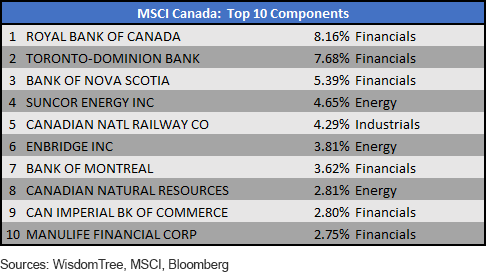
If, for whatever reason, the Canadian financial system were to encounter serious difficulty, investors would be hit by a one-two punch. The attendant economic weakness would hang over the stock market, and it would be the very companies that dominate the stock market that would be battling demons. Canada’s top-heaviness, where more than $2 of every $5 in the MSCI Canada Index is in financial stocks, is not normal or reassuring for a developed economy.1 We should stop making like it is.

In fact, it would be better for the TSX if the “T” stood for Tokyo, at least on the sector diversification side of things, as we show below.

Stuck in the mud

Everywhere you turn, countries that are top heavy are doing something about it. Saudi Arabia, for example, sees the writing on the wall for fossil fuels; either the price mechanism may cause a phase-down in oil demand in the next quarter century, or environmental action groups will crush demand themselves. Either way, the ruling Crown Prince Mohammad bin Salman is keen to avoid state failure if a bleak future for oil comes to pass. That country will soon float an IPO of Aramco, the state-run oil behemoth that may be equal to several ExxonMobils. Proceeds will be diverted into tech, infrastructure—anything that isn’t oil.

China, too, realized it was turning into a one-trick pony. After building its export machine after Mao’s death, the time for middle-class demand eventually arrived. When it joined the WTO at the turn of the century, the country’s household consumption was 46% of GDP. It fell to 36% of GDP in 2007, but it has been rising ever since; sights are set on 40% this year.2

But not Canada. The hat is hung on the same two sectors, as always. Nine of this country’s top 10 corporations by market capitalization fit the bill (figure 1). This, in a country where the average investor has 86% of assets inside these borders.3

That is concentration on top of concentration.

Figure 1: Canada’s Sector Concentrations

Compare the “T” for Toronto with another T: Tokyo. Figure 2 shows Japan’s national champions. They don’t dominate allocations quite like Canada’s do.

Figure 2: Japan’s Largest Companies

Continue Reading…

Why and how Financial Independence is achievable

By Jade Anderson

Special to the Financial Independence Hub

Financial independence can mean different things to different people, but the widespread definition is to be financially secure and on the right track to a safe retirement.

Sometimes people will still need to work in order to maintain their financial independence (aka “Findependence”), but the main idea is that you are free from any debt or outside help from financial institutions. This may seem like something that is unachievable for anyone outside of retirement age, who isn’t well established; however, because of the different types of financial independence, it may not be so difficult after all. Adjusting your spending habits, creating a budget for your self and several other things can lead you towards Findependence, if you know the right things you need to consider.

Reduce unnecessary expenses

Setting up a budget for the long term is extremely important if you’re wanting to become financially independent. If you can cut down on any unnecessary expenses (such as extra food, clothing, and entertainment) in your weekly spending, then you’ll find it will be a lot easier to save. If you are not used to saving money, starting small is important because it will help you establish a pattern of saving properly, and it will be easier for you when you move up to saving more of your average income.

Plan your savings and spending

Planning not only your savings, but also your spending is crucial for ensuring your financial independence. If you have a few debts, and you can make plans to pay off certain amounts by certain dates, you’ll find that the overall debt is easier to pay off, than if you paid it off in a lump sum. Using one of the financial calculators like those on Brighter Finance can help you calculate your budget and repayment periods for your loans, so you can keep track of your money more easily.

Continue Reading…

What does it really take to move overseas?

Overseas life is adventuresome

By Akaisha Kaderli

Special to the Financial Independence Hub

In preparing for a retirement overseas, we would wager that most people occupy themselves with the practical concerns of residential visas, banking, owning property, finding a doctor they like, medical care that they can afford and dealing with any language barriers. These are pragmatic matters with realistic solutions, and we say that these areas are almost the easiest part of making this lifestyle change. While the above mentioned topics are important and must be solved, we want to share with you what it really takes to move overseas.

It may surprise you, but what we have seen take people down, destroying their retirement dreams and sometimes even their marriages, are the emotional and psychological challenges one faces in adjusting to their new lifestyle overseas.

How do you prepare for these obstacles ahead of time? We hope the following tips and insight will shed some light on the topic.

Just like home, only cheaper

You could save a bundle moving overseas

Many people trip themselves up with their giddiness over the fantastic cost of living in their new location. They often come into a new country talking themselves into believing that living in their new destination is just like home, only cheaper. We want to tell you that no place overseas is just like home. Customs, foods, weather cycles, housing codes, the treatment of pets, the laws, the language, cobblestone streets and workmanship quality are all different.

We have seen folks love the quaintness of their new town but then fall apart because they can’t find parking near to markets where they shop. Their charming town might not have one-stop-shoping with a parking lot tying several stores together so they find that market day involves stopping in six locations, perhaps fighting traffic in between. Instead of taking their time to enjoy their enchanting town, they find this situation to be annoying and they carry the frustration with them all day.

 Culture and customs

Animals are treated as animals in developing nations and not as family members. Street dogs are common and if your heart is easily broken, then this might pose a problem for you. Continue Reading…

Accidental Death Insurance: What you must know before buying it

By Lorne Marr, CFP
Special to the Financial Independence Hub

Some insurance products are quite straight-forward (e.g. term life insurance), but others were created when insurance companies saw an opportunity in the market to increase their sales while reducing their own risk of needing to pay the claims. Accidental death insurance (often called accidental death and dismemberment) is one of these products.

Think of this product this way:

“If you look for a simple explanation, imagine all life insurance products to be cars. Your accidental death insurance is a car that you can drive only 30 minutes a day and only in one particular neighbourhood …”

Now, let’s understand this product better …

What is accidental death insurance?

Accidental death insurance is a life insurance policy (or an addition to an existing policy) that pays a claim only in particular cases: when the cause of death is an accident. In other cases, this insurance will pay nothing.

An important statistic to know is that only ~5 per cent of all deaths in Canada originate from accidents. That means that, in 95 per cent of cases, the policyholder will not be paid.

What is accidental death and dismemberment insurance?

Accidental death and dismemberment insurance is an insurance policy that pays a claim only if a death or a dismemberment (such as the loss of a particular body part, like a leg, hand, finger, etc.) occurred due to an accident. Typically, an accidental death and dismemberment insurance contract will define what amount will be paid in case of death and certain different types of dismemberment. Claim coverages associated with heavier dismemberments (e.g. a lost leg) are normally higher than claim coverages associated with smaller dismemberments (e.g. loss of a finger).

Is accidental death insurance worth it?

The quick answer is that, in most cases, it is not worth it. Continue Reading…