
All posts by Financial Independence Hub

6 steps to avoiding a bear market near Retirement

By Fritz Gilbert, TheRetirementManifesto.com

Special to the Financial Independence Hub

Did you know a looming Bear Market Crisis is approaching?!

I just read it on the internet, so it’s got to be true!

To make matters worse, I just retired a month ago.

Uh Oh!  (Am I screwed?)

Today, some reality about Bear Markets, along with 6 steps to consider as you structure your retirement portfolio.

A Looming Bear Market

Ok, I’m having a bit of fun with the “read it on the internet” line, but the reality is that a Bear Market WILL happen. I’m not being prophetic, just stating the facts.  Since before the days of the tulip mania in 1637, bear markets have always been will us, and they always will.  We’ve benefited from a very nice bull run. We’re being naive if we think that it will never end.

Since 1900, we’ve had 32 Bear Markets, defined as a correction of 20% or more.  Do the math, and that averages out to a Bear Market every 3.7 years.  The average bear market lasts 367 days (the longest was 34 months!). Here’s what they look like graphically:

The Looming Bear Market Will Drive A Retirement Crisis

I actually did read an article on the internet about the looming bear market crisis.  In The Next Bear Market In Stocks Will Drive A Retirement Crisis,“ the author states:

“A recession could decimate even substantial retirement portfolios.”

Further, the author goes on to say that Social Security and Medicare, and the resulting increase in taxes, increase in eligibility age and reduction in benefits “would be a disaster” for those dependent on the safety net.

Add to that the Voices Of Worry over the global debt pile up and the underfunded status of many state & local pension funds and things could get really, really ugly.

Maybe I shouldn’t have retired early. 

Too late now, I guess I’d better get to work on building a Bear Market Crisis Prevention Plan.

The Looming Bear Market Crisis

We all know a Bear Market is coming. It’s been an increasing theme in the blogosphere, with even the esteemed Financial Samurai taking risk off the table. America’s wealthy are moving to cash.  Ben Carlson of A Wealth of Common Sense has 36 Obvious Investment Truths to remind folks that you should protect yourself.

I’m not a panic-driven investor, screaming a scare tactic headline to drive traffic (tho, if you’re reading this, I guess it worked, right?).  Rather, I’m reminding folks of the reality of how the markets work and encourage you to think about it as you develop your retirement portfolio strategy.  Yes, stocks have historically outperformed over the long-term, and will likely continue to do the same.  Just recognize that the road can be bumpy, and plan accordingly to avoid getting bitten by a bear when you can least afford it.

A Bear Market Crisis Contingency Plan

The reality is that bear markets have always been with us, and always will.  Unfortunately, we never know when that snake is going to strike, so it’s best to wear snakeproof boots along the path of retirement.  Following are some steps I’m taking, as an early retiree, to defend our portfolio against the risk of a bear attack.  View them as suggestions, and pick and choose as appropriate for your situation.

6 Steps To Bear Market Protection Continue Reading…

Oil pumping up returns for Canadian investors

By Neville Joanes

(Sponsor Content)

We don’t just use it to drive. It’s in the roads we drive on. In fact, it is used in over 6,000 products that help make up modern life. “Oil,that is. Black gold. Texas tea …” And for a fossil fuel commodity supposedly going the way of the dinosaur, oil is looking pretty slick these days.

Oil hit $73 recently and then moderated down to a sweet spot in the mid-$60 range. But can $100 oil really be on its way down the pipeline? Spoiler alert: you might not be thinking big enough. $100 is just a number, not a cap.

As an example of the importance of oil to the Canadian scene, let’s look at the Horizons S&P/TSX 60 Index ETF, which holds the top 60 companies on the S&P 500 index as well as the Toronto Stock Exchange. (WealthBar holds HXT because it is an efficient way to have exposure to Canadian companies or businesses in our clients’ portfolios.) A significant number of those companies are energy producers (ie. oil companies). Indeed, on the TSX, nearly one fifth of the stocks represent energy companies.

Their success fuelled a bounce to a record high in late June. Oil is back — and that means Canadian investors (or at the very least, investors in Canada’s oil-fuelled economy), a steady pipeline of profits is bubbling up.

The recent history of oil. Before the boom, the bust

If you filled up your car recently, the dog days of oil might seem like a distant memory. But it wasn’t that long ago. Thanks to a glut of supply on the world market, oil was down at $30/barrel in 2016. How did it get so low? Mostly, fracking.

North American energy companies employed new technology techniques to bump up energy production by exploiting fields formerly deemed uneconomical. This reduced the need for importing oil from abroad.

The world did not adjust, at least not right away. Russia and the OPEC countries are addicted to revenues from exported oil. With few alternatives as a revenue pipeline, these nations had continued to pump oil even as the price was clearly sliding. Soon, the world had an ocean of cheap oil on its hands.

Moving forward to the dog days of August 2017 and that glut was still choking down the price per barrel. Note the final bolded conclusion in this Bloomberg article:

When OPEC and Russia first embarked on their strategy to clear a global oil glut, it was expected to succeed within six months. It now looks like the battle could last for years.

The Organization of Petroleum Exporting Countries and its partners plan to wrap up their production cuts next spring, already nine months later than originally expected. Yet oil prices are faltering again as data from the International Energy Agency show world inventories could remain oversupplied even after the end of 2018. ESAI Energy LLC predicts that, rather than months, draining the surplus may take years.

With oil priced so low, North American energy companies struggled to keep pumping. At the height of the crash, tens of thousands of Canadians, mostly in Alberta, lost high-paying jobs. By 2017, our Prime Minister was even talking about phasing out the oil sands.

But predictions of oil’s demise were premature.

Oil slides back from the brink

The rebound in oil happened a lot quicker than the experts expected. Today, it is welling up past $70/barrel. What happened? Supply met demand. Continue Reading…

Are you prepared for the new Income Tax rules for Private Corporations?

By John Fisher

Special to the Financial Independence Hub

As many of you are aware, the Canadian government announced new rules in February concerning the taxation of passive income in Canadian controlled private corporations (CCPCs).

The Liberals’ original draft legislation proposed to target tax strategies that have been used by small businesses and professionals since the early 1970s, so naturally the initial announcement in July 2017 drew widespread condemnation.

The government’s concern with the accumulation of passive income-generating investments in private companies stems from the fact that CCPCs pay a blended federal and provincial small business tax rate of 13.5% (in Ontario) on active business income up to the small business deduction (SBD) limit of $500,000 in 2018. This compares favorably to the tax rates on income earned by individuals. On a combined federal and provincial basis, the differential between the highest marginal tax rate on personal income and the small business tax rate ranges between about 36% and 41%, depending on the province in which a CCPC resides.

As a result of this tax rate differential, owners of a CCPC are almost always better off retaining corporate earnings and investing within their corporation. While a similar amount of combined corporate and personal tax is ultimately paid by business owners when monies are withdrawn through dividends, taxes can be deferred until such time as the money is required personally. This effectively allows business owners to temporarily obtain the benefit of investing a larger amount of money than would otherwise be available if they earned the money personally or immediately withdrew profits from their corporation.

One side note worth highlighting here: it is a common misconception that passive investment income earned within a corporation can be taxed at the lower small business tax rate. This is incorrect, as passive income is generally taxed at about the same rate (over 50%), whether earned inside or outside a corporation; so there is no real benefit, per se, from earning investment income in a corporation. Rather, the advantage is that the corporate entrepreneur is able to temporarily invest the amount of taxes deferred by delaying the withdrawal of funds from his/her company.

So what are the new rules governing passive income?

The government has announced its intention to introduce legislation that will reduce the SBD limit by $5 for every $1 of investment income above a $50,000 threshold, beginning in 2019. Once passive investment income exceeds $150,000, the SBD limit will be reduced to zero and the CCPC will pay tax at the general corporate tax rate of 26.5% as opposed to the 13.5% SBD Rate (for Ontario CCPCs).

The $50,000 threshold applies to passive income earned on both legacy and new investments which is important to note given the government’s original promise to “grandfather” any passive income earned from investments previously accumulated

How will the rules affect you as an owner of a CCPC?

Many entrepreneurs are asking if the new rules will result in them paying additional taxes if their corporations generate passive income in excess of $50,000. In most circumstances, the answer is that they will pay more corporate taxes, thereby reducing the size of their tax deferral advantage (from 40% down to 27% on their 2019 corporate income earned in Ontario).

The loss of the entire SBD limit would cost an Ontario CCPC about $65,000 in additional annual corporate taxes ($500,000 x 13% increase in the corporate tax rate). However, once income is paid out by way of dividends from the CCPC, the analysis we have reviewed suggests that the combined personal and corporate tax burden will increase by only about 1% as compared to the current tax regime.

What can you do in light of the proposed changes? Continue Reading…

Is typical retirement advice good? – Testing popular Retirement rules of thumb

Special to the Financial Independence Hub 

You want to retire soon. How should you set up your retirement income?

You talk with some friends, read about it on the internet, and talk with a financial advisor. Are you actually getting good advice?

When it comes to retirement income, most financial advisors rely on a few rules of thumb handed down from one generation of advisors to the next. The rules appear to be common sense and are usually accepted without question.

Do these rules of thumb actually work?

Before giving clients this advice, I tested them with 150 years’ history of stocks, bonds and inflation. I wanted to see if these rules were reliable for a typical 30-year retirement. (The average retirement age is 62. In 50% of couples that reach their 60s, one of them makes it to age 92.) 

These five rules are the “conventional wisdom” – the advice typically given to seniors:

  1. 4% Rule”: You can safely withdraw 4% of your investments and increase it by inflation for the rest of your life. For example, $40,000 per year from a $1 million portfolio.
  2. “Age Rule”: Your age is the percentage of bonds you should have. For example, at age 70, you should have 70% in bonds and 30% in stocks.
  3. “Sequence of returns”: Invest conservatively because you can’t afford to take a loss. You can run out of money because of the “sequence of returns.” You can’t recover from investment losses early in your retirement.
  4. Don’t touch your principal. Try to live off the interest.
  5. Cash buffer: Keep cash equal to 2 years’ income to draw on when your investments are down.

The results: NONE of these rules of thumb are reliable, based on history.

Let’s look at each to understand this.

1.) “4% Rule”: Can you safely withdraw 4% of your investments plus inflation for the rest of your life?

Based on history, the “4% Rule” was safe for equity-focused investors, but not for most seniors.

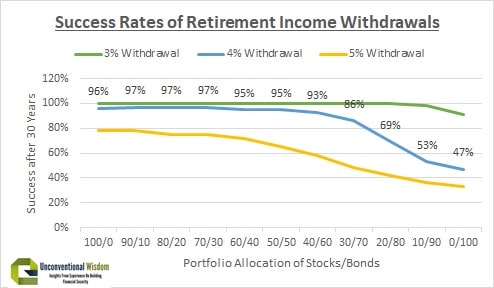
In the results shown in the graphic at the top of this blog, the blue line is the “4% Rule,” showing how often in the last 150 years a 4% withdrawal plus inflation provided a reliable income for 30 years.

The “4% Rule” only works with at least 50% in stocks.

The “4% Rule” worked only if you invest with a minimum of 50% in stocks. Even safer is 70-100% in stocks. It is best to avoid a success rate below 95% or 97%. They mean a 1 in 20 or 1 in 30 chance of running out of money during your retirement.

Most seniors invest more conservatively than this and the 4% Rule failed miserably for them.

A “3% Rule” has been reliable in history, but means you only get $30,000 per year plus inflation from a $1 million portfolio, instead of $40,000 per year.

These results are counter-intuitive. The more you invest in stocks, the safer your retirement income would have been in history.

To understand this, it is important to understand that stocks are risky short-term, but reliable long-term. Bonds are reliable short-term, but risky long-term. Why? Bonds get killed by inflation or rising interest rates. If either happens during your retirement, you can easily run out of money with bonds.

The chart below illustrates this clearly. It shows the standard deviation (measure of risk) of stocks, bonds and cash over various time periods in the last 200 years. Note that stocks are much riskier short-term, but actually lower risk for periods of time longer than 20 years.

Stocks are more reliable after inflation than bonds after 20 years.

Ed’s advice: Replace the “4% Rule” with “2.5% +.2% for every 10% in stocks Rule.”  For example, with 10% in stocks, use a “2.7% Rule.” If you invest 70% or more in stocks, then the “4% Rule is safe.

2.) “Age Rule”: Your age is the percentage of bonds you should have. For example, at age 70, you should have 70% in bonds and 30% in stocks.

Continue Reading…

Affordable Housing: Which Toronto neighbourhoods are friendliest for Condo buyers?

By Penelope Graham, Zoocasa

Special to the Financial Independence Hub

There’s no denying Toronto real estate prices have tumbled since the Fair Housing Plan was introduced by the Ontario government last April, to address the searing 33-per-cent year-over-year price growth that alarmed buyers and policymakers alike. Detached house prices – the hardest hit segment following the Plan – have since declined 14.8 per cent, representing a dollar loss of $180,878, while the average aggregate home price is down 11.8 per cent, a loss of $108,696.

However, affordability continues to be a keenly-felt issue in the city, especially among what is supposed to be the affordable entry point for new home buyers: condos.

While the priciest home segments posted deep declines in the volatile months following the Plan, condos consistently posted year-over-year gains in value; now, just over a 15 months later, they’re sitting at an average of $561,097, an increase of 8.1 per cent.

FHP did little for first-time buyers

That means that, while those in the move-up markets have enjoyed improved buyer conditions, the most vulnerable and cash-strapped have faced only worsening affordability following the new policies. Rather than find an affordable entry-hold in the 416, first-timers are increasingly drawn to further-flung communities, such as homes for sale in London, Ontario, or even Ottawa real estate, where detached living can be had at the fraction of the cost for a city condo.

However, these are aggregate data, reflecting home prices collected from the entire region monitored by the Toronto Real Estate Board. As real estate is extremely local, and can differ from neighbourhood to neighbourhood, savvy condo buyers seeking a deal may still have options within the City of Toronto proper.

Toronto’s most affordable Condo communities

To identify where this is possible, Zoocasa crunched the affordability numbers per neighbourhood, factoring in the average price in each as well as the median income earned in Toronto households.

The findings revealed that, for households earning two or more incomes at the median of $96,294, 18 of the 35 examined markets remained within the realm of affordability.  They are:

Continue Reading…

Powered by the Financial Independence Hub.
© 2013-2026 All Rights Reserved.
Financial Independence Hub Logo

Sign up for our Daily Digest E-Mail!

Get daily updates from the FindependenceHub.com straight to your inbox.