All posts by Financial Independence Hub

Estate Planning: Half of us STILL lack Wills

By Rowena Chan, TD Wealth 

Special to the Financial Independence Hub

Creating a will can be an emotional experience, but it’s an important step in ensuring peace of mind for you and for your loved ones. According to our recent survey, it was surprising to learn that half of Canadians do not have a will, a crucial step in allocating assets after death.

Moreover, more than a quarter (28%) of Canadians without a will are between the ages of 53 and 71. Even more concerning is the stat that 39% of boomers  have not even discussed estate planning wishes with their children.

The risks of not having a will are two-fold: first, the government can intervene and distribute your assets which could mean that your wishes are not fulfilled; and second, not having a will can create unnecessary conflict and animosity among members of the family during an already difficult time.

The survey found that one in five Canadians (19%) who received a family inheritance say they experienced conflict with their siblings and other relatives over the division of those assets, with two in five (41%) saying they considered taking a smaller share of the inheritance to maintain family harmony.

Although some may believe estate planning is only necessary for those with significant financial assets, the truth is that it is essential for everyone, regardless of the total value of assets. To help manage your estate and avoid potential tax implications and family conflicts, we offer the following tips:

Personal property

Items like the family home, summer cottage or jewelry are all considered property assets, regardless of what they’re worth. A professional appraisal is an important starting point for valuing these assets. Once you understand the dollar value, you can get a sense of how to distribute them among your loved ones.


Continue Reading…

How to set long- and short-term financial goals

By Angela Baker

Finances are always problematic, and everyone struggles to find balance in this field.

At the beginning of our professional careers, we are on a tight budget with little perspective for any progress. As time passes, our financial goals get higher and desires may seem unrealistic.  There are many ways to plan finances and to set long-term and short-term financial goals. Below, we will try to explain steps for success in this activity.

Define goals and objectives

If you decided to set financial goals, start with clear contemplation about what you need and how you will achieve that. This is the first and most important step. Decide how much money you want to possess each day, month or year. Then after you have determined the amount, start to plan the way for realizing the financial goal.

This may include a new activity like running a website, opening a store, renting houses or finding a well-paid job. No matter what is it, you need a lot of planning and counting. Also, you must research a lot, listen to advice from friends, people around you, and acquaintances. Only with fully-planned action will you be on the way to achieve short- and long-term financial goals.

Identify your financial requirements

The second strategy in setting your financial objectives includes identifying personal needs about money. Everyone spends a certain amount of money daily for basic needs as food, car, hygiene, or meetings with friends. If you live alone, it will be easier to recognize personal requirements because we all know our own needs. Otherwise, if you have a big family and  have to maintain all of them, it will cost you days to count how much money you need. Also, you should not leave out extra spending for a holiday, services in the house, clothes, etc. The final list could make you scared or nervous, but you must face it.

Improve your saving habits

Continue Reading…

Confident domestic investors fuel Indian markets

 By Dwarka Lakhan (Sponsored Content)

In a display of overwhelming confidence in India’s booming stock markets, domestic investors have for the first time ever invested more money than foreign institutional investors (FII) in Indian equities.

The surge in investments is being led by mutual funds and insurance companies, which over the 1-year period ending May 26, 2017 pumped Rs 71,665 crore (US$ 11.1 billion) into the market, compared to foreign institutional investor (FII) net purchases of Rs 60,000 crore (US$ 9.3 billion.)[i]

Mutual fund inflows into the market have been primarily channelled through systematic investment plans that have become increasingly popular in the lower interest rate environment, following the demonetization of large currency notes.

“Demonetisation pushed interest rates down and a large section of investors became wary of investing in gold and real estate. That increased the flow towards mutual funds,” says Susmit Patodia, Associate Director & Head, Institutional Sales with Motilal Oswal Institutional Equities.[ii]

Domestic Indian investors see more value in local equities

Traditionally, Indian investors have been more risk averse but their shift to equities over the past year is an emerging sign of market maturity and the recognition that they could derive greater value from investing in domestic equities. Continue Reading…

Is a fixed-rate or variable-rate mortgage right for you?


By Alyssa Furtado, RateHub.ca

Special to the Financial Independence Hub

Interest rates in Canada have rarely seen such lows, which makes borrowing money to buy a home pretty attractive. But when you start looking around for the best mortgage rates, homebuyers face a choice of going with a variable-rate or a fixed-rate mortgage.

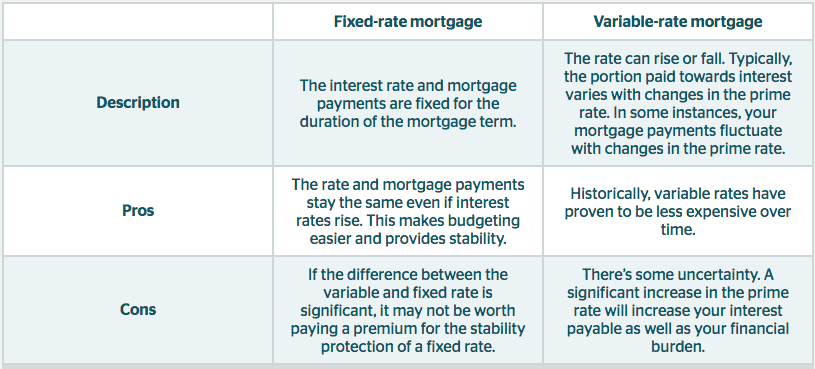
So what’s the difference? A variable-rate mortgage follows interest rates as they move up and down. And a fixed-rate mortgage is locked in for a certain term. Sounds simple, but deciding which option works for you can depend on a number of factors. Here are some essential pros and cons:

Fixed-rate mortgages

Pro: Added security

You don’t have to worry about whether your payments will change because of economic factors you can’t control during the mortgage term. This makes long-term financial planning much easier.

Say you get a five-year fixed-rate mortgage, with a 2.5% interest rate. Regardless of whether interest rates go up or down elsewhere, the rate will stay at 2.5% for the entire five-year period. This allows you to set it and forget it until it comes time to renew your mortgage, at which point you’ll need to renegotiate your rate. At this point your rate could be higher or lower.

Con: Added expense

The luxury of knowing your rate will remain the same will likely cost you, as fixed rates tend to be higher overall.

Variable-rate mortgages

Pro: You can save a bundle

Although by no means guaranteed, historically borrowers save more money over time with this method. Your rate is correlated to the prime lending rate, which can fluctuate. Your rate is quoted as the prime rate plus or minus a certain percentage, such as prime minus 0.4%. In this instance, if the prime rate is 2.7%, your mortgage rate will be 2.3%. Such a small percentage might not look like it will affect your payments, but the savings will add up significantly over time.

Con: Rates can always go up

The variable-rate option comes with a certain risk. If your bank’s prime lending rate changes, the interest moves up or down in conjunction with it. The amount you actually pay your lender on a regular basis (biweekly, monthly, etc.) won’t necessarily change. If the interest rate goes down, more money from your payment will go toward paying down the principal. If the rate goes up, more of the payment will be eaten up by interest, and sometimes your regular payment can also rise. Continue Reading…

The 10 most common Millionaire Habits

By Jessica Kane

Special to the Financial Independence Hub

The ambition and ability that it takes to achieve wealth comes from all kinds of people, but not all from the same locale, upbringing or backgrounds. This begs the question, do rich people have anything particular in common? Well in a sense, yes they do.

Most of the people who have achieved the status of millionaires engage in daily rituals that help them meet their goals. These are primarily activities that engage them in a personal and private way, but many other millionaires share these daily rituals in common with other wealthy individuals.

So for readers who would like to become richer and realize their potential to become millionaires themselves, here are the ten things to consider incorporating into your own daily routine. These 10 daily rituals may be the boost you are looking for to become the next millionaire, or at least a person of better financial means.

1.) Be the Early Bird

Everyone has heard this one expressed by mentors in life, but not everyone takes it to heart like they probably should. Starting early is a common theme when discussing daily rituals with most modern day millionaires. Getting a jump on the rest of the day begins by being awake earlier than the other birds out there. Also, being up early allows more time in the day and more hours to engage in personal activities. This seems to be the most common daily ritual that most millionaires practice.

2.) Maintain a healthy diet

Staying healthy is important, but a lot of people don’t make it a priority. Not the average millionaire: these people understand that a sick day means a non-working day. The more involved in wealth building a person becomes, the more value they place on their personal health and well being. Because if you are not able to get out of bed, you surely cannot make decisions and be there when needed in the business world. So eating right is a first step to being more successful.

3.) Keep fit and exercise

Continue Reading…