
General

Congratulations – Your credit score has just gone up!

Richard is the author of a soon to be released book called "What the Average Joe Needs to Know". He needed a headshot for the website and the other promotional materials related to the book. ©2011, Sean Phillips http://www.RiverwoodPhotography.com
Richard Moxley

By Richard Moxley, eCreditFix.ca

Special to the Financial Independence Hub

Congratulations – Your credit score has just gone up!

I would love to say it increased just because you are reading this article but in reality it is because Equifax has implemented a change in its algorithm (the computer scoring system that banks use to predict the chances of you paying on time).

These changes have had a huge impact on the report and 80 per cent of Canadians have seen a jump in their personal credit score. So if you were declined for financing previously, you might want to try again.

Here are some of the main changes that have been made:

Mortgage Payments now affect your credit score

As of June, your mortgage payment history now affects your credit score. If you are like most Canadians and paying your mortgage is top priority, then this will be one of the main reasons why your score has jumped.

Lines of Credit report different than your Credit Card

Before the recent changes, a high balance (any balance over half of the limit) on a line of credit or a credit card would lower your score the same amount. Now, a high balance on your line of credit will not hurt your score as much as if you have a high balance on a credit card. Continue Reading…

How “Victory Lap” was conceived

MOSCOW - AUGUST 08: Group Russian unknown golfers shake hands on annual open international event for professionals and fans - VI Moscow Festival Retrostyle in Le Meridien Moscow County Club August 08, 2008 in Moscow, Russia
Victory Lap: Work while you play, play while you work

How did the Victory Lap concept originate? I smile every time I think about the fact that Jonathan and I have written a retirement book about not retiring. I know it’s weird, but weird seems to work in today’s world …

It all started about five years ago: the day I woke up and realized I didn’t want to do my corporate job anymore. Thinking like this was strange for me because I had always liked my job. I was good at it and it paid well, providing security and a good living for my family.

But truth be told, over the last few years the job was starting to have a negative effect both on my health and on my personal well-being. The stress of performing at a high level year in and year out was getting to me. I was reminded of this every morning, when I took my blood pressure medication.

Continue Reading…

The search for yield ahead

WT_Blog_722x140_FixedIncome

kevin-temp2By Kevin Flanagan, Senior Fixed Income Strategist, WisdomTree

Special to the Financial Independence Hub

Unfortunately for fixed income investors, the search for yield remains an ongoing challenge. Without a doubt, a primary culprit behind the historically low-rate backdrop in the U.S. are overseas developments, as developed world sovereign debt yields have been hitting their own new lows throughout the summer.

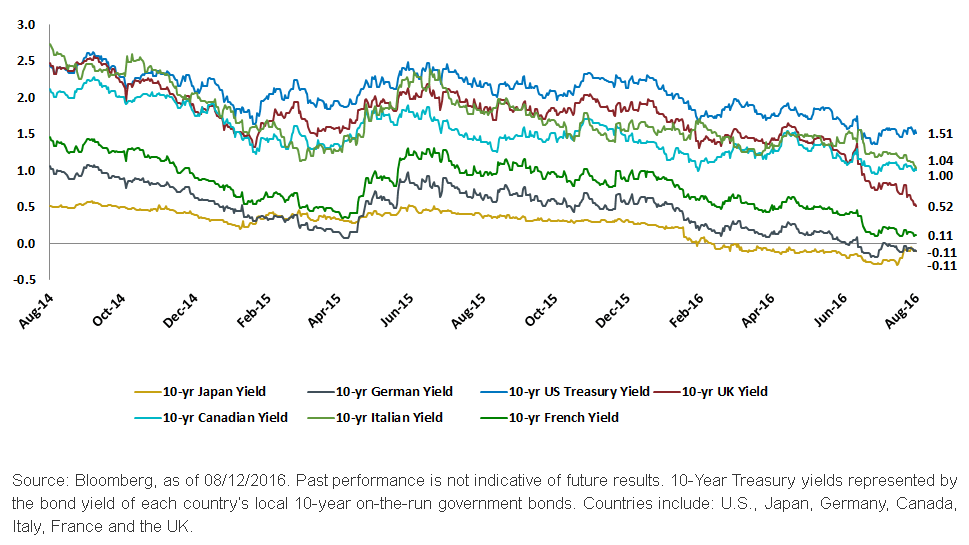
The low-rate phenomenon does not necessarily have a “center of the universe” aspect to it, either, as yield levels on a global scale are all part of this spectacle. As the graph below clearly illustrates, low sovereign debt yields can be found throughout the G7 group of nations, ranging from Japan and Europe (Germany, France, UK, Italy) to North America (U.S., Canada).

Indeed, as of this writing, the bellwether 10-year maturity ranges from a low of -0.11% in Japan and Germany to a high of only 1.51% here at home. In between, France is barely above the zero threshold, while Canada and Italy post readings around the 1% level. The UK had been the second-highest-yielding sovereign rate, but the recent Brexit fallout has 10-year gilts back into the middle of the pack, making the UK a full-fledged member of the “negative and sub 1%” club.

10-year Treasury Yields

10-yr-Treasury

The reasons behind the current — and more than likely upcoming — environment have been well documented: slow global growth, low inflation, flight-to-quality/event risks and the monetary policy responses associated with these developments.

Continue Reading…

Early retirement? Half of us in trouble if we miss a single paycheque

Patrick_Mar05web
CPA CEO Patrick Culhane

As my Financial Post blog today summarizes, far from being confident about a comfortable or even early retirement, almost half of working Canadians (48%) say it would be hard to make ends meet if their paycheque were delayed even a single week. Click on the highlighted headline for full story: Nearly half of Canadians are living paycheque to paycheque — and that has big consequences for retirement security.

Almost one in four (24%) don’t think they could come up with $2,000 if an emergency arose in the next month, according to the Canadian Payroll Association (CPA)’s eighth annual Research Survey of Employed Canadians, which is being made public on Wednesday.

The survey of 5,600 employees across Canada (conducted by Framework Partners between June 27 and Aug 5) found 40% spend all or more than their net pay, while 47% are able to save only 5% or less of earnings. Little wonder that 75% have saved a quarter or less of their retirement goal. Even among those aged 50 or more, a “disturbing” 47% are still less than a quarter of the way to their retirement savings goal.

Half think they’ll need $1 million to retire, and will need till 62 to do so

Continue Reading…

When to buy an ETF for maximum return


To determine when to buy an ETF, some investors use technical analysis and other tools. But you need to dig deeper.

ETF-25Y-medallion-ROUND-ENInvestors often wonder: what is a good entry point when purchasing a stock or an ETF?

The first question before asking when to buy an ETF is whether an exchange traded fund investment is right for your portfolio. An ETF investment is one of the most popular and most benign investing innovations of our time. ETF investments are a little like conventional mutual funds, but with two key differences.

First, ETF investments trade on a stock exchange throughout the day, much like ordinary stocks. So you can buy them through a broker whenever the stock market is open, and generally you pay the same commission rate that you pay to buy stocks. In contrast, you can only buy most conventional mutual funds at the end of the day. What’s more, commissions vary widely, depending on negotiations with your broker or fund dealer.

Second, the MER (Management Expense Ratio) is generally much lower on ETFs than on conventional mutual funds. That’s because most ETFs take a much simpler approach to investing. Instead of actively managing clients’ investments, ETF providers invest so as to mirror the holdings and performance of a particular stock-market index.

ETFs practice this “passive” fund management, in contrast to the “active” management that conventional mutual funds provide at much higher costs. Traditional ETFs stick with this passive management—they follow the lead of the sponsor of the index (for example, Standard & Poors). Sponsors of stock indexes do from time to time change the stocks that make up the index, but generally only when the market weighting of stocks change. They don’t attempt to pick and choose which stocks they think have the best prospects.

This traditional, passive style also keeps turnover very low, and that in turn keeps trading costs for your ETF investment down.

When to buy an ETF

Continue Reading…