General

Why RRSPs are less critical for Millennials than for the Boomers

The TFSA and an expanded CPP means Millennials will depend less on RRSPs than the Boomers did

My contribution to the Financial Post’s first RRSP special report of the season can be found by clicking on this headline: For Boomers, the RRSP decision was easy but for Millennials, things are a little more complicated. The piece, which also appeared on page FP 10 of Wednesday’s print edition, recaps the three big advantages of RRSPs, articulated by regular Hub contributor Adrian Mastracci.

As baby boomers, both my wife and I have maximized contributions to our RRSPs almost from the moment we entered the workforce in the late ’70s (actually, in my case, only since 1984, when I rolled over a Defined Benefit pension into my first RRSP). And with no employer pension plan, my wife has continued to maximize her RRSP, to the point some of my sources tell me it’s time to stop, if we don’t wish to be subjected to onerous taxations and OAS clawbacks once we reach our 70s.

As for Millennials, the FP piece makes the argument that the Millennials enjoy two things the Boomers did not have for most of their investing careers: the Tax-free Savings Account (TFSAs, the Canadian equivalent of America’s Roth plans), and second, the newly expanded Canada Pension Plan or CPP.

As I noted in a Motley Fool special report in the fall, by the time the expanded CPP fully kicks in around the year 2065, someone who qualifies for maximum benefits and waits till 70 to receive them could get as much as $2,356 a month just from CPP, or $4,712 a month for a qualifying couple. Add in a giant untaxed TFSA and that might be all they’d need in retirement: assuming this high-saving couple maximized TFSA contributions at $5,500 a year (plus any inflation adjustments to come) from age 18 on.

To be sure, the eternal (well, eternal since TFSAs were introduced in 2009) question of TFSA, RRSP or both will depend on earning levels and tax brackets, which the FP article goes into in some depth. And it also bears mentioning that the TFSA advantage would be almost twice as compelling if the Liberal government had not acted to cut back on the $10,000 TFSA limit we enjoyed one year back to the current inflation-adjusted level of $5,500. So as it stands, high earners have roughly four times as much annual RRSP contribution room as they do for TFSAs, which is a pity.

The Hub looked at this last Friday, when another regular Hub contributor — certified financial planner Ed Rempel — performed a rigorous analysis. See TFSA or RRSP? The right answer for you. See also this nine-year-old tax expert’s analysis of the same topic that ran on the Hub in December: Baby Sitting and RRSPs: a 9-year-old’s rules for when to TFSA.

My personal inclination is to maximize BOTH the RRSP and TFSAs, which certainly should be possible if you’ve eliminated all forms of consumer debt. Most dual-income couples should be able to do both, in my view, although of course if one of them is taking temporary stints outside the workforce (perhaps for child-raising), income-splitting practices like using spousal RRSPs may make sense.

Motley Fool blog on possible ban of trailer commissions

For those who missed it week before last, you can find my latest Motley Fool blog on the Canadian Securities Administrators report on the possible ban of trailer commissions on various investment funds can be found here, under the headline Banning Trailer Commissions Could Give Canadian Investors a Wealth of Lower-Cost Products.


RRSPs — Getting past the contribution inertia

By Aman Raina,  SageInvestors.ca

Special to the Financial Independence Hub

In the early part of the New Year we see, hear, and read a lot of messages regarding Registered Retirement Savings Plans (RRSPs). From every indication, they are important to have as a saving tool as we get older.

RRSP and Containers

Before getting to why it is important, a quick overview of the RRSP concept. The best way I can explain the concept of a Registered Retirement Savings Plan or RRSP, is that it is essentially a container. It can be a jar, a glass, a bathtub, anything that can hold something.

In terms of RRSP containers, I’ll keep this simple. You have several types to choose from:

Asset Specific RRSPs –can only hold a specific type of asset like a GIC or a mutual fund. You can hold multiple containers of Asset Specific RRSPs

Self-Directed RRSPs –can hold a variety of securities including individual stocks, bonds, ETFs, mutual funds, cash, GICs, Treasury Bills. They are much more flexible in terms of your options of what you want to put in your container. The banks and brokerages usually charge an annual fee for the privilege of using their containers, however if you have enough assets to put into the container or throw a lot of business there way, you can get it waived.

Continue Reading…

Steps for saving Money in 2017

By Barney Whistance

Special to the Financial Independence Hub

With a new year come new resolutions and new hopes. You hope to have a better life by maintaining good health, having emotional stability and making yourself stronger financially. All these tasks are achievable, provided that you have proper guidance and will power.

To end up with a lot of savings at the end of the year is no easy feat. Anyone faced with loans, taxes, and insurance payments would want to save some money at the end of the year. There are a few steps that can be taken to maximize your savings and lead you to a better retirement plan than now.

Car Insurance

If you have purchased a new car, it is worth having insurance against theft and accidents. But if your car has been in your possession for more than a 7-year period, it is better that you let go of that insurance. As the price of your car has already declined precipitously, it is no use insuring something that costs so much less. Your insurance will only add to the unwanted expenses since you could have most parts of it repaired for a lot less.

Food

Food is the basic necessity of every human. Studies have found that people in America spend at least an average of $151 on food in a week. Eating at home is far more economical and healthier than eating out. To contain your food budget, allot yourself a fixed amount for every week and see if you can manage within the budget. If you are still left with enough money, indulge yourself in eating out. Moreover, to save on your grocery purchases, you can buy in bulk from a supermarket, which can save you money. Be sure to buy only those items that you use excessively and have a long shelf life. Plan your shopping on the days the store is known to give discounts.

Energy Bills

Continue Reading…

Snowbird season is also tax season

By Kristin Zacharchuk, Master Tax Professional, H&R Block Canada

Special to the Financial Independence Hub

Each year, more than half a million Canadians escape the cold and travel to the U.S. sun-belt to wait out the winter, while the rest of us suffer. Must be nice!

One thing they need to remember while soaking up the sun and sipping on daiquiris, is that snowbird season is also tax season and escaping our Canadian weather, unfortunately does not allow you to forget about taxes.

The reality is, snowbirds are under a lot of pressure to understand their tax obligations, as initiatives are built between Canada and the U.S. to better track movement, assets and residency. Failing to do so could result in much worse than a sunburn including stiff penalties, lost benefits or even resident obligations that bring higher tax payments. Need I go on?

So, if you are planning to migrate south this winter, please keep these tips in mind:

Entry/exit initiative

It’s important that you keep a record of your trips to the U.S. since the Entry/exit initiative border tracking system allows Canada and the U.S. to monitor who crosses the border, when they do, and the length of their stay. Track and record this information in case you are asked to report it. If you don’t, you run the risk of being required to file a return as a U.S. resident or even losing certain benefits like provincial healthcare.

Resident alien status

The IRS looks at how much time you spend in the U.S. in order to figure out if you are a resident alien. Since, resident aliens are supposed to file a U.S. tax return, it’s important you find out if you meet their U.S. residency standards.

Closer connection declaration

Continue Reading…

TFSA or RRSP? – The right answer for YOU

By Ed Rempel

Special to the Financial Independence Hub

TFSA vs. RRSP is one of the most common questions I am asked. If you want to know for sure which is better for you, then you need a financial plan.

Many articles have been written on this topic that list pros and cons with general opinions.

The truth is that:

1.) Rather than just having an opinion, there is a precise right answer specifically for you. To the extent that you know your present and future marginal tax brackets, you can calculate a precise optimal contribution for RRSP and TFSA for each year, as well as the optimal amounts to withdraw each year after you retire.

2.) The decisive factor is your tax brackets now vs. after you retire. Most people just assume they will be in a lower tax bracket after they retire, because their income will be lower. In many cases, that is not true.

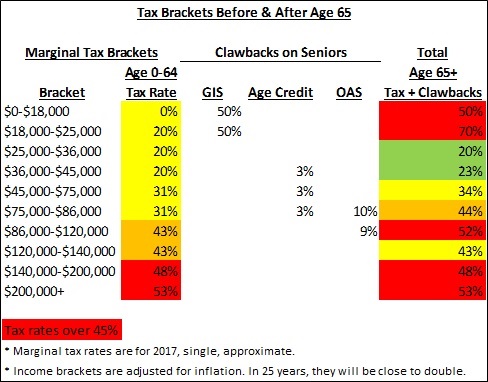
When you include the clawbacks of government income programs that affect everyone over 65, many seniors are in shockingly high tax brackets!

The clawbacks cost you actual money and are the same as a tax. The three main clawbacks are the 50% clawback on GIS for low incomes (under $20,000), 15% clawback on the age credit for middle incomes ($35,000-85,000), and the 15% clawback on OAS for higher incomes ($75,000-120,000).

The chart above shows the actual approximate tax brackets before and after age 65. Check out the tax brackets over 45% in red:

Understand the differences

You can own the same investments in your TFSA as your RRSP. The main difference is that RRSP contributions and withdrawals have tax consequences, while TFSA contributions and withdrawals don’t.

Therefore, the answer to TFSA vs. RRSP is primarily based on your marginal tax bracket today compared to when you withdraw after you retire: Continue Reading…