2.) Longer life expectancy (See also the Hub’s Longevity & Aging section for more on this trend.) Go the full link at USA Today to click on its Life Expectancy Calculator.
3.) Social Security (or for Canadians, CPP/OAS/GIS. More on that in Monday’s Financial Post)
4.) Choices in the financial marketplace: stocks, bonds, insurance, annuities, mutual funds and ETFs, real estate, commodities, hedge funds
A big aspect of planning for retirement is health and longevity. Back in the summer, I devoted a blog at the Hub’s sister site to Mark Venning of ChangeRangers.com. Venning helps clients prepare for two things: making the shift from employment to entrepreneurship, and also to help prepare for a future of extended longevity and life expectancy. That’s “why the word ‘Retirement’ doesn’t work for me. It’s about longevity planning,” he told me, “My core message is plan for your longevity, not for retirement.”
That’s one reason the Financial Independence Hub includes sections both on Entrepreneurship and Aging & Longevity. But we’re not just a site for the Boomers: we take an “Ages & Stages” approach to financial independence, starting with material for Millennials and their focus on debt reduction, family formation and home ownership. Then by the time we reach those in mid-life (call them Gen X if you will), the focus is on Wealth Accumulation.
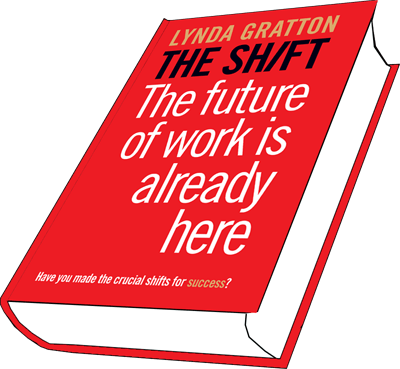
One of several book recommendations from Venning to his students — many of them terminated from full-time employment — is a book by Lynda Gratton called The Shift: The future of work is already here. It’s not brand new: my copy was published by Harper Collins in 2011. But it’s still relevant, especially to the generation of baby boomers, myself and Venning included, who are grappling with the issues of retirement planning.
Gratton, who is a business school professor, identifies five forces that are shaping the world of work, plus three “shifts.” They’re all worth summarizing here.
The 5 forces shaping our future
1.) Technology
2.) Globalization
3.) Demography and Longevity
4.) Society
5.) Energy Resources
The 3 shifts
1.) From shallow generalist to serial master
2.) From isolated competitor to innovative connector
3.) From voracious consumer to impassioned producer
For baby boomers and others who are nearing retirement, or moving into semi-retirement or self-employment, almost all of these forces and shifts need to be taken into consideration. In earlier blogs like this one — Never Work Again — we looked at the revolution in Internet marketing, which is based on both the Technology force and Globalization. When you can run a web-based business from anywhere in the world merely with a laptop computer and a smartphone, you know you’re embracing these forces.
Gratton’s points on demography and longevity seem particularly apt: this was the topic that most fascinated the team of researchers she tapped into for the book. “We quickly understood that technology is changing everything and will continue to do so, and that natural resources are depleted and carbon footprints must be reduced,” she writes. But demography and longevity “is intimately about us, our friends and our children … It’s about how many people are working, and for how long.”
The dark side: some boomers will grow old poor
In 2010, when Gratton was writing the book, there were four distinct generations in the workforce: the Boomers’ parents, the Boomers, Gen X (born between 1969 and 1979) and Gen Y (1980 to 1995). And coming up is Gen Z, born after 1995. Gen Y will be ascendent in the workplace by 2025 but increasing longevity means the Boomers and Gen X will still be hanging around, wanting to work and contribute in some capacity well into their 60s, if not beyond. Gratton also warns that “some baby boomers will grow old poor,” particularly if they don’t respond to the gift of extended longevity by embracing the forces and shifts that are confronting them.
Because of globalization and technology, the privilege of being born in North America may no longer be sufficient advantage for those who don’t embrace The Shift. Books like The Laptop Millionaire describe how those with wealth can take advantage of outsourcing: for example, hiring English-speaking Filipinos as full-time virtual assistants for something like $250 or $300/month.
There is a dark side to these shifts: those not equipped to embrace change increasingly will have to compete for jobs or contracts with people half a world away who are technologically sophisticated and willing and able to work for much less than North Americans.
Gratton devotes big chunks of the book to fictional scenarios of the near future of work, some of them pessimistic, some of them optimistic. All in all, it’s well worth reading. It reinforced my own belief that “If you’re not sure whether you should retire or can afford to do so, then just keep working, preferably in a congenial line of work you can continue to practice well into your 70s.”
Below we’re pleased to publish the second piece here at the Hub from Sean Cooper, a millennial who really “gets it” when it comes to financial independence. His first contribution was on how he plans to become Findependent, or at least debt and mortgage free, by age 31. The key to this is what the book, Findependence Day, calls “guerrilla frugality.” If the term is new to you, see this primer on the term (as well as “frooger”), which is right below Sean’s article here in the Debt & Frugality section of the Hub.
Sean’s piece is a classic example of guerrilla frugality. Because we all have to eat!
Sean Cooper
Over to the maestro of frugality!:
By Sean Cooper
Special to the Financial Independence Hub
Do you find it challenging to keep your grocery spending on budget? You’re not alone. For most of us, groceries are the second-highest expense after putting a roof over our heads. With temptation down every aisle, it’s easy to let grocery spending spiral out of control.
I’m living proof you can spend less and still enjoy your favourite foods for under $100 a month. I’m able to use the extra money I save towards goals like paying down my mortgage. I know not everyone can live on $100 a month worth of groceries, but maybe my strategies can help reduce your grocery spending a little bit. I’ve found the secret comes down to making wise spending choices.
How I Spend Only $100 a Month on Groceries
Spending $100 a month on groceries is about making specific choices. Instead of going shopping every day, I make a shopping list and go only once a week. Not only does this save time, it helps me avoid impulse purchases. I’ll bring the flyers of other grocers so I can price-match. In a typical shopping week I usually buy only the basics: fruits, vegetables, bread and milk. For under $15 I can get everything I need for the coming week. I’ll only splurge and spend more if I’m running low on something and it’s on sale. For example, if spaghetti sauce is on sale for half price I’ll buy 20 jars — enough to last me until the next sale. As for protein, I stock up on peanut butter and almonds when they’re on sale and never pay full price. I also like to cook for every meal, including breakfast. Instead of buying expensive breakfast cereal, I cook oatmeal. It’s a lot less expensive and more nutritious.
I want to tell you the tale of what I did. I’m not expecting you to become vegetarian, but consider taking a look at some of the changes you can make in your own life.
Evaluate Your Budget
How would you like to buy your everyday grocery items for a lot less? Have you ever considered shopping at discount supermarkets? That’s what I do. The savings can really add up. Shaving $20 off your grocery bill each week will add up to yearly savings of over $1,000. I find discounts grocers often have produce and meat that is just as good in terms of quality as the so-called premium stores. I’m not telling you to stop shopping at your local grocer, but by re-evaluating your budget you can find new ways to save.
Make a Shopping List
To avoid overspending, consider making a shopping list and browsing the flyers for deals on products you’re already planning to buy. I save even more money by price-matching, Many discount grocers match the price of rival stores simply by showing a competitor’s weekly flyer. I show a flyer of the rival grocery store to the cashier and I’m given the lower price. You don’t have to price-match, but just by making a list you’re less likely to overspend.
Consider Cutting Back on Meat
No, that’s not your steak being grilled, it’s your wallet. Sizzling meat prices can really take a bite out of your grocery budget. I’m a vegetarian; instead of eating meat, I get my daily dose of protein from foods like nuts and dairy products. I’m not saying you have to give up strip loin steaks and pork chops, but you might choose to eat meat less often, or buy cuts that are on sale.
Try to Limit Fast Food
I know it can be tempting to pick up fast food on the way home after a long day at the office. We’re all guilty of doing this once in a while. But if you can limit dining out to only once a week, the savings can really add up. By cooking at home instead, you’ll save money and eat healthier, too. Have you ever considered cooking your meals in batches? That’s what I do. I’m not saving you have to give up takeout food, but by eating at home more often you can save a lot.
Consider Buying Items on Sale
If you’re willing to stock up on grocery items you buy every week when they’re on sale, it can add up to big savings. When you see your favourite non-perishable items like canned vegetables and coffee on sale, consider stocking up. By buying enough to tide you over until the next sale you can avoid paying full price. (For some perishables, like meat, and frozen dinners or desserts, a freezer can come in handy if you stock up when the items are on sale: JC.)
Buy in Season
Buying your favourite fruits and vegetables out of season can cost you a bundle. Have you ever seen the price of cherries in January? Yikes! Consider substituting your favourite fruits and vegetables for produce that’s in season. For example, instead of buying watermelons during the winter, I purchase less costly fruits like apples and oranges. If you’re not ready to give up your favourite fruit, you can still save money buying it less frequently – perhaps only once a month instead of every week.
You don’t have to follow my example to the letter, but if you’re willing to make small changes, they can have a big impact on your monthly budget.
Sean Cooper is a Personal Finance Expert and Financial Journalist. He is a first-time homebuyer and landlord who aspires to reach findependence by age 31. Follow him on Twitter @SeanCooperWrite and read his blogs and request his writing services on his website: http://www.seancooperwriter.com/
Today’s blog title comes from Chapter 14 of The Upside of Aging, a book we mentioned several weeks ago at sister site FindependenceDay.com. This is recommended reading for anyone nearing the traditional retirement age. It consists of 16 essays from various experts, all of whom look at the topic of longevity through various lenses: urban planning, global demographics, healthcare and pharmaceutical research and so on. For example, Ken Dychtwald of Age Wave pens an interesting essay titled “A Longevity Market Emerges.”
Pictured below is Dan Houston, president of Retirement, Insurance and Financial Services for the US-based Principal Financial Group, who wrote the chapter I flagged in the title.
Retirees can expect one spouse to reach 90
Dan Houston
Houston begins by observing that because of longer expected life spans, the mind-set around retirement is evolving, and for the better. “Couples age 65 now have a 45 per cent chance that at least one will live to age 90,” Houston says, citing the Society of Actuaries, “This may be the first time in history where someone spends more years in retirement than in a traditional working career.”
The downside is of course financial: living another 20 to 40 years after leaving the workplace comes with a “substantial cost,” Houston says, “one that has to be funded. It’s an increasingly challenging prospect given inflation, the high cost of health care, and the risk of outliving savings.”
Try living on $400/month
The statistics, at least in the U.S., are not encoring. Fewer than four in ten pre-retiree households (aged 55 to 70, not yet retired) have financial assets of US$100,000. And even if they did have that amount on the nose, it would generate guaranteed lifetime income of just $400 a month.
Many think they’ll need less income in later life than recommended and many plan to draw down on assets at such high rates (9% a year on average) that assets will be depleted within 13 years. The recommended “safe” annual withdrawal rate is closer to 4%. They underestimate the cost of unreimbursed health care costs: in the U.S. Houston estimates a moderately health retired couple will need US$250,000 just to cover health care expenses and premiums throughout retirement. This is one area that Canadians may be ahead because of our universal health care system.
Don’t count on working in retirement
I’ve said before that the solution to this is to “just keep working,” but of course this may not always be an option. It’s a sad fact that agism still prevails in the workplace and costly older workers may be asked to leave before they’re ready to do so; and eventually body or mind may not permit full-time work even if one can find a willing employer. Houston says pre-retirees tend to overestimate their ability to work for income in retirement: more than two thirds expect to be able to supplement retirement income with some work but in reality, only one in five retirees actually works. That statistic, Houston observers, “reflects availability of work, as well as ability to work.”
Just as disturbing is the fact that 55% of American workers, and 39% of retirees, report having a problem with their level of debt. And those who do manage to save are not saving enough: 43% of workers report that neither they nor their spouse is currently saving for the future, while 57% report the total value of savings and investments is under US$25,000.
Four key investment risks
Even where there is ample savings to invest, Houston lists for key risks: inflation, market volatility, income and longevity. These are all linked: the longer you live, the more inflation can cut into your income. Consider this alarming stat on inflation’s power to erode savings: a dollar invested int he S&P500 in 1971 grew to $2.27 by 1982 but on an inflation-adjusted basis, that dollar depreciated to 96 cents. Houston notes that even annual inflation of 3% will cut a retiree’s purchasing power in half.
This calls for investments that have a fighting chance against inflation: Houston mentions Treasury Inflation-Protected Securities (TIPS, known in Canada as Real Return Bonds or RRBs); commodities, global REITs, natural resource stocks and Master Limited Partnerships.
As if that’s not all enough to keep a retiree awake at night, Houston reminds readers that the “insolvency” date for America’s Social Security system keeps moving closer: 2033, according to Washington’s May 2013 estimate. Meanwhile the over-65 population will double between 2010 and 2050.
As has been noted elsewhere, every day 10,000 baby boomers turn 65. While Canada’s combo of CPP and OAS seems on relatively solid ground, I continue to believe the best way to prepare for a long-lived retirement is to spread your income sources around: employer pensions, savings in RRSPs, TFSAs and non-registered plans, the government plans mentioned above, some part-time work or business income and perhaps rental income from investment real estate.
The big lie about being an index investor, however, is that it is possible to be one in a pure sense, as opposed to an investor who uses indexing as a tool. There are no pure indexers: everyone, like it or not, is an asset allocator, or asset picker if you prefer.
As I noted here last week in Core & Expore Redux, I certainly agree there are very few “pure” indexing investors, whether they use index mutual funds or ETFs (exchange-traded funds). Even if average retail investors “get” the idea of low-cost passive asset-class investing, most of them still tend to mix it up with both indexing and individual securities. This is a strategy called “Core and Explore.” Preet Banerjee wrote an excellent story on this last year in MoneySense magazine.
There are pure indexing purists and pundits
Spot the indexer: Dan Solin or Jim Cramer (Huffington Post)
However, as I also said at the Motley Fool — Is it Possible to Successfully Blend Stock-Picking and Indexing? — I think there are many indexing “purists” among some financial advisers who “get it.” These tend to be authors and/or pundits who are committed to indexing as a consistent philosophy. Here I’m thinking of authors like Dan Solin or Andrew Hallam, who articulate their philosophies in such books as Solin’s The Smartest Money Book You’ll Ever Read (and others in his “Smartest” series) or Hallam’s Millionaire Teacher. In his book and articles, including one at MoneySense, Hallam memorably describes how he weaned himself off such futile activities as market timing and stock-picking.
Even Jim Cramer says some should index
I find it amusing that even Jim Cramer in his daily Mad Money TV show — he’s the epitome of the belief in stock-picking and the antithesis of Solin — tells viewers who have neither the time nor the energy to pick stocks that they should just stick with an S&P 500 index fund or ETF.
The Reuters piece also touches on a point that has long intrigued me: a global one-stop portfolio, which it describes “only as an idea.” I have long asked the question why the mutual fund industry’s much-ballyhooed “Global Balanced Funds” would not be the only fund you’d need?
Will robo-advisers succeed where global balanced funds did not?
In theory, such one-stop-shopping funds should do what the newer robo-advisers are doing: provide access to all asset classes and securities around the world, with the fund managers (likely co-managers entrusted with equity and fixed income responsibilities) making all the asset allocation decisions and rebalancing.
But show me just one investor anywhere in the world whose only investment is a single global balanced fund. Never mind that their fees are typically going to be high for investors, I’ve seldom seen even the fund companies with big marketing budgets spend even a fraction on advertising the alleged benefits of such one-stop solutions.
Talk about a black swan, finding an individual who puts 100% of their wealth in a single global balanced fund would be a rarer event than locating a pure indexer. If you do know of one, by all means email me at jonathan@findependenceday.com and I will definitely highlight the fact here at the Financial Independence Hub.
It’s still early innings for the robo advisers but I do think we will soon find investors who hand over all their wealth to one of these firms and that these will be the first instances of (the equivalent of) a global balanced fund.

 Posted By
  From USA Today this weekend comes this article by Bob Powell that should give “those saving for or living in retirement” several trends or statistics to be thankful for.