
All posts by Jonathan Chevreau

Gamechanger? Vanguard Canada launches 3 new Asset Allocation ETFs (plus my take)

Vanguard Investments Canada Inc. has announced the listing of three new low-cost Asset Allocation ETFs that give investors one-stop shopping to the firm’s globally diversified strategies. They began trading on the TSX today (February 1, 2018.)

Both investors and advisors are asking for “simple yet sophisticated single-ticket investment solutions that provide well-diversified global equity and bond exposure within a low-cost ETF structure,” says Atul Tiwari, managing director for Vanguard Canada. The new ETFs offer investors three different risk profiles and regular rebalancing.

In effect, each ETF is a fund of funds although Vanguard describes them as having an “ETF of ETFs structure.” Each holds seven existing core Vanguard index ETFs (which I list in the postscript below). Each new ETF of ETFs has a management Fee of 0.22%. Vanguard says that when one of its ETFs invests in underlying Vanguard funds, “there shall be no duplication of management fees.” Spokesman  Matthew Gierasimczuk said “There are no duplicate fees beyond the 0.22 management fee, other than a basis point or two for operating expense and the trading fee for buying or selling the ETF.”

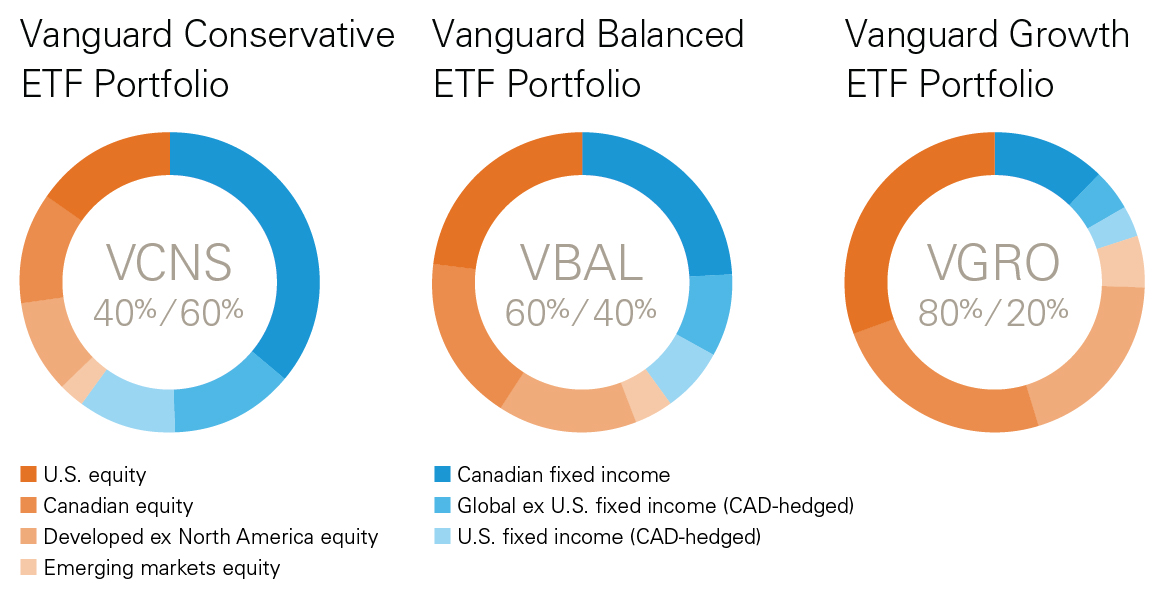
The three asset allocation ETFs cover the normal range from Conservative to Balanced to Growth, as reflected in the product names. Equity weights range from 40% for the Conservative offering, to 60% for the Balanced and 80% for the Growth.

Here are the 3 ETFs and their ticker symbols on the TSX:

Vanguard Conservative ETF Portfolio (VCNS) seeks to provide a combination of income and moderate long-term capital growth by investing in equity and fixed income securities with a strategic allocation of 40% equities and 60% fixed income.

Vanguard Balanced ETF Portfolio (VBAL) will provide long-term capital growth with a moderate level of income split 60% equities to 40% fixed income.

Vanguard Growth ETF Portfolio (VGRO) provides long-term capital growth by investing in equity and fixed income securities with 80% equities and 20% fixed income.

In a press release, Vanguard Canada head of product Tim Huver said the ETFs offer “a simplified and scalable solution for financial advisors, and a one-stop globally-diversified and transparent option for investors … Investors can rely on Vanguard’s global investment experts to continuously assess their portfolio’s exposure and rebalance it back to its intended risk level.” 

With the three new ETFs, Vanguard Canada now offers 36 ETFs, with C$14 billion in assets under management. Vanguard Investments Canada Inc. is a wholly owned indirect subsidiary of The Vanguard Group, Inc.

You can find more at Vanguard Canada’s website.

Postscript: My Take

After sleeping on this announcement, it strikes me as more significant than I had initially perceived. Continue Reading…

Franklin Templeton extends Canadian ETF family with Emerging Markets, Global Dividends

As my latest Financial Post blog this morning explains, mutual fund giant Franklin Templeton Investments Canada has expanded its ETF lineup with a pair of new “Smart Beta” ETFs and an actively managed balanced ETF. Click on the highlighted text for full story: Franklin Templeton boosts Canadian ETF offerings with Emerging Markets play.

As I note in the piece, Franklin Templeton has long had an Emerging Markets mutual fund, famously managed until last year by globetrotting fund manager Mark Mobius, who retires on January 31st after a 30-year career with the company. Franklin Templeton once had a closed end version of the fund but it was closed down in September of 2001, a company spokesman said.

The new Franklin LibertyQT Emerging Markets Index ETF (CAD) bears the memorable ticker symbol FLEM on the TSX, allowing Franklin Templeton to play catch-up to long-established Emerging Markets ETFs from rivals BlackRock Canada (iShares) and Vanguard Canada. You can find more about the new ETF family here.

FLEM is a four-factor “Smart Beta” ETF: the single biggest “factor” at 50% is a quality screen, along with 30% value, 10% momentum and 10% low volatility. Its largest single geographic weighting is South Korea at 15.4%, followed by 13.9% in China, 13% in India, 12.8% in Taiwan and 10.8% in Russia, according to Franklin Templeton vice president of ETF business development Amed Farooq.

The expected Management Expense Ratio (MER) for FLEM is 0.55%. The two other ETFs are The Franklin LibertyQT Global Dividend index ETF (FLGD/TSX, MER 0.45%) and an actively managed balanced ETF, Franklin Liberty Core Balanced ETF (FLBA/TSX), with an MER of 0.45%.

Time to “rebalance” from US equities to Emerging Markets?

Both the two new smart-beta ETFs provide a rebalancing opportunity for investors who feel US stocks have run up sufficiently to start taking profits. Earlier this month, famed investor Jeremy Grantham warned of one last market “meltup” for US stocks before another correction, and said his firm was rebalancing into Emerging Markets. You can find the full January 3rd article here: Bracing yourself for a possible near-term melt-up.

You can also find his comments made in a recent interview with Consuelo Mack’s WealthTrack show here.

I asked about this at the ceremonial opening of the TSX Monday morning, which focused on the ETF launches. Financial advisor John De Goey said he was doing just such a rebalancing for his clients and in an interview, Franklin Templeton senior vice president Dennis Tew said he knew of at least one advisor with a large book of business who likewise has been rebalancing from US income funds to Emerging Markets equities.

Balanced ETF managed by Franklin Bissett

Continue Reading…

Retired Money: Finally, a “Tontine” proposal for true Longevity Insurance

Even if they’ve saved a million dollars, retiring baby boomers lacking Defined Benefit plans and their inherent longevity insurance justly fear outliving their money. It’s been said some fear this more than death itself.

The latest instalment of my MoneySense Retired Money column looks at an intriguing proposal made this week by the CD Howe Institute. Click on this highlighted text for the full link: An annuity that pays off — if you live long enough.

CD Howe has proposed the creation of a “pooled risk insurance” scheme called LIFE, which has all the hallmarks of a 17th century concept known as the tontine.

Moshe Milevsky has long suggested tontines as one remedy for outliving our money

Annuity expert Moshe Milevsky — also a finance professor at the Schulich School of Business and author of books like Pensionize Your Nest Egg — says LIFE is a “great idea.” He actually made the case for the resurrection of “tontine thinking” three years ago in a book I reviewed at the time also at MoneySense: Tontine: Retirement Plan of the Future? 

The CD Howe paper (Headed for the Poor House) authored by Bonnie-Jeanne MacDonald doesn’t actually come out and call LIFE a tontine scheme but it certainly appears to contain the DNA of one.

LIFE stands for Living Income for the Elderly. The idea is that by sharing mortality risk, those who make it to age 85 start to receive monthly payouts for as long as they live, funded in part by the less fortunate members who die between 65 and 84. Apart from normal investment returns, the lucky survivors would enjoy the “added return” of the mortality premium.

Continue Reading…

Here are a million reasons to ignore 5 popular RRSP myths

A lot of Canadians seem to be harbouring misconceptions about the value of RRSPs (Registered Retirement Savings Plans) but I can give you a million reasons why it’s dangerous to believe the  five popular RRSP myths.  My latest two blogs in the Financial Post this week explain why.

In Thursday’s Post, also published in some regional dailies, I described how young people can easily save a million dollars as long as they start early enough. Click on the highlighted text for the online link: How to build a million-dollar RRSP: it isn’t as hard to get there as you think.

Yes, it’s the old story of disciplined saving year in and year out, and the magic of compounding, all aided by the lure of an upfront tax refund and a multi-decade deferment of taxes. Of course, eventually it will be time to draw an income and pay some tax on the RRIF but that’s a story for another day.

Whether a million is enough is open to debate but with today’s paltry interest rates and rising expectations for long lives, the need for annuities or some form of longevity insurance has become urgent. More on that shortly.

Exploding 5 RRSP myths

This morning, Friday,  the FP also ran a blog by me commenting on tax guru Jamie Golombek’s debunking of five common myths average investors harbour about RRSPs. You can find Golombek’s column here: The 5 biggest RRSP myths Canadians can’t stop repeating.

My take on it and a CIBC poll that accompanied the report, can be found here: Almost 40% of Canadians see ‘no point’ in investing in RRSPs — Here’s why they’re wrong.

In short, Golombek and I agree that the RRSP makes a lot more sense than investing only in taxable (non-registered or “open”) accounts. And while the TFSA is a compelling alternative to RRSPs for young people in low tax brackets, or for low-income seniors counting on living on Old Age Security, for the vast majority of middle- and upper-middle-income private sector workers lacking a Defined Benefit plan, the RRSP remains an essential tool for building wealth.

And as I also point out, if you’re in a high tax bracket, you don’t have to choose between an RRSP and a TFSA: you should maximize both!

Blue Monday: Here’s what gives us the financial blues on this saddest day of the year

Feeling the financial blues a bit today? Little wonder because today, Monday, Jan. 15th, is Blue Monday, dubbed the saddest (most depressing?) day of the year.
 Call me a masochist but I also decided this was the day to download the 2017 online version of TurboTax and at least confront the looming reality of preparing another year’s tax returns. The program said it can be used to print and file your 2017 tax return by mid-January, and that NetFile will be available as of 6 am on February  26th. How depressing is that a mere two weeks after the holidays?

But if the thought of filing your taxes doesn’t make you blue, or even the snow that’s falling as I write this, maybe the thought of credit-card bills from the holidays will do the trick. Credit Canada and the Financial Planning Standards Council today released the results of  a Blue Monday themed Financial Blues survey that revealed that 53% of Canadians are “already feeling financially blue, with the younger generations struggling.”

The Financial Blues Survey was based on a Leger poll that asked Canadians “when it comes to your finances, what makes you blue this time of year?”

Well, bowl me over with a feather: the start of another tax season didn’t make the cut in the poll, or at least the top five “standout” findings. Here’s the top candidates for feeling blue in January:

  • 20% of us have a credit-card balance larger than our savings accounts
  • Younger adults aged 18 to 44 are especially blue about finances right now: 68% of them versus just 41% for adults aged 45 or older
  • 25% of us lack the funds to take a winter vacation in the sun
  • 6% have already broken their financial new year’s resolutions
  • 21% over-spent during the Holidays

Credit Canada CEO Laurie Campbell  says that while “we are seeing a good deal of Canadians stressed out about their financial situation … the takeaway message is that there is hope. Develop a plan, tackle debt, and realize your financial potential. There are professional resources available to you, so don’t feel you need to go it alone.” Continue Reading…
