All posts by Jonathan Chevreau

Half of us fear rising interest rates will be negative for our finances

Now that interest rates have finally appeared to bottom, consumers are starting to worry about the prospect of rising rates and their impact on their personal finances.

This is explored in my latest article, which is in Monday’s Financial Post (e-paper and online). You can access it by clicking on this self-explanatory highlighted headline: Only a quarter of Canadians have a  rainy day fund, but more than half worry about rising rates.

It describes a new Forum Research Inc. poll that shows more than half of Canadians (51%) fear rising rates will negatively impact their personal finances. The national poll of 1,350 voting-age adults was conducted after the Bank of Canada raised the prime interest rate from 0.75 to 1% on September 6th, which in turn followed an initial 0.25% hike in July.

After an amazing run of nine years of ultra-low interest rates, it’s clear consumers are starting to fret the party is over. Anyone with variable-rate mortgages might well be petrified that interest rates could again reach the high teens, as they did in the early 1980s. Little wonder that many homeowners are starting to “lock in” to fixed mortgages while rates are still relatively low.

Of course, as Credit Canada’s Laurie Campbell notes, for the longest time it’s paid to stay variable and flexible, whether with a variable-rate mortgage or a line of credit. It does cost a bit more to “lock in” to fixed mortgages, as Campbell notes, but the ability to sleep well at night in my opinion more than makes up for the difference.

While the poll asked specifically how consumers felt about the second hike, “they are worried more are coming,” Forum Research president Lorne Bozinoff told me. 12% say the negative effect will be extreme. However, 17% believe rate hikes will have some positive aspects:  you’d expect debt-free seniors to welcome higher returns on GICs and fixed-income investments. Another 38% don’t think it will have an effect either way.

Lorne Bozinoff

A quarter have no emergency savings at all

Bozinoff is more concerned that 26% of respondents have no emergency savings, and 40% have a cushion of a month or less: 9% have less than a month and 11% just a one-month cushion.

Financial planners generally recommend three to six months as a hedge against job loss or other setbacks. A minority do: 14% have two to three months, 9% four to five months, and 13% six months to a year. Only 15% have a year or more and predictably, 56% of the latter group are 55 or older. Continue Reading…


Blockchain Revolution, Global Prosperity and Prosperium

What does the Blockchain Revolution have to do with global prosperity and what’s this new cybercurrency called Prosperium?

Let’s start with the bestselling book Blockchain Revolution, by technology guru Don Tapscott and his son Alex, a former investment banker. I recently re-read the book in preparation for a series of blogs I am doing for a cybercurrency start-up called Prosperium (http://www.prosperium.io/). Prosperium promotes and more importantly intends to generate actual community prosperity. This blog you’re now reading is the debut of that series.

My connection with the firm is through a serial entrepreneur and Canadian internet commerce pioneer named Tony Humble, who was the co-founder of Basis 100 (BAS: TSX). I have previously done business with Tony via The Wealthy Boomer magazine and website (which ran from 1999 to 2005) and later my financial novel Findependence Day, which spawned the Financial Independence Hub (where you’re reading this blog.)

We’ll look at Prosperium and its business model specifically in the follow-up blog to this, including interviews with Prosperium’s founder, Doug Coyle (shown in photo near the end of this blog). But let’s focus first on Blockchain Revolution, since the book is as its title implies a revolutionary blueprint for all things fin-tech, including cybercurrencies like the original Bitcoin and everything spawned in its wake, including Canadian-inspired firms like Ethereum and now Prosperium.

I attended the original launch of the Tapscotts’ book at the Rotman School on May 5, 2016 and you can find my review at the Financial Post and a subsequent one on the Hub. The FP review ran the day after the launch, and the headline is as good a place to kick off this second look at the book: Bitcoin and Blockchain could be the start of a bigger revolution than the Internet itself.

Don Tapscott (L) and Alex Tapscott (R). Youtube.com

Rather than repeat my points in this limited space I refer readers first to that review and then to my first Hub review of the book, which ran on June 1st, 2016. At the end you can find a link to a half-hour YouTube video produced by ThatChannel.com in which Norman Evans (the Hub’s creative director) and I interviewed both Tapscotts and some others who attended the Rotman launch.

Blockchain promises a quantum leap in global prosperity

Continue Reading…

Retired Money: Cashing RRSP to pay off debt is a poor strategy

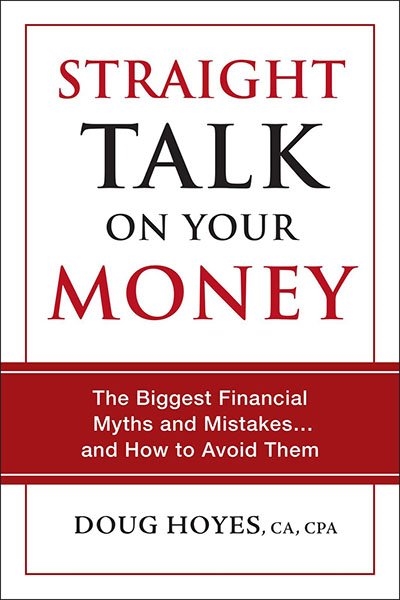
Should you cash in your RRSP to pay off debt? While some prospective retirees may be tempted to do so, this is one of a score of damaging financial myths, according to insolvency trustee and author Doug Hoyes.

I mention this in my latest MoneySense Retired Money column, which has just been published. You can retrieve it by clicking on the highlighted headline here: The wrong way to pay off Debt.

As I say in the article, Cashing in your RRSP to pay off debt is Myth #9 of 22 common financial misconceptions outlined in Hoyes’ new book, Straight Talk on Your Money (cover shown adjacent: we share a common publisher.)

Hoyes is particularly concerned about senior debt in Canada and how these myths can affect their retirement. Myth #10 often afflicts retired seniors: that Payday Loans are a Short-term Fix for a Temporary Problem.

Seniors racking up debt faster than other age groups

Earlier this week in the Financial Post, columnist Garry Marr reported that Seniors in Canada are racking up debt faster than the rest of the population. Over the past year, senior debt grew by 4.3%, according to a survey published Tuesday by Atlanta-based Equifax Inc. Continue Reading…

Paycheque to paycheque: the fate of half of Canada’s employees

Living paycheque to paycheque? You’re hardly alone. As my latest Financial Post blog reprises today, almost half of Canadian workers (47%) told the Canadian Payroll Association’s 2017 survey that they’d find it hard to meet their financial obligations if their pay cheque were delayed by even a single week.

You can find the full blog by clicking on the highlighted headline here: Nearly half of Canadians would face a financial crunch if paycheque delayed by even a week, survey shows. The  article also appears in the Thursday print edition, page FP5, under the headline Nearly half of Canadians walk financial tightrope.

As I point out at the end of the FP piece, there’s some irony in that the way out of this savings conundrum is to make an effort to save paycheque by paycheque: a strategy the CPA and other financial experts generally term “Pay Yourself First.”

That means using your financial institution’s pre-authorized chequing arrangements (PACs) to automatically divert 10% of net pay into savings the moment a paycheque hits your bank account. Just like income taxes taken off “at source,” the idea is that you won’t miss what you don’t actually receive.

Pay Yourself First

Continue Reading…

If an enhanced CPP takes you off GIS rolls, count your blessings!

Let’s HOPE this advisor’s financial plan means this senior couple won’t qualify for the GIS!

Here’s my latest MoneySense column, which looks at the headline-grabbing “news” that an  Enhanced Canada Pension Plan (CPP) would mean roughly 243,000 low-income seniors might not be eligible for the Guaranteed Income Supplement (GIS) once the full-bore enhanced CPP system is in place in the year 2060.

Click on the highlighted headline for the full piece: Retirees should be happy not to qualify for GIS.

None of the five financial experts whose input appears in the piece disagreed with this article’s premise: that far from being a bad thing to make so much from CPP (or any other source of retirement income) that you exceed GIS minimum income thresholds, it’s actually a good thing. Yes, you have to work at a job to earn CPP benefits, whether “enhanced” or not, and yes, this entails payroll contributions taken off the top. That’s no different than anyone with a good employer pension or who saves in RRSPs or any other vehicles.

That’s what saving is all about: providing for future needs by taking a little out of current income. It’s all about living within your means, being responsible for your own future and all the other themes that the Financial Independence Hub espouses every day.

The Hub and MoneySense recently looked in-depth at OAS and the GIS, which you can find here.  And earlier today we looked at Survivor benefits for CPP, OAS, GIS and other sources of retirement income.

One of the sources for the GIS article was TriDelta Financial’s wealth advisor, Matthew Ardrey. Time and space limitations meant we could include only a snippet of Matthew’s analysis in the MoneySense column itself but he has given us permission to run his whole opinion below:

TriDelta Financial’s Matthew Ardrey

The government plans to enhance CPP through two measures. One, increasing the contribution amount from 25% to 33% and two by increasing the income limit on which contributions are made to $82,700. Combined these two measures will take the maximum pension of $13,370 today to about $20,000 in the future.

There will be some measures to offset these contributions for the employee including an enhanced Working Income Tax Benefit (WTIB) to help offset the cost for lower income workers and making the enhanced contributions a tax deduction instead of a tax credit. Though that helps out today it does nothing for the low-income earner in retirement.
Continue Reading…