All posts by Financial Independence Hub

Avoiding the “big mistake” — How Evidence-based investing saves long-term wealth

By Steve Lowrie, CFA
Special to the Financial Independence Hub
Buy low, sell high.

Sure, it’s a tired cliché, but it’s actually good advice.  Everyone knows it.  Most of us may even manage to do it by simply leaving well enough alone instead of constantly questioning our investments.  This is especially so if you’ve preceded your inactivity by setting up a solid plan and investing accordingly.

But here’s the challenge: Even the most stay-put investor is still at risk for making that rare “big mistake.”  It happens when seemingly game-changing news tricks you into falling for a different financial platitude: This time is different.

Even if you only deviate from your routine in the face of an extreme event, the financial damage done can last a lifetime.  One of the biggest, most recent anomalies was the Financial Crisis of 2008/2009.  At the time, many investors (and many advisors as well) wondered whether the markets would ever recover.

Although we are almost 10 years removed from this time, it was a highly emotional period for investors.  In fact, one of my favourite financial commentators — Nick Murray — refers to this period as The Great Panic. To put this into context, let me share a few real-life investor anecdotes.

Take “Joe,” for example, who reached out to me to inquire about my services in October 2008.  At the time, Joe had a $2.6 million portfolio.  He had a very stable and successful business and wasn’t planning to tap into his investments for a couple of decades.  His portfolio wasn’t perfect.  Some of his holdings had high expense ratios, and some of them could have been better managed.  But overall, they seemed relatively well diversified and well structured.  He was doing okay.

Still, Joe was thinking about abandoning his balanced approach and moving to cash.  I offered Joe this timeless advice:  When we’re in the thick of a bear market, nobody knows when or how it might reverse course.  But we do know it is highly likely it eventually will: often quickly and without warning.  If you try to time when to be in and out of the market for optimal effect, you must not only correctly guess when to get out, you’ve also got to predict exactly when to get back in.

Cashing out in 2008

So, November 2008 came and, along with it, a second major market drop. This was too much for Joe.  In late November, he called me and told me something like this:  “Thanks for your time.  However, this time really is different, and your history and evidence doesn’t matter.  I have sold my entire portfolio and moved all my investments into cash.”

I don’t know what happened to Joe after that, because we went our separate ways.  In the short run, he was right.  We didn’t know it then, but the third (and final) major drop in the equity markets arrived in January/February 2009.  Using historical index data and assuming a balanced portfolio of 60% Global Equities and 40% Global Bonds, liquidating his portfolio ahead of this final drop “saved” him from a loss in the range of $200,000.

Once again, using index data, had he simply held his portfolio he would have made back the “$200,000 loss” by May/June 2009 and then been almost 20% higher by November 2009.  In dollar terms, that is over $500,000 higher than he was in November 2008.

I doubt Joe had the nerve to reinvest anytime in 2009 …  it’s far more likely he waited until the recovery was in full swing, buying higher than necessary and sacrificing returns that could have been his by simply holding tight.  Or, for all I know, he’s still sitting in cash today.  If so, he has so far given up about $3 million in potential wealth … even after assuming reasonable fees for investment management, financial planning, and (most importantly in Joe’s case) behaviourial coaching. Continue Reading…

The 4 Percent Rule: Is there a new normal for Canadian retirees?

By Dale Roberts

Special to the Financial Independence Hub

Those two questions are certainly related, or let’s say one can determine the other. If you can earn a 7 percent annual return from your investments that will generate much more income compared to investments that only earn a 1 percent return. A $500,000 portfolio generating that 7 percent return could pay out $35,000 per year and maintain the original portfolio balance. You get ‘paid’ that $35,000 and you still have your initial $500,000.

A 1 percent return on your portfolio will only deliver $5,000 per year. Of course you could simply take out the $35,000 per year from your lower yielding portfolio, but over time the money will disappear.

So how much can you ‘safely’ take out of your retirement investment portfolio?

The financial gurus would suggest that spending 7 percent of your portfolio is much too aggressive. The gold standard retirement studies suggest that you can take out 4 percent – 4.5 percent of your portfolio value, inflation adjusted (2-3 percent annual increase in spending) and you will have a high probability of success over a 30 year period. You are creating perpetual income, just as would a pension. In fact, if your investments are positioned sensibly you are mimicking a pension – you are creating your own pension.

It’s an industry standard so much so that they call it – The 4 Percent Rule. 

The 4 Percent Rule: A Safe Withdrawal Rate in Retirement

The 4 percent rule is based on the work of Bill Bengen. The rule has been challenged and studied perhaps more than any other research in the retirement landscape. Mr. Bengen also took another look and challenged his own 4 percent rule in this 2012 article for Financial Advisor Magazine, How Much is Enough? 

Here’s the final thought from Mr. Bengen in that article. While there are no guarantees in life, and in investing, the rule of thumb has held up.

In summary, the 4.5 percent rule (and its infinite variations for time horizon, tax bracket, current market valuations, etc.) may be challenged in coming years. However, it appears to be working now.

The sensible retirement portfolio (pension) will typically consist of two components, a growth component (stocks) and a risk reducing agent (bonds). Durable income is created from enough growth in the stocks in a lower risk or lower volatility arrangement. Investing can be quite simple, even in the more ‘complicated’ retirement funding stage. Once again, we’re back to that simple mix of stocks and bonds. As always, we want to keep our fees as low as possible. This is no time to be paying ‘others’.

But is that 4 percent rule dead? Many think so. The reason for that is that the bond component of the portfolio, well, it kinda stinks these days. Or at least the yield or income from the bonds is nothing to write home about.

Challenges with the 4 Per cent Rule

Go back a couple of decades and your basic lower risk investment grades bonds would pay retirees 6-7 percent. The bonds on their own were enough to create durable income in a lower risk environment. Retirees did not need to take on much or any stock market risk. These days it might be difficult to generate more than 3 percent from your bond component. The yield on Canadian Bond Universe Exchange Traded Fund (ETF) XBB from iShares is 3.18 percent.

Yields have started to creep up over the last year, but they are still historically low. And bond yields can stay low. They do not have to go up just because they are down. Bond yields can and have in the past stayed very low for decades. We should always keep in mind that we do not know where bonds will go over time, just as we do not know where stock markets will go over the near term. Continue Reading…

Retiring at home — and how to get the funds to do it

By Darlene Vilas

Special to the Financial Independence Hub

I’ve spent many years helping a lot of retirees to stay in their home. So, I wasn’t surprised when a survey by HomeEquity Bank and IPSOS revealed that 93% of Canadians aged 65+ are determined to retire at home.

For people with a healthy pension and retirement savings, staying in their home is rarely a problem. However, many Canadians have inadequate retirement savings. According to a report by CIBC, 30% of people have no retirement savings at all, while another 19% have saved less than $50,000. I help people with lower retirement income to understand the financial options available to them, so they can retire comfortably in their home.

Why staying put is so important

According to HomeEquity’s research, maintaining independence is a key reason for retirees wanting to stay in their home, followed by staying close to family, friends and their community.

Many of my older clients find just the idea of moving to be very stressful. They don’t like the thought of downsizing, which means leaving behind loved ones and places they’re familiar with.

I can understand that, so I try to help people stay in their home, whatever their financial situation. Thankfully, for homeowners, there are several options available.

The financial tools that can help you stay at home

Taking out a mortgage or a line of credit can allow you to cash in on some of your home’s equity. However, the mortgage option is becoming increasingly difficult for retirees. With the new mortgage stress test, you have to qualify at a much higher rate than before, which means you can now borrow much less. Plus, taking on mortgage payments for up to 20 years can put a strain on your retirement income. If you miss some payments, you could lose your home.

A home equity line of credit can be a good option if your income qualifies.  They are fully open and can be repaid at any time without penalty. This is a very helpful option for homeowners who would like to access cash easily if they experience unforeseen home expenses such as emergency repairs to the home. Payments are typically interest only, which keeps your monthly obligation at a minimum.   The downside of a home equity line of credit is they are callable at the discretion of the bank.  This means you could be forced to sell your home to repay the line of credit.

With a reverse mortgage, you can borrow up to 55% of your home’s value. You never have to make a mortgage payment and you’ll never be forced to move out. Many of my clients use a reverse mortgage as an efficient way of cashing in some of their home’s equity. Because there are no regular mortgage payments, it can help them to greatly improve their financial situation, boost their disposable income and live the kind of retirement they’d hoped for.

Those people concerned about maintaining their home’s equity can make monthly interest payments, but the nice thing is, they don’t have to. Continue Reading…

How to retire and fill 40 hours a week

By Tea Nicola

(Sponsor Content)

“Can you believe it, honey? Friday’s my last day at work! Time sure flies. I can’t wait to start spending all of our free time together!”

Did this thought warm your heart, or get your pulse racing in panic? That probably depends on whether you’ve given some good thought to what you’re doing after retirement.

But what do you actually want to do after you stop working? Your retirement income goals will depend much on your answer to that question, as your financial adviser is apt to tell you.

We’re living longer — and that’s a good thing, if you plan for it

‘Retirement’ wasn’t really a thing, until recently. You lived, you worked, you died … and the world kept turning as youth picked up the baton of life’s track meet. That’s partly the reason pension age was set at 65: few were expected to live long enough to claim it! When the USA passed their Social Security Act in 1935, American men were expected to live to about 58.

But with our longer life spans, you could still be shuffling around decades after you’ve stopped working. According to Statistics Canada and the 2016 Census, “there were 5.9 million seniors in Canada, which accounted for 16.9% of the total population. In comparison, there were 2.4 million seniors in 1981, or 10% of the population.”

There are more retirees than ever! So, our question is a practical one: how do you retire and still fill 40 hours a week?

What Canadian retirees are already doing with their time

How to retire and fill 40 hours a week. Time chart

Does this all seem inspiring … or overwhelming? Is the room spinning at the prospect of playing shuffleboard and doing yard work for the next two or three decades? Fortunately, we’ve picked up an important idea from doing retirement income planning with countless clients. Continue Reading…

New mandatory risk rating is misleading Canadian investors

By Nick Barisheff (Sponsor Content)

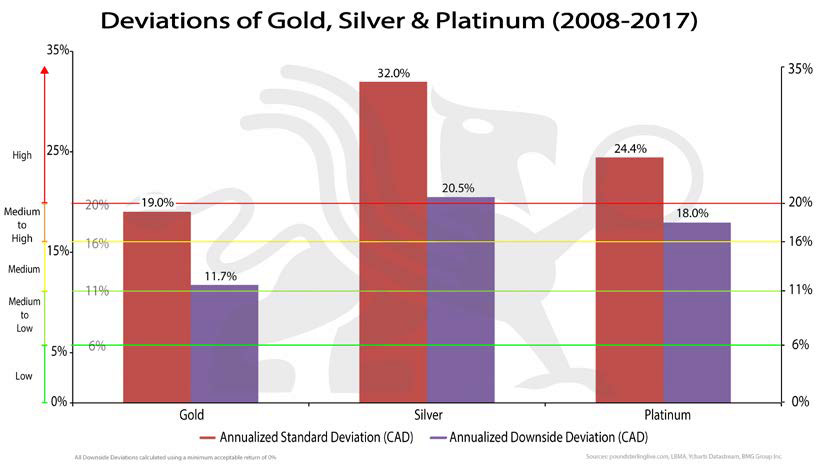
Canadian securities regulators may be putting investors at risk. They implemented a new mandatory risk weighting system in September 2017 based on 10-year Standard Deviation. Every Canadian mutual fund and exchange-traded fund (ETF) must now include a risk rating based on the following:

Before implementing this policy, the Ontario Securities Commission (OSC) asked for submissions from the industry. These can be viewed here.

Over 50 submissions were received (mine included.) and out of those, three warned about the deficiency that Standard Deviation does not differentiate between upside and downside volatility.

Scott C. Mackenzie of Morningstar made a particularly succinct comment:

“A conservative investor’s portfolio that is missing a key sector or asset class, essential for prudent diversification (and risk reduction), may demand the inclusion of a small amount of a concentrated sector mutual fund or ETF. A single measure risk score for such a vehicle may be higher than recommended for the investor and they are consequently dissuaded from incorporating it. The irony and potential downside is that the risk of the conservative portfolio may actually be higher than otherwise would have been had the investor included the diversifying investment. “Diversification as a risk-reduction activity is a sensible approach, practiced by many, and supported by decades of investment research.” http://www.osc.gov.on.ca/documents/en/Securities-Category8-

Comments/com_20140312_81-324_mackenzies.pdf

There are two major flaws with the methodology:

  1. It does not differentiate between Standard Deviation and Downside Deviation; and
  2. It measures individual portfolio components rather than the overall Standard Deviation of the entire portfolio.

This policy will not protect investors from experiencing losses, but may prevent investors from structuring portfolios for reduced volatility, optimal performance and effective diversification. The resulting reduction in investment demand in sector funds will result in a negative impact for many Canadian public companies.

The overall weakness of this approach is best exemplified by the fact that Bernie Madoff’s fund had the lowest Standard Deviation in the industry for over 30 years – yet investors lost most of their money.

David Ranson of H.C. Wainwright & Co. published a report entitled “Why Standard Deviation Won’t Serve to Classify the Risk of a Portfolio.” This report details why Standard Deviation is a poor and overly simplistic approach to measuring the risk of a portfolio.

“The riskiness of an investment product cannot be represented by the Standard Deviation (volatility) of its historical returns, or by any other single statistic … On a real risk scale, cash could be assessed as risky and gold as safe.” 

http://bmg-group.com/wp-content/uploads/2017/12/why-standard-

deviation-wont-serve-to-classify-the-risk-of-a-portfolio.pdf

As an example of how flawed this policy is, Morningstar Canada lists 9,412 equity classes of mutual funds. Of these,1,932* have 10-year performance histories. The best-performing fund is the TD Science and Technology Fund, which achieved an 18.00% 10-year annualized return net of MER. A $10,000 investment in 2007 would now be worth $66,554*.

On the other side of the performance scale is the Brompton Resource Fund. It ranks as 1,932*(last) in performance and has experienced a-21.8% annual decline over the same 10-year period. A $10,000 investment ten years ago would now be worth only $643*.

*As of July 18, 2018

The 10-year (2008-2017) Standard Deviation for the TD Science and Technology Fund is 17.7% (MEDIUM to HIGH RISK) and for the Brompton Resources Fund it is 29.57(HIGH RISK)However, the Downside Deviation is 10.6% (LOW to MEDIUM RISK) for the TD Fund and 25.7% (HIGH RISK) for Brompton Fund.

It should be obvious, even to the unsophisticated investor, that the risk of these funds that are at opposite ends of the performance spectrum is not similar.

This flawed methodology is more pronounced when it comes to physical bullion funds such as the BMG Funds. According to this methodology, the Standard Deviation for gold results in a MEDIUM to HIGH risk rating. Silver and platinum would be rated HIGH RISK.

This new risk rating methodology is in direct contradiction to the suggested risk rating for gold established by the Basel Committee on Banking Supervision (BCBS). BCBS brings together regulators from 28 countries, and establishes rules governing the appropriate level of capital for banks. The current version of these rules, known as Basel III, is a key element of the international regulatory reform agenda put in motion following the global financial crisis of 2008. During the 2008 financial crisis, gold was used in international settlements as a zero-risk asset after many decades of being sidelined in the monetary system. Gold’s old emergency usefulness resurfaced, albeit behind closed doors, at the Bank of International Settlements (BIS) in Basel,Switzerland. Continue Reading…