All posts by Financial Independence Hub

How mortgage rule changes impact affordability

By Alyssa Furtado

Special to the Financial Independence Hub

The mortgage market in Canada is heavily regulated. Both the federal government and the Canada Mortgage and Housing Corporation (CMHC) control almost every aspect of residential mortgage lending.

The government decides what criteria people must meet when getting a mortgage in Canada. Rules apply to almost every aspect of the mortgage, ranging from the maximum amortization to the minimum down payment required when buying a home.

In the last few years, the government has taken action in response to rapidly rising house prices in an effort to keep people from taking on mortgages they can’t afford. A number of changes have been made to mortgage rules since 2012. Dry descriptions of the changes make it difficult to understand their true effect.

Instead, let’s take a look at some examples of how some recent mortgage rule changes affect their ability to borrow.

Sarah and Rachel

Even though Sarah and Rachel are choosing a three-year fixed mortgage with a rate of 2.39% for their condo purchase, new “stress testing” rules introduced in October 2016 mean they have to qualify at a substantially higher mortgage rate than they’ll actually get. The qualifying rate is set by the Bank of Canada (BoC), and is currently 4.84%. When checking a mortgage payment calculator, they find that even though their monthly payment will be $2,352 at their chosen rate, they’ll need to prove they can afford payments of $3,043.

A new rule pertaining to minimum down payments that came into effect in February 2016 will apply to Sarah and Rachel as well. The minimum down payment on a home sold for over $500,000 was raised to 5% of the first $500,000, and 10% of any amount thereafter. For their $540,000 purchase, Sarah and Rachel have to save a little longer: the minimum down payment went up to $29,000 from $27,000. They’ll also need to pay for CMHC insurance since their down payment is less than 20%. Continue Reading…

6 unexpected expenses you need to prepare for

By Lidia Staron

Special to the Financial Independence Hub

“Life is like a box of chocolates. You never know what you’re gonna get.”

Truer words were never spoken. We all know how life can be full of surprises: some of them happy while others can be a huge pain in the backside.

We’re talking about unexpected expenses here. Even when you’ve already set your budget,  you’re sticking with it, and you’ve got some savings set aside, you can still get knocked off your financial track due to a cost you never anticipated paying for. While you were patting yourself on the back for your financial savviness, life was preparing to throw you a curveball. To help you expect the unexpected and plan your savings accordingly, we’ve listed six of the most overlooked costs that are just waiting for you around the corner.

1.) Home repairs or replacements

It’s a fact of life that everything breaks down eventually, especially if it experiences everyday wear and tear. Your home won’t last forever, especially since you and your family are living inside it everyday. Anything that breaks down will need to be taken care of right away. Plumbing, electricity, a leaking roof, a flooded kitchen, a broken oven, termites …  all  these are things you never think of saving for when you plan your budget.

2.)  Health-related bills (Dental and vision care)

We all know you need to save up for those emergency room visits and prescriptions you may need to fill. But have you ever considered that you may suddenly need to pay your dentist or eye doctor a visit? If you’ve ever had a really bad toothache that turned out to be a root canal in your future, then you know this is something that needs to be placed in your “health budget” right away. Continue Reading…

Borrowing to invest? Beware of rising interest rates.

Del Chatterson

By Del Chatterson

Special to the Financial Independence Hub

Your financial advisor is probably not recommending it and you may be naturally averse to more borrowing, but it is hard to ignore the basic principles of financial leverage from Finance 101. (The principles have not changed, since I first taught the course in 1972!)

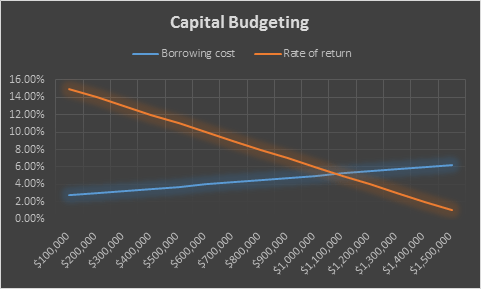
As explained in a chapter on Capital Budgeting, companies and investors should continue to invest in projects until the marginal cost of capital equals the marginal rate of return: assuming you select projects in order from the highest return to the lowest return and that the cost of borrowing increases with the total amount of loans outstanding.

So in the example chart shown to the right, you would borrow and invest up to $1.0 million, which is the point where the expected rate of return declines to meet increasing cost of borrowing at about 5%.

You may have confirmed the theory from your own experience. Your current portfolio has a few investments that are achieving better than 10% or 12% returns, most congregate around the long-term average of 7% to 8% and a few continuing disappointments are returning below 5%, or worse.  Your lowest cost of borrowing is probably the mortgage you signed in 2015 at 2.5% or a car loan at 1.9%, but your subsequent borrowing for a personal line of credit is at 3.25%.

Continue Reading…

Liberal tax changes would spark exodus of Canadian entrepreneurs

By David J Rotfleisch, CA, CPA, JD

Special to the Financial Independence Hub

The proposed changes to the Income Tax Act that the Minister of Finance, the Honourable Bill Morneau, has released have real-world implications. The consultation period ends October 2, 2017, so now is the time to make your voice heard. Call or email your member of Parliament, or Minister Morneau directly.

I recently had a meeting with a high-tech entrepreneur in an internet-based business. He is very conservative and has not carried out any tax planning. His wife helps him but he does not do any income splitting with her. He has about $1 million in his corporate bank account for possible business use, but has not invested it and just earns minimal bank interest. The hype about the proposals has caused him to take notice of his tax affairs and meet with me.

I told him that under the new proposals income splitting with his wife, other than a fair salary for services performed, will be prohibited. His wife will probably not be able to participate in the lifetime capital gains exemption. If he decides to invest his retained earnings, there may be an additional tax on his income. He is now thinking about lifestyle and whether he wants to leave the country. I fully expect to prepare a memo for him about becoming non-resident.

Minister Morneau’s proposed tax changes will have the effect of causing an exodus of Canadian entrepreneurs for more business-friendly jurisdictions.

I had lunch with accountants a few days ago and they reported the same types of conversations with high-tech clients. They are considering leaving the country. Now, some won’t because of the education of their children, to be close to aging parents, adult children,or because they like their Canadian lifestyle. Others will decide it’s more important to maximize after-tax income and that it makes sense to move offshore.

70% of Canadians work for firms with 100 or fewer employees

Remember,  statistics show that the vast majority of Canadians — 70 per cent — who are the economic engine of this country, work for companies with between 1 and 100 employees: the very targets of these new measures, and who are able in many cases to pack up and leave.

This is not just the view of tax professionals. Ryan Holmes, the CEO of social media internet company Hootsuite, was reported as saying on Sept 14, 2017 that the proposals are causing a lot of concern to business owners and that “I think you need to be very favourable at the small end of the market.”

I was recently contacted by a Liberal MP who is very opposed to what his government is doing. He has an entrepreneurial background and he realizes the impact of these proposals.

Continue Reading…

Women have distinct financial planning needs

Marie Philips

By Marie Philips

Special to the Financial Independence Hub

The financial assets controlled by Canadian women as well the income earned by women is projected to grow significantly over the next decade.

This increase in wealth will result from a greater overall participation in the work force, higher level professions, an increase in female entrepreneurship and being the beneficiaries of a large share of the $1 trillion wealth transfer that is underway in Canada.

By 2026, women in Canada will control close to half of all accumulated financial wealth, roughly $900 billion in financial and real estate assets. That’s a significant increase compared to a decade earlier, when the share was closer to one third.

Yet according to a recent white paper published by IPC Private Wealth in collaboration with Strategic Insight, almost two  thirds of financial advisors (85% of whom are men) do not believe a female client should be viewed in any different light than a male client.

If we look at some of the concerns women have, we can see that there are distinct financial planning needs for women compared to men. Life expectancy at birth now means mortality in 2015 is 84 (80 for men).  Women live longer and are likely to have interrupted careers as a result of family responsibilities (children and caring for elderly parents) which all lead to potential lower available savings for retirement income.

Caregiver women more likely to end up in poverty

Research shows that women caregivers are likely to spend an average of 12 years out of the workforce raising children and caring for an older relative or friend.  Continue Reading…